Public complaint material about NationalBet centres on three recurring themes: extended or repeated KYC checks, slow or stalled withdrawals, and account-related issues during the period when the closure signals began to appear. None of those reports proves criminal conduct on its own, and individual complaints can be incomplete or one-sided. Read together with the brand-controlled page that now reports closure, they form a useful reputation picture for UK players, and they explain why this site does not present NationalBet as a casino to test with deposits or fresh identity documents.
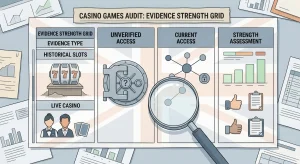
Complaint evidence is most useful when it is sorted by theme, date, source type and what it can actually prove.
Complaint position in one line
Clustered reports of KYC friction, withdrawal delays and account problems align with the closure signals and support the wider trust position; they do not on their own establish a finding of fraud and should not be relied on without documentation.
The themes found in third-party complaint sources
The recurring complaint themes split into three groups. Each one is a description of what user reports said, not a proven legal finding.
KYC friction
Reports describe extended Know-Your-Customer checks: repeated requests for the same documents, additional address or source-of-funds questions, and verification delays at the point a withdrawal was requested. Some users described feeling that the documentation bar moved between submissions. KYC tightening is not unusual in the regulated gambling industry; the pattern still matters when it groups around withdrawal requests rather than the registration moment.
Withdrawal delays and stalled payouts
Reports describe withdrawals that took longer than the operator’s previously published timelines, requests that remained in pending state, and balances that became inaccessible after account checks. Combined with the KYC theme, these are the most consistent reputation signals in the third-party material.
Account closures and access issues
A separate cluster of reports describes accounts being closed, locked or rendered unreachable around the period when closure signals began. Some users referenced contact attempts that went unanswered. After the brand-controlled page started reporting unavailability, these access issues are consistent with the broader closure picture rather than isolated incidents.
Evidence strength: what these reports can and cannot prove
Third-party complaint material is best read as a signal of where to look, not as a definitive ruling. Individual reviews can be partial, mistaken or sometimes adversarial. The signals become more useful when they cluster: same theme, separate reporters, separate dates, separate platforms. For NationalBet the KYC and withdrawal themes cluster in that pattern, which makes them appropriate as caution evidence even where no single review is decisive.
Two things the reports cannot prove. First, they cannot stand in for a regulatory finding: the Gambling Commission is the body that issues remote-casino enforcement against GB-licensed operators, and NationalBet was not verified as GB-licensed (see the UKGC licence check). Second, they cannot quantify how widespread the issues were across the full player base – only what individual reporters publicly described. Both limitations argue for cautious wording, not for ignoring the signals.
KYC and withdrawal context for GB readers
For a GB-licensed online casino, the Gambling Commission requires age and identity verification before play, and operators are expected to handle withdrawal requests fairly: deposit balances should be withdrawable subject to verification, bonus balances can be withdrawn subject to clearly disclosed wagering rules. Withdrawal friction that effectively prevents a legitimate payout is treated as a regulatory matter for GB-licensed operators. Disputes that cannot be resolved through the operator can usually be escalated to an approved Alternative Dispute Resolution (ADR) provider in the gambling sector.
For NationalBet, this regulatory framework matters more as a benchmark than as a current enforcement route. The brand was not verified as GB-licensed in this research, so the GB-specific dispute mechanisms do not automatically apply. The complaint themes describe gaps against the GB benchmark; the appropriate complaint route depends on the licensing position at the time of the dispute and on the payment method used.
Documentation checklist for affected past players
For anyone who held a NationalBet account and is still trying to resolve an issue, the most useful action is documentary. Recovery outcomes depend on what can be evidenced cleanly; without that, even an in-principle valid case is hard to take forward.
- Account email, login screenshots and any registration confirmation from the original sign-up.
- Deposit history with dates, amounts, method (card, e-wallet, bank transfer) and any provider receipts.
- KYC submissions: copies of the documents shared and the dates they were submitted or re-submitted.
- Withdrawal requests: dates submitted, amounts, method, status changes, and any communication explaining a delay.
- Support communications: emails, ticket numbers, chat transcripts, especially anything that quotes published timelines or terms.
- The terms and conditions in force when the account was active, including any bonus terms that applied to the affected balance.
- Snapshots of the brand-controlled page, including any closure or unavailability notice and the dates of capture.
Practical complaint routes that may still apply
Even for a closed brand, two routes can sometimes help.
The first is the payment provider. For card deposits, a chargeback through the card scheme may be possible depending on the timing, the rules of the relevant scheme and the evidence available. For other methods (e-wallet, bank transfer), the relevant dispute process is provider-specific and time-limited. Genuine chargeback or dispute applications do not require an upfront payment to a third party; any “recovery agent” demanding upfront fees should be treated as a separate scam risk.
The second is consumer-protection and complaint mediation. Citizens Advice in the UK can give general guidance on consumer rights and on which body to approach in a given case. Where an approved ADR provider in the gambling sector would normally apply (for a GB-licensed operator), the route depends on whether the relevant licence existed at the time the issue arose. Outcomes from a closed unlicensed operator cannot be guaranteed; documentation increases the chance of a useful outcome with the bodies that can act.
Lookalike domains and recovery scams
One additional risk attaches specifically to closed casino brands: lookalike “recovery” services. The pattern is consistent enough to flag here. A site or message presents itself as able to recover historical balances from NationalBet, asks for personal documents and an upfront fee, and then either disappears or returns with further demands. UK consumer guidance is clear: legitimate chargeback, complaint and refund routes do not require upfront payment, and a third party promising recovery from a closed operator is not the appropriate first contact.
The same caution applies to NationalBet-themed sites that ask for fresh deposits or fresh identity documents under the original brand. None of those is verified as a continuation of the historical operator, and feeding new information to them does not improve the chance of resolving an old case.
When the complaint pattern should change behaviour
The complaint cluster around NationalBet is one input. It points in the same direction as the licence finding and the closure signals: do not register, do not deposit, do not upload documents. For past players, it explains the documentation focus and the legitimate complaint routes above. For anyone considering a “relaunched” NationalBet-themed site, the historical complaint pattern is reason to wait for clear primary evidence (operator identity, GB licence, dated terms) before changing that position.
The complaint signals do not, by themselves, justify accusatory language. This site does not call NationalBet a scam or repeat individual abusive review text. The position is descriptive: a closed brand with no verified UK licence and a complaint pattern that supports caution.
Where this fits in the wider review
The complaint signals on this page sit alongside the UKGC licence check and the current status page. The combined picture is what the trust review summarises. For account-specific reading on the registration and identity-document side, see the registration and KYC caution page; for withdrawal-specific framing, see the withdrawal claims and rights page. None of these pages is decisive on its own; together they explain why this site treats NationalBet as a closed, evidence-limited brand for UK players in 2026.
Material created by the team NationalBet Casino UK