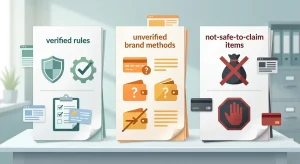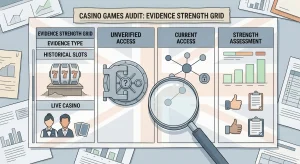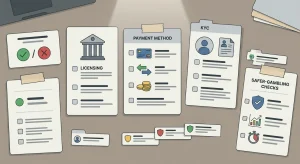
A guide to Mines play, free demos and bonus offers, with context on licensing, random outcomes and the limits of simulator evidence.
Online Mines Play and the UK Casino Landscape
Searching for Mines in an online casino brings a game query into a market with an important legal distinction: operators licensed to serve customers in Great Britain sit within the UK Gambling Commission’s regulatory system, while offshore casinos that accept UK players operate outside it. The distinction concerns the operator’s status, not the name or apparent format of a game. An online casino game is available only where its provision is permitted by law.
A specialist review has described the 2026 UK online casino market as having these two parallel parts. That description should be treated as a characterisation of the market, rather than as evidence that the two parts have equivalent legal status. Offshore platforms may accept players from the UK, but that does not put them inside the UKGC system or make them UK-licensed casinos.
The regulatory position follows from the Gambling (Licensing and Advertising) Act 2014. Since its introduction, operators seeking to take bets from British residents have been required to hold a licence. The UKGC regulates operators licensed to serve the British market; a platform based abroad does not escape that requirement merely because its business is located elsewhere. Accordingly, online gambling in the UK is legal through sites holding the relevant UKGC licence.
Choosing a Mines casino in the UK involves more than the game itself, so it helps to check the available information before deciding where to play. These short verdicts highlight the one confirmed detail provided for each operator.
1. NightLuck
Payout speed: 1-3 business days NightLuck has a stated payout speed of 1–3 business days.
2. Jetsetspins
Payout speed: 1-3 business days Jetsetspins lists payouts as taking 1–3 business days.
3. SpinFormula
Payout speed: 1-3 business days SpinFormula gives a payout speed of 1–3 business days.
4. Revery Play
Payout speed: 1-3 business days Revery Play has a stated payout timeframe of 1–3 business days.
5. WinBeast
Payout speed: 1-3 business days WinBeast lists a payout speed of 1–3 business days.
6. x3bet
Payout speed: 1-3 business days x3bet states that payouts take 1–3 business days.
7. SlotoSport
Payout speed: 1-3 business days SlotoSport has a stated payout speed of 1–3 business days.
8. BeOnBet
Payout speed: 1-3 business days BeOnBet lists payouts as taking 1–3 business days.
9. Zombillion
Payout speed: 1-3 business days Zombillion gives a payout timeframe of 1–3 business days.
10. NightWin
Payout speed: 1-3 business days NightWin has a stated payout speed of 1–3 business days.
This provides a useful frame for interpreting references to an online Mines casino. The phrase can describe an intended type of casino experience, but it does not establish whether a particular site is licensed to serve UK customers. Nor does a site’s willingness to register UK players demonstrate that it complies with British licensing requirements. Availability and regulatory status are separate questions: a platform may be reachable or may accept UK players while remaining outside the UKGC system.
That distinction matters because “offshore” describes a location or regulatory position, not a UK licence. Offshore casinos accepting UK players operate beyond the UKGC framework. Their presence in online searches or their acceptance of customers from Britain should not be taken as evidence that they are authorised under the rules applicable to operators serving the British market. The legal obligation attaches to the activity of taking bets from British residents, not simply to the operator’s address.
The broader category of casino games is not confined to physical premises. Casino games can be offered through online casinos where the law permits. The online setting changes how a game is accessed, but it does not remove the need to consider the operator’s regulatory position. For Mines, as for any other casino-game search, the relevant market context is therefore not just whether a platform appears to offer the game, but whether it is operating within the UKGC-licensed system.
Search terms such as “play Mines online” or “Mines casino game online” can blur that distinction because they describe an activity without specifying the legal status of the site. A result may refer to a UKGC-licensed operator or to an offshore platform that accepts UK players. The wording alone cannot resolve which applies. It is therefore more precise to distinguish between a casino game offered online in a lawful, licensed setting and a platform that happens to be accessible from the UK.
Online Bingo UK: Rooms, Tickets and Slots
The UKGC framework also helps avoid treating the market as a single undifferentiated list of online casinos. A UK-licensed operator and an offshore casino may both present online gambling products, but only the former is within the UK regulatory system for serving British customers. The presence of both kinds of platform in the wider online environment does not make their legal position interchangeable.
For a UK-facing discussion of Mines, the term “online casino” should consequently be read with care. It may refer broadly to a digital casino environment, while the legal meaning depends on whether the operator holds the licence required to serve British residents. An offshore casino may accept those residents, yet remain outside the UKGC space. That difference is central to the market context and does not depend on any particular claim about how Mines is played or what features a specific version offers.
Free Play, Demos and Bonus Offers
“Free” can describe different things in a casino context. A game may be available in a practice or demo mode, while a no-deposit bonus is a promotional reward. The two are not interchangeable: a bonus that does not require an initial payment does not, by itself, show that a particular game can be played in demo mode. For Mines, the distinction matters because a promotional offer and access to a free version are separate features.
A demo, where a game offers one, is a way to experience play without staking cash. It is not a bonus balance and should not be treated as money available to withdraw. By contrast, a no-deposit bonus is defined by how it is received: it is a casino bonus available without spending money. That description does not establish which games qualify, whether the bonus can be used on Mines, or what conditions apply before any resulting funds can be withdrawn. Those details depend on the particular offer.
Casino Dice Games in the UK: How Outcomes Work
This distinction also clarifies what a Mines casino review can establish. A review may discuss a promotion, but that is not evidence that the game itself has a free-play option. Conversely, the presence of a demo would not demonstrate that an operator offers a no-deposit bonus. These are separate questions and need separate evidence. A description that uses “free” without explaining whether it means a demo or a bonus leaves the practical meaning unclear.
Free play and demo access
A free Mines game would ordinarily mean access to the game without a cash stake, but the phrase alone does not specify how that access works. It might refer to a practice mode, a promotional feature, or simply a bonus-related claim. Without information about the game and the operator, those possibilities cannot be treated as equivalent. In particular, the existence of a no-deposit offer cannot be used to infer that the game has a demo.
The distinction is relevant to rules as well. A bonus comes with terms that govern its use; a demo is not, by definition, a bonus. A reader looking for free casino Mines access therefore needs to identify which of those meanings is intended before interpreting a page or offer. Promotional wording may emphasise that no payment is needed, while still leaving unclear whether the activity is a simulated game or bonus-funded gambling.
No Mines-specific rules follow from the terms “free play” or “demo”. Those labels do not establish the game’s instructions, features, or outcome process. They only concern the claimed way of accessing it. A clear description should identify whether access is a demo or a promotional balance and state any applicable terms. Without that distinction, a claim of “free Mines” is too broad to explain what is actually being offered.
No-deposit bonuses and their conditions
A no-deposit bonus is a casino promotion that can be received without first spending money. “No deposit” describes the absence of an initial payment requirement; it does not mean that all play or withdrawal conditions disappear. The offer’s terms remain important, including which games are eligible and what wagering requirements apply. The bonus should not be presented as evidence that Mines itself is free to play.
Do
- Distinguish between a game demo and a no-deposit bonus
- Review all wagering requirements and withdrawal conditions
- Verify the operator’s regulatory status within the UKGC system
Don’t
- Assume a no-deposit bonus means the game is free to play
- Treat a demo mode as a balance available for withdrawal
- Use a bonus offer as evidence that a game has a demo version
A specialist review reports that, from 19 January 2026, wagering requirements attached to gambling incentives may not exceed 10x the bonus funds. This cap is a limit on the requirement, not a statement that every promotion uses that multiple or that a bonus can necessarily be withdrawn immediately. The conditions still need to be read as a whole. Any promotional description should make its terms clear and fair rather than relying on a headline that could give an incomplete impression.
The same specialist review reports that a single incentive cannot combine different gambling product types, such as casino games and betting. In practical terms, a promotion should not make a casino reward conditional on gambling across casino and betting products together. This restriction is distinct from a game’s own rules: it concerns the structure of an incentive, not how Mines is played.
A bonus can also be described as “free” while carrying requirements that affect its value. Wagering requirements determine how much qualifying play must take place before bonus funds or winnings can become withdrawable, where the terms permit withdrawal. The maximum permitted requirement does not answer other questions, such as which stakes count, whether particular games are excluded, or how the operator treats winnings. These details should be set out in the offer rather than assumed from its title.
Reading an offer alongside game access
A promotion and a demo should be assessed separately. To establish that a game can be played in a free mode, the relevant information would need to describe demo access itself. To establish what a no-deposit bonus provides, the offer would need to explain its eligibility, applicable games, wagering requirements, and any withdrawal conditions. One description cannot substitute for the other.
The same care applies to claims that Mines is available “free” through a bonus. If bonus funds are used to gamble, the activity is not the same as a non-wagering demo: the bonus is being used under promotional terms. The no-deposit element means that the bonus can be received without spending money, not that every subsequent condition is absent. A reader should be able to distinguish a game demonstration from a promotional balance in the wording itself.
JetX Casino Game in the UK: What to Know
In the UK, offers are also subject to market requirements beyond the game description. Promotions must have clear and fair terms, and participation in offers is restricted to people aged 18 or older who are UK residents. Operators must verify age before allowing a customer to deposit. These conditions do not establish that a particular Mines demo or bonus exists; they govern the wider setting in which gambling offers are made.
Payment rules are relevant where an offer leads to real-money gambling. UK-licensed platforms cannot accept credit cards for gambling, including credit-card funding routed through a money service business, and cannot accept wallet payments where credit-card funds can be used for gambling. This does not change the meaning of “no deposit”: it concerns permitted funding methods, not whether a promotion is a demo or a bonus.
Descriptions of a Mines free game, a demo, or a no-deposit offer should therefore be read as different claims. A demo concerns access to a non-cash version of play; a no-deposit bonus concerns a casino reward that can be received without an initial spend and remains subject to its terms. Neither label, on its own, establishes the other. Nor does either one explain the game’s rules. The useful distinction is not whether the word “free” appears, but what kind of access or promotion is being described and what conditions accompany it.
What the Available Evidence Says About Mines Casino
“Mines casino” and “Mines casino game” describe a search for a casino-game experience, but the label alone does not establish how a particular title works. Casino games share a broad feature: participants stake cash or chips on possible outcomes, or on combinations of outcomes. That general description places a Mines-branded game in the casino context when it is offered as gambling, without determining its rules, presentation or technical design.
The distinction matters because a game’s name does not, by itself, identify the mechanism behind its results. Casino games can involve different forms of play and different ways of producing outcomes. In random-number games, selected numbers are generated by a computer or other gaming equipment.
Crash Casino Games in the UK: What to Know
A casino game can therefore be considered at two levels. The first is its broad function: a player stakes something of value on an uncertain result. The second is the particular design: the rules that define a round, the choices available, and the way a result is determined. The first level is part of the general meaning of casino gambling. The second requires information about the individual game and cannot be inferred from a title alone.
This is why references to Mines casino games should not be treated as evidence of a uniform product. The same wording may be used to describe a game category, a particular title, or an offering within a casino. Those possibilities are not interchangeable. A title may suggest a theme, but a theme does not establish whether a game uses random-number technology, what a player does during a round, or how a payout is calculated.
The general economic structure of casino games also provides relevant context. Such games typically give the casino a predictable advantage over the long term, while still allowing players to make short-term gains. These two features can coexist: an individual result may favour a player, even though the game’s overall structure is expected to favour the casino across extended play.
It is also important to distinguish a casino game from a claim about its performance. Calling something a casino game does not establish its return, odds, volatility or suitability for a particular player. Those are game-specific matters, and broad descriptions of gambling cannot supply them. Nor does the general possibility of short-term gains imply that a particular outcome is likely or repeatable.
For the UK audience, the phrase “Mines casino UK” may refer to interest in a game offered through an online casino, but the country reference does not alter the general definition of casino gambling. A casino game remains an activity involving stakes and uncertain outcomes; the local market context concerns where and under what conditions such gambling is offered, rather than proving details about a game’s internal operation.
The broad casino model also carries a long-term house advantage alongside the possibility of short-term player gains. These general points explain the category without turning an unfamiliar title into a set of assumed rules or features.
Aviator casino game UK: licensing and play
Playing Mines: What Can and Cannot Be Specified
A casino game involves staking cash or chips on a possible random outcome, or on a combination of outcomes. That general description places Mines within the broader casino context, but it does not explain how a particular game is played. A usable walkthrough would need to establish the rules and controls for the specific version in question. The name alone is not enough to support instructions about what to select, when to act or how a round ends.
This distinction matters because a game title is not itself a rulebook. Instructions that sound plausible can still misdescribe the version available on a particular platform.
The question of where Mines can be played is separate from how it is played. Casino games are available through online casinos where permitted by law, but that general point does not establish which platform offers a particular Mines game. Nor does the presence of a game name in a casino’s catalogue establish that two versions have identical rules. A platform’s own game information is therefore the relevant place to establish what that version offers; a generic description cannot substitute for it.
Likewise, the phrase “play for free” can refer to different arrangements, and it does not, by itself, describe a particular game mode. Whether a specific Mines title has a non-wagering way to play is a separate question from the general fact that casino games involve gambling stakes.
The same care applies to tips. Presenting such advice as a Mines strategy would turn an assumption into an instruction. General casino context does not validate a tactic, a preferred sequence or a claim that a certain approach improves results.
It would also need to distinguish the game’s stated rules from commentary about tactics.
Assessing Mines Casino Options Without a Ranked List
A “best” label for a Mines casino would imply that named sites had been assessed against consistent, relevant criteria. That judgement cannot be made from a game name alone. A casino’s general reputation or a promotional claim does not, by itself, establish that it offers a particular Mines game or that its terms and protections make it a stronger option.
Chicken Road Casino UK: What Is Actually Verified
The UK market also requires a distinction between regulatory settings. A specialist review describes the online casino market in 2026 as having a UKGC-regulated side and an offshore side operating outside that system. Offshore casinos may accept UK players, but acceptance does not make them UKGC-licensed. For a comparison focused on legal UK provision, the regulatory position is therefore a necessary threshold, not a minor feature to weigh against a bonus or interface.
That distinction limits what a ranked list can responsibly communicate. Combining UKGC-regulated operators with offshore platforms under one “best” heading would treat materially different regulatory contexts as though they were equivalent. A ranking limited to one context would still require evidence that each named operator offers the relevant game and that the same criteria had been applied across the comparison. Without that basis, ordering sites would suggest a level of verification the label cannot support.
The phrase “best Mines casino in the UK” can therefore describe an evaluative aim, but it is not itself evidence of quality. A defensible comparison would need to identify the game being assessed, establish its availability at each operator, and state what makes one option preferable under a consistent standard. General claims about a casino cannot substitute for those game-specific checks.
Fruit machine slots in the UK: how online play works
This leaves a narrower but more accurate way to frame the subject: Mines casino options should not be presented as a league table unless the comparison establishes both the relevant regulatory context and the basis for ranking. A list without those foundations risks turning a broad market distinction into an unsupported recommendation.
Strategy, Patterns and Random Outcomes
A strategy can describe how decisions are organised, but it does not necessarily predict what a casino game will produce. In random-number games, selected numbers are generated by a computer or other gaming equipment. A sequence that appears to form a pattern therefore does not, by itself, show that later outcomes can be forecast from earlier ones.
This distinction matters when assessing claims about a Mines game pattern. A run of similar results, or a change after a particular choice, may seem meaningful when viewed in a short stretch of play. Yet an observed sequence is not evidence of a dependable signal unless the game’s outcome process and the claimed relationship are established. Pattern-based systems that infer what is “due” from previous results should not be treated as a proven way to improve predictions.
Online Casino Tournaments UK: Formats and Scoring
The phrase “Mines strategy” can also refer to different things. It may describe a decision rule, such as stopping after a chosen point, rather than a method for identifying future outcomes. A rule can make play more consistent, but consistency is not the same as gaining an advantage over the game. Without reliable information about the particular game’s rules and outcome design, claims that a certain sequence of choices is optimal cannot be assessed.
Casino games typically give the casino a predictable long-term advantage, while still allowing players to experience short-term gains. These two features are compatible: individual results can vary, but a favourable short run does not establish that a strategy has changed the underlying odds. Nor does a losing sequence prove that a reversal is imminent.
Accordingly, claims about a winning Mines system require more than anecdotes, screenshots or selected examples. They would need evidence that the proposed decisions consistently affect outcomes under the game’s actual rules, rather than simply describing a sequence that happened to succeed. A strategy may structure choices; a perceived pattern may describe past results. Neither, on its own, demonstrates predictive power or removes the casino’s long-term advantage.
Real-Money Play and Its Risks
Playing a casino game for real money means putting cash at stake on an outcome, or on a combination of outcomes. A result may bring a short-term gain, but the possibility of winning does not remove the financial risk: money staked can also be lost.
Casino games typically give the casino a predictable advantage over the long term. This describes the broad balance of outcomes across continued play; it does not mean that every individual round produces a gain for the operator, or that a player cannot win in the short term. A run of favourable results may occur, but it does not establish that later outcomes will be favourable as well.
That distinction matters when considering real-money Mines play. The general risks of gambling with cash apply, but the broad description of casino games does not establish the rules, payout structure or precise risk profile of a particular Mines game. Those details should not be inferred from the game’s name or from general claims about casino play.
Financial Risk
Real-money gambling involves the risk of losing staked funds, as casino games typically provide the operator with a predictable long-term advantage.
The amount of money exposed depends on the stakes chosen and the course of play. No stake level changes the underlying fact that casino gambling involves uncertain outcomes and possible losses. A gain in one session is not evidence that the game offers a reliable way to make money, just as a loss does not by itself reveal what a later result will be.
In the UK, real-money online gambling is legal only through operators holding the relevant UKGC licence. That legal condition concerns the operator; it does not make outcomes predictable or eliminate the possibility of losing money. Real-money play should therefore be understood as gambling, not as a dependable source of income.
How Casino Outcomes Work—and What Winning Claims Can Establish
In random-number casino games, outcomes are produced using numbers selected by a computer or other gaming equipment. This describes a general way casino outcomes can be generated; it does not, by itself, establish the precise system used by a particular Mines title. The name “Mines” is not enough to determine how a game generates results, what a round involves or how a win is calculated.
That distinction matters when assessing claims about winning. A statement that a particular method guarantees success would need evidence about the game’s rules and outcome-generation process, as well as support showing that the method works under those conditions. General information about casino games cannot establish such a method for a specific title. Nor does an isolated winning result demonstrate that the same approach will produce another.
Casino games typically give the operator a predictable long-term advantage while allowing players to make short-term gains. These two features are compatible: a player may win in an individual session, but that possibility does not show that outcomes can be controlled or that a particular approach changes the underlying advantage. A winning account or promotional claim should therefore be treated as evidence of an asserted result, not proof of a repeatable way to win.
UK casino sites for slots: licensing and play
For a claim about Mines to be meaningful, its scope would need to be clear: which game is being discussed, what rules apply, and what evidence supports the stated outcome. Without those details, claims about how the game works or how to win it remain unsubstantiated. General principles about computer-generated random outcomes explain why results may be unpredictable, but they do not supply title-specific rules or a reliable winning method.
What a Mines Simulator Can Be Verified to Show
A Mines simulator may present an approximation of a casino game, but the label alone does not establish what is being modelled. Without information about its design and relationship to a particular casino product, its output can show only what that simulator itself produces under its own rules. It cannot, by itself, confirm that a real game uses the same rules or generates outcomes in the same way.
This distinction matters when interpreting a Mines casino game simulator. A displayed sequence or result is evidence of the simulation’s behaviour, not proof of how an independently operated casino game behaves. Any stronger conclusion would depend on substantiated details about the simulator and the product being compared. A visual resemblance, or use of the same game name, would not establish equivalence.
Casino games are available in online casinos where permitted by law. That general availability does not verify a particular simulator, its accuracy, or its connection to a licensed casino game. Nor does a simulation establish that its results predict future casino outcomes. Those claims require evidence beyond the simulator’s own display.
Accordingly, a simulator can be assessed as a representation only to the extent that its rules and operation are made clear. Where those details are not established, conclusions should remain limited: the tool shows a simulated experience, while its relevance to any specific Mines game remains undetermined.
Material created by the team NationalBet Casino UK