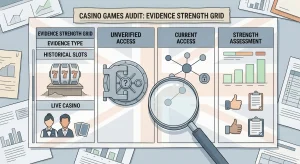
Non-participating operators may not check the GamStop register, but access to a site and permission to serve the British market are separate matters.
How GamStop exclusion can be bypassed—and why that matters
GamStop is designed to block a registered person from gambling with participating operators. Its effect is not universal across every gambling service that can be reached online. A person may therefore encounter ways to gamble outside the scheme while an exclusion remains active. Describing those routes is not a recommendation: using them can defeat the practical purpose of self-exclusion.
One route is to register with a gambling establishment that does not cooperate with GamStop. Because that operator is not checking the GamStop register as part of the scheme, the exclusion may not prevent an account being opened there. This does not mean the operator is authorised to serve customers in Great Britain. Access to a site and permission for an operator to offer gambling in the British market are separate questions.
Other routes involve attempts to get around identity or location checks. A report by neconnected.co.uk describes the use of another person’s personal information to register. That is identity misuse, not a legitimate way to restore access to gambling. It can expose the account holder and the person whose details are used to disputes or other consequences, and it may breach an operator’s terms. The possibility that such conduct is attempted should not be mistaken for evidence that it is reliable or safe.
If you have registered with GamStop, using a site that bypasses that exclusion can undermine the block you chose to put in place; consider keeping it active and seeking support if gambling feels difficult to control. The information below is limited to the stated payout speed and does not establish licensing, safety, or suitability for UK players.
1. NightLuck
Payout speed: 1-3 business days The only stated detail is a payout speed of 1–3 business days.
2. Jetsetspins
Payout speed: 1-3 business days The only stated detail is a payout speed of 1–3 business days.
3. SpinFormula
Payout speed: 1-3 business days The only stated detail is a payout speed of 1–3 business days.
4. Revery Play
Payout speed: 1-3 business days The only stated detail is a payout speed of 1–3 business days.
5. WinBeast
Payout speed: 1-3 business days The only stated detail is a payout speed of 1–3 business days.
6. x3bet
Payout speed: 1-3 business days The only stated detail is a payout speed of 1–3 business days.
7. SlotoSport
Payout speed: 1-3 business days The only stated detail is a payout speed of 1–3 business days.
8. BeOnBet
Payout speed: 1-3 business days The only stated detail is a payout speed of 1–3 business days.
9. Zombillion
Payout speed: 1-3 business days The only stated detail is a payout speed of 1–3 business days.
10. NightWin
Payout speed: 1-3 business days The only stated detail is a payout speed of 1–3 business days.
The same report describes anonymising tools, including virtual private networks, anonymous proxies and the TOR browser, as possible means of reaching gambling services. These tools can obscure or alter how a connection appears, but they do not cancel a self-exclusion registration. Nor do they establish that a site is permitted to accept a customer from Great Britain. An operator may still request identity information, apply its own checks or refuse access. Circumventing a location or identity check can also lead to account restrictions or problems establishing ownership of funds.
neconnected.co.uk has also reported on cryptocurrency gambling services that do not require registration or customer verification. That description should be treated as a report about a route, not as a claim that no-registration services are a standard feature of the market. Where cryptocurrency is used, transactions are irreversible; an error in a wallet address may result in permanent loss. The apparent reduction in checks does not remove financial risk or make an active exclusion less relevant.
The central issue is not whether a technical or administrative route exists. It is that an exclusion is chosen to create a barrier to gambling. Seeking a route around it can undermine that barrier and make it harder to maintain the separation from gambling that the registration was intended to provide. The fact that an online casino is not connected to GamStop does not make it a suitable substitute for a participating operator, particularly for someone who registered because gambling had become harmful.
Trusted Casinos Not on GamStop UK: What to Know
Sites outside the scheme also sit beyond the protections imposed through the UK Gambling Commission’s framework. They may not provide the same mandatory safeguards, and their systems do not share the exclusion information held by GamStop. Any safer-gambling controls they choose to provide are not a replacement for the block created by an active registration. UK-based support may also be less accessible when gambling takes place with an operator outside the British system.
The phrase “casinos not on GamStop” can therefore describe a real distinction in access, but it should not be read as an endorsement or a measure of suitability. A site’s willingness to accept a registration does not establish that bypassing an exclusion is safe, lawful for the operator, or consistent with the reason the exclusion was set. In particular, no search for the “best” such site can resolve the underlying conflict: the person remains excluded from participating operators, while the alternative may lack the same regulatory protections.
For someone with an active GamStop registration, the most consequential fact is that access elsewhere does not switch the exclusion off. Using another person’s details or masking a connection does not change its purpose; it only attempts to evade a barrier. The existence of these routes is important to understand precisely because it shows where the scheme’s boundary lies—and why crossing that boundary may leave a person with fewer protections rather than a safer form of access.
Identity Misuse
Using another person’s personal information to register an account is identity misuse and may lead to disputes or legal consequences.
What “non-GamStop” means in regulatory terms
GamStop is a self-exclusion scheme linked to the regulatory system overseen by the UK Gambling Commission (UKGC). Its restrictions apply to registered users at gambling establishments within that system. The term “non-GamStop” describes an operator that does not participate in the scheme; it does not describe a separate form of GamStop membership or a different status within GamStop itself.
The distinction is therefore about regulatory reach. A casino operating under the UKGC’s jurisdiction is subject to the requirements attached to that framework, including participation in GamStop. An operator outside that jurisdiction is not connected to the scheme in the same way. Its exclusion arrangements do not form part of GamStop’s system, and it does not receive GamStop data for the purpose of applying registered users’ exclusions.
Participation and regulatory scope
A casino being described as a non-GamStop casino should not be read as evidence that GamStop has assessed it and decided not to include it. The description indicates a lack of participation. GamStop’s restrictions are applied through participating establishments, rather than being a universal block that follows a person across every gambling service.
This matters because the scheme’s effectiveness depends on its defined regulatory scope. Within that scope, a registered person is restricted from gambling at establishments licensed by the UKGC. Outside it, the operator does not implement GamStop’s exclusion measures and does not share data with the service. The result is a boundary between systems, not an alternative form of self-exclusion administered by GamStop.
Casino Without a Swedish Licence: UK Guide
That boundary also limits what can be inferred from a site’s description. “Non-GamStop” does not establish that an operator has been checked by the UKGC, that it meets UKGC requirements, or that its safeguards are equivalent to those required within the UK framework. It identifies the relationship with GamStop: the operator is not part of its participating network. The phrase is not, by itself, a regulatory approval or a measure of consumer protection.
What the label does not establish
The label alone does not explain which rules govern a particular operator, how its complaints are handled, or what protections apply to its customers. Those questions concern the operator’s regulatory position and the jurisdiction in which it operates, not GamStop participation alone. A site may use “non-GamStop” as a description, but that wording cannot substitute for evidence about its licence or the rules attached to it.
Nor does the term mean that a casino has access to a registered user’s GamStop status and chooses to disregard it. The relevant distinction is that operators outside the UKGC’s regulatory reach do not share data with GamStop and do not apply its exclusion measures. Any conclusion beyond that requires separate evidence about the operator and its regulator.
For UK readers, there is an important legal distinction between a player’s position and an operator’s obligations. A person’s ability to reach a site does not show that the operator is authorised to provide gambling services in Great Britain. Remote operators offering gambling to consumers there must hold the relevant UKGC licence. Non-UK operators outside the UKGC framework do not provide the same regulatory protections as licensed UK operators, and their services may lack tools that are mandatory under that framework.
Regulatory Boundary
A non-GamStop casino is simply an operator that does not participate in the UK self-exclusion scheme; this label is not a regulatory approval or a measure of consumer protection.
This distinction is not merely technical. GamStop is designed to operate through participating establishments, so a non-participating casino cannot be treated as though the scheme’s exclusion controls extend to it. The absence of those controls also means that access to UK-based support services should not be assumed for customers using such a site. Voluntary measures, where an operator offers them, do not make it a GamStop participant or bring it within the UKGC system.
“Non-GamStop casino” is consequently a narrow description of scheme participation, not a general quality category. It says that the operator sits outside GamStop’s data-sharing and exclusion arrangements. It does not show that the operator is safe, suitable, or legally authorised to serve the British market. Those are distinct questions, and the label cannot answer them.
Curacao, European licences and the limits of comparison
A casino described as Curacao-licensed or European may hold permission from a gambling authority outside the United Kingdom. Malta, Gibraltar and Curacao are among the jurisdictions in which non-UK casinos may be licensed. These labels identify a licensing connection; they do not, by themselves, show that an operator is authorised under the UK Gambling Commission’s framework or that its protections match those required of a UKGC-licensed casino.
The distinction matters when interpreting descriptions such as “Curacao non-GamStop casino” or “European non-GamStop casino”. The words can point to a jurisdiction associated with the operator’s licence, while “not on GamStop” indicates that the site does not participate in the UK self-exclusion scheme. Neither phrase establishes that the operator is regulated for the British market. A foreign licence and UKGC authorisation are different regulatory statuses, not interchangeable versions of the same approval.
Non-Gamban casinos in the UK: what exclusion means
“European” is particularly broad. It may refer to a licensing jurisdiction such as Malta or Gibraltar, but the label alone does not specify which authority issued a licence, what entity holds it, or whether a particular site is covered by it. Nor does it establish that a casino is physically based in the place named in its marketing. A jurisdictional description should therefore be read as a claim about regulatory association, not as a complete account of the operator’s legal position or the protections available to customers.
The same restraint applies to Curacao. A Curacao licence may establish that an operator is associated with that jurisdiction’s licensing system, but the word “licensed” is not evidence of UKGC oversight. It also does not show that GamStop will apply: casinos licensed abroad are not obliged to connect to that UK scheme. In practical terms, a licence from Curacao, Malta or Gibraltar cannot be treated as a substitute for the UK licence required of operators providing remote gambling services to consumers in Great Britain.
This is why “regulated non-GamStop casino” needs careful interpretation. It may mean that a site claims oversight by a regulator outside the UK, rather than that it operates within the UK regulatory system. The existence of a foreign licence is not the same claim as authorisation to serve the British market. A casino’s international character does not erase that distinction, and the word “regulated” on its own cannot resolve it.
Curacao Licence
An association with the Curacao licensing system that does not imply UKGC oversight or GamStop participation.
European Licence
A broad label referring to jurisdictions like Malta or Gibraltar, which does not establish equivalent UKGC protections.
Regulated non-GamStop
A term indicating oversight by a regulator outside the UK, rather than authorization to serve the British market.
Comparison also has limits because the jurisdictional label does not provide a direct measure of consumer protection. It does not, without further evidence, establish how complaints are handled, what safeguards are mandatory, or what remedies are available in a dispute. It would therefore be unsound to infer equivalent standards from the fact that two sites each display a licence, especially when one is licensed by the UKGC and the other is not.
For readers assessing international casinos not on GamStop, the central point is not whether an overseas licence exists in the abstract. It is what the named regulator’s authority means in relation to the specific operator and the market in which it offers services. A foreign licence may identify a form of oversight, but it does not convert an offshore casino into a UKGC-licensed one. These categories should remain separate when interpreting descriptions of Curacao or European casinos.
Assessing claims made about non-GamStop casino sites
Descriptions such as “best” or “top” are conclusions, not evidence. A ranking of casinos not on GamStop has limited value unless its criteria are clear and applied consistently. A prominent position on a list does not, by itself, establish the quality of a site’s safeguards or the protection available if a dispute arises.
The basis for comparison matters. A review may assess payment options, games or promotional offers, but those features do not show that a site provides consumer protection equivalent to that associated with a UK Gambling Commission licence. Casinos outside the UKGC framework do not provide those UKGC-linked protections, and may lack responsible-gambling measures that are mandatory for UK-licensed operators. A favourable overall score should not obscure that distinction.
Claims about safer-gambling tools also require careful qualification. A specialist review may report that a particular non-GamStop casino offers deposit limits, loss limits, session time limits or reality checks. Such tools may be voluntary rather than legally required under the UKGC framework. Their presence can be relevant to an assessment, but it does not establish that the operator must provide them, how they are implemented, or whether they work in the same way as protections required of a UK-licensed site. A list of available features is therefore not, on its own, evidence of comparable oversight.
The wording of a claim can be as important as the feature it names. “Supports responsible gambling” is broad; a useful assessment distinguishes between a stated policy and a specific tool, and between a feature described in a review and a protection required by regulation. If the basis for a ranking is not explained, its result is difficult to interpret. The same applies when a list presents an overall verdict without separating consumer protection from convenience or entertainment.
This distinction is especially important in pages presenting the best non-GamStop casino sites in the UK. The phrase can imply a recommendation, even where the underlying material is only a comparison of selected features. A list should not be treated as proof that an operator is safe, suitable for someone experiencing gambling harm, or equivalent to a UKGC-licensed casino. The available protections may differ, and voluntary tools do not replace mandatory safeguards.
Attention A high overall score in a review may be based on convenience or entertainment and should not be mistaken for evidence of mandatory UKGC-linked consumer protections.
Playing at a non-GamStop site is not a criminal offence for the player, but that does not remove the regulatory and consumer-protection distinction. “Top” and “best” labels should therefore be read as editorial judgements whose meaning depends on their criteria, not as assurances. Claims about protective features warrant particular scrutiny when the operator sits outside the UKGC framework.
Casinos outside GamStop and the boundaries of self-exclusion
GamStop self-exclusion is a time-limited restriction, not a setting that can be switched off whenever circumstances change. Its available periods are six months, one year or five years. Once a period has been selected, it cannot be shortened or cancelled before it expires. The distinction matters because access to a casino that does not participate in GamStop does not alter the registration or bring the exclusion period to an end.
Land-based gambling is separate from online casino access. A person may be able to gamble at a physical establishment while registered with GamStop, but doing so does not cancel or pause the online exclusion. It is therefore misleading to treat a land-based venue as a route for ending self-exclusion: the selected period remains active, and the online restriction continues to apply to participating sites.
Casinos outside GamStop are a different case again. They do not apply the exclusion through the scheme, so registration with GamStop may not prevent access to them. That distinction describes the limits of the scheme’s reach; it is not a recommendation to use such a site during an active exclusion. Gambling in this way can undermine the purpose of having set a restriction in the first place. These casinos operate outside the UK Gambling Commission framework and may lack mandatory responsible-gambling tools and access to UK-based support.
The available alternatives should not be confused with changing the registration. Waiting until the chosen period has ended is the point at which the restriction can conclude; it cannot be brought forward by deciding that the exclusion is no longer wanted. A person who selected a longer period remains subject to it for that full period, even if circumstances change in the meantime.
This boundary also helps clarify what “outside GamStop” does and does not mean. It refers to a site that does not participate in the scheme, not to a change in a person’s exclusion status. Similarly, gambling in a physical venue is not the same as reopening access to online accounts covered by the restriction. Each is a distinct setting, while the registration remains in force until its selected end date.
For someone who self-excluded to interrupt gambling, the practical significance is that neither a non-participating casino nor a land-based venue provides a way to cancel the commitment. The restriction ends only after the selected period has elapsed. Until then, access elsewhere should not be mistaken for evidence that the exclusion has been lifted or that the protections intended by it remain intact.
European and Curacao casinos: what the location label tells UK readers
Descriptions such as “European casino” or “Curacao casino” identify a claimed geographic or licensing connection, but do not establish what protections apply to a particular site. Casinos outside the UK may be licensed in jurisdictions including Malta, Gibraltar or Curacao. The label alone does not show which entity issued a licence, whether that licence is current, or what rules govern the operator.
For UK readers, the relevant distinction is not simply Europe versus the Caribbean. A casino licensed outside the UK is not required to connect to GamStop, and operators outside the UK Gambling Commission’s regulatory reach are not obliged to enforce registrations with the service. A European location therefore does not mean that a site participates in UK self-exclusion arrangements. Nor does a Curacao connection, by itself, establish that a casino is independent of those arrangements in every operational respect; the specific operator and its regulatory status matter.
The word “European” is especially broad. It may describe a company’s location, a licence jurisdiction, or merely the way a site presents itself. Those are not interchangeable claims. Even when an overseas licence exists, it should not be treated as equivalent to a UK Gambling Commission licence: different regulators may impose different requirements, and a geographic label cannot demonstrate the level of consumer protection available.
The same caution applies to “Curacao casino not on GamStop UK” as a description. It may indicate that the operator is outside the UK scheme, but does not establish the identity of the licensee, the scope of oversight, or the route available if a dispute arises. A licence claim needs to be assessed against the relevant regulator’s records rather than inferred from branding or a site’s stated location. Where a regulator is less established, its oversight may not provide protection equivalent to the UK framework.
Casino Sites Not Registered with GamStop in the UK
A casino outside GamStop may also lack mandatory safer-gambling measures associated with UKGC regulation. Any limits or exclusion tools offered by an individual operator should not be assumed to be required, consistent across sites, or linked to GamStop. UK-based support services may not be accessible through such an operator, so their availability should not be presumed.
Accordingly, “European” and “Curacao” are starting points for understanding a site’s claimed connection, not assurance of its standards. Neither label confirms that an operator is authorised to serve the British market, participates in GamStop, or provides protections comparable to those required under UK regulation.
UK players and the legal position of overseas operators
The legal position of a player and that of an operator are distinct. A UK player may be able to access an online casino licensed abroad, but access does not establish that the operator is authorised to provide gambling services to people in Great Britain. Under the UK licensing framework, an operator offering online gambling to UK residents must hold a valid licence from the UK Gambling Commission (UKGC), regardless of where the business is based.
This distinction matters when assessing claims that a casino is “accepting UK players”. The phrase describes whether a site appears to permit registrations or play; it does not confirm that the operator has the licence required to serve the British market. An overseas licence, or the absence of a technical block on access, cannot substitute for UKGC authorisation. If an operator offers its services to UK residents without that licence, it is acting unlawfully.
That does not mean the player’s position is identical to the operator’s. Using a casino that is not on GamStop is not itself a criminal offence for a UK player. However, the fact that a player is not committing an offence does not make the casino’s operation lawful, nor does it confer regulatory approval on the site. These are separate questions: one concerns the conduct of the customer, the other the operator’s permission to provide gambling services.
Accordingly, descriptions such as “non-GamStop casinos for UK players” should be read cautiously. They may indicate that a site is accessible or willing to take registrations, but they do not show that it can lawfully target or serve the UK market. A claim that a casino accepts British customers is not evidence of a UKGC licence.
The same distinction applies when an operator is based outside Great Britain. Its location does not remove the licensing obligation if it offers remote gambling to customers in the British market. The relevant issue is not simply where the company is incorporated or which foreign authority licensed it, but whether it holds the UKGC authorisation required for the services it offers in Great Britain. A player’s ability to reach a site therefore cannot be treated as proof that the site is authorised to operate there.
Offshore gambling and voluntary safeguards
Responsible-gambling tools at offshore casinos are not governed by the same UK Gambling Commission requirements that apply to licensed operators serving Great Britain. Some non-UK sites may offer deposit limits, self-exclusion or reminders, but a specialist review has reported these features as operator offerings rather than protections required by every relevant regulator. Their presence, wording and operation therefore need to be assessed individually; a feature label alone does not establish how effectively it works.
This distinction matters because a voluntary setting is not equivalent to a safeguard imposed within the UK regulatory framework. Its availability may depend on the operator, and the terms governing it may differ. A self-exclusion option, for instance, should not be assumed to cover other sites or to connect with GamStop. Nor does a displayed limit establish that the operator will apply the same controls or oversight as a UKGC-licensed business.
The limits are also practical. A person using an offshore non-GamStop casino should not assume access to UK-based gambling support through the operator. The site is outside the UKGC framework, and its own tools cannot be treated as a substitute for UK support services or the protections associated with a UKGC licence. Playing at a site outside GamStop is not itself a criminal offence for the player, but that does not mean the site provides equivalent consumer protection.
Payment choices can introduce separate risks. Cryptocurrency transfers are irreversible: an error in a wallet address may cause a permanent loss, while changes in the cryptocurrency’s value can alter the value of funds received. These risks are not resolved by deposit limits or safer-gambling reminders.
Cryptocurrency Risk
Cryptocurrency transactions are irreversible; any error in a wallet address may result in the permanent loss of funds.
Accordingly, voluntary safeguards are best understood as features an operator may choose to provide, not as evidence of a common standard. Their existence does not establish that an offshore casino is safe, regulated to UK standards or suitable for someone seeking protection from gambling. An active self-exclusion is a signal to maintain the barrier, rather than to rely on controls offered by a site outside the scheme.
Reviewing bonus terms before treating an offer as value
A headline bonus does not establish its practical value. The wagering requirement determines how much qualifying play must take place before bonus funds or related winnings can be withdrawn, while other conditions may restrict how that requirement can be met. The written terms therefore matter more than the advertised size of an offer.
Some specialist casino reviews describe wagering requirements of around 30x to 40x as an industry average and characterise requirements above 50x as predatory. These are review-based benchmarks, not a regulatory standard or a guarantee of what a particular promotion will require. Each offer needs to be assessed against its own wording, including whether the requirement applies to the bonus, a deposit, or another defined amount.
Game contribution can materially change the workload. Slots may count differently from table games: table games can contribute less towards wagering, or be excluded altogether. A promotion that appears usable across a casino’s game catalogue may therefore qualify only through particular games or at different rates. The contribution schedule should be read alongside the wagering figure, rather than treated as a minor detail.
A specialist review may also flag conditions such as a maximum bet while wagering is active, a deadline for completing the requirement, or a cap on withdrawals from bonus winnings. These provisions can affect whether winnings remain eligible for withdrawal, even when the stated wagering target has been met. Their effect depends on the exact terms; a headline figure alone cannot reveal it.
Comparisons between non-GamStop casino reviews are meaningful only when the underlying conditions are compared on a like-for-like basis. Differences in eligible games, contribution rates, deadlines, maximum bets and withdrawal caps can make two offers with similar headline wording quite different in practice. Unclear or difficult-to-find terms also limit how confidently an offer can be evaluated.
Bonus analysis is separate from an assessment of the operator’s regulatory status. A promotion with comprehensible conditions does not establish that the casino has UKGC authorisation or provides protections equivalent to a UKGC-licensed site. Casinos not on GamStop operate outside that framework, and their bonus terms should not be mistaken for consumer safeguards.
The 2026 position: exclusion periods and UKGC participation
In 2026, the central point about GamStop remains its link to UK Gambling Commission licensing. Operators licensed by the UKGC are required to participate in the scheme. A person who registers is therefore blocked from gambling with participating operators for the exclusion period selected.
GamStop offers exclusion periods of six months, one year or five years. The chosen term defines how long the block applies at participating sites; the date in the calendar does not itself change that period or the scheme’s scope. The key distinction is participation: the block applies across UKGC-licensed operators, rather than being a general restriction on every gambling service accessible online.
This matters when interpreting claims about casinos that bypass GamStop in 2026. The phrase does not describe a change to GamStop’s rules. It refers to services that are outside the scheme’s participating network, not to UKGC-licensed operators being permitted to ignore an active registration. A site’s availability does not establish that it participates in GamStop or that the exclusion is recognised there.
Accordingly, the relevant regulatory status is whether an operator holds a UKGC licence, since licensed operators must take part in GamStop. The exclusion period is the user’s selected term, and participating operators are subject to the scheme during that period. The date-led wording of the topic should not be read as evidence that the scope of the system has changed: in 2026, UKGC participation remains the defining boundary.
Are casinos that bypass GamStop illegal for UK players to use?
No, using a non-GamStop casino is not a criminal offence for a UK player. However, an operator offering gambling to UK residents without a UK Gambling Commission licence is acting illegally.
What is GamStop?
GamStop is a self-exclusion service for UK residents that blocks registered users from gambling with participating UK Gambling Commission-licensed operators for their selected exclusion period.
What exactly does GamStop block?
It restricts registered users from gambling with establishments licensed by the UK Gambling Commission that participate in the scheme. It does not block access to every gambling service outside that regulatory system.
Is it safe to play at non-GamStop gambling sites?
Non-GamStop sites do not provide the consumer protections associated with a UK Gambling Commission licence, and they do not apply the GamStop exclusion. Some may offer safeguards voluntarily, but those are not a replacement for the UK framework.
Can I reverse a self-exclusion from GamStop early?
No, a GamStop exclusion cannot be shortened or cancelled before the selected period ends. You can unsubscribe once that period has finished.
What are casinos not on GamStop?
They are gambling operators that do not participate in GamStop, generally because they operate outside the UK Gambling Commission’s regulatory reach. They do not receive GamStop data or apply its exclusions.
Material created by the team NationalBet Casino UK