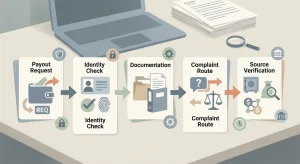
A VPN changes the network location shown to a casino, while its terms, verification checks and payment rules still shape account access.
How VPN Connections Interact with Online Casinos
A VPN-friendly casino is an online gambling site that allows a connection made through a virtual private network. The term describes how the site accepts a network connection; it does not describe a special kind of casino software or a different way of playing. A VPN changes the route by which internet traffic reaches the site and masks the IP address associated with the player’s ordinary connection.
Without a VPN, a casino connection travels through the player’s internet service provider and reaches the site using the IP address assigned to that connection. With a VPN active, traffic is routed through a VPN server first. The casino then receives the connection from that server, so the visible IP address is the server’s rather than the player’s original one. If the server is outside the UK, the connection can appear to come from a network outside the country.
This masking can affect access at the network level. UK internet service providers may apply access restrictions to particular sites. Because a VPN routes the connection through another network and presents a different IP address, it can bypass restrictions applied to the original connection. That describes a technical effect of changing the route and visible address; it does not, by itself, establish whether a casino accepts VPN connections or how it handles them.
Use this list as a starting point when researching VPN-friendly casinos in the UK. VPN compatibility is not specified here, so check each operator’s terms before using a VPN.
1. NightLuck
Payout speed: 1-3 business days NightLuck’s listed payout speed is 1–3 business days. No information is provided here about its VPN policy.
2. Jetsetspins
Payout speed: 1-3 business days Jetsetspins has a listed payout speed of 1–3 business days. Its VPN compatibility is not specified.
3. SpinFormula
Payout speed: 1-3 business days SpinFormula’s listed payout speed is 1–3 business days. No VPN-policy details are provided.
4. Revery Play
Payout speed: 1-3 business days Revery Play has a listed payout speed of 1–3 business days. Its VPN compatibility is not specified.
5. WinBeast
Payout speed: 1-3 business days WinBeast’s listed payout speed is 1–3 business days. No information is provided here about its VPN policy.
6. x3bet
Payout speed: 1-3 business days x3bet has a listed payout speed of 1–3 business days. Its VPN compatibility is not specified.
7. SlotoSport
Payout speed: 1-3 business days SlotoSport’s listed payout speed is 1–3 business days. No VPN-policy details are provided.
8. BeOnBet
Payout speed: 1-3 business days BeOnBet has a listed payout speed of 1–3 business days. Its VPN compatibility is not specified.
9. Zombillion
Payout speed: 1-3 business days Zombillion’s listed payout speed is 1–3 business days. No information is provided here about its VPN policy.
10. NightWin
Payout speed: 1-3 business days NightWin has a listed payout speed of 1–3 business days. Its VPN compatibility is not specified.
The phrase “online casino VPN” can refer either to a casino that permits VPN connections or to the use of a VPN while visiting a casino. These are separate parts of the arrangement. The VPN service handles the encrypted connection and routing, while the casino operates the gambling site. A site described as VPN-friendly is one that allows players to connect through a VPN, rather than one that provides the VPN itself.
What the encrypted connection changes
A VPN also encrypts internet traffic between the device and the VPN service. Encryption makes the information travelling across that connection harder for outsiders to read if they intercept it. This can help protect personal information from hackers or cybercriminals, particularly when data is passing across networks the user does not control.
Encryption and IP masking are related features of a VPN, but they do different jobs. Masking changes the IP address presented to the casino by routing traffic through a VPN server. Encryption protects the traffic on its way between the device and that service. Neither feature means that all activity on a device becomes invisible, or that a VPN removes every form of online risk. The protection described here applies to the internet connection; it should not be confused with a guarantee about the security of every service or device involved.
The distinction also matters when describing an online casino that allows VPN use. A VPN-friendly site permits the connection route, while the VPN encrypts and forwards the traffic. The casino does not become a VPN provider, and the VPN provider does not control the casino’s games or services. The connection passes through both systems, each with a different role.
Anjouan casino licence in the UK: what it means
Keeping the connection consistent
A VPN needs to remain connected for its routing and encryption to continue. If the VPN connection drops, the device may stop using that route; depending on the VPN settings, internet traffic could then resume over the ordinary connection. For a casino session using a VPN, keeping the VPN active throughout the session avoids an unintended change in the connection path. A change of route can also mean a change in the IP address visible to the site.
The label “VPN-friendly” should therefore be understood narrowly. It indicates that a site allows a connection through a virtual private network. It does not mean that every VPN server or connection will behave identically, nor that the VPN changes the underlying content of the casino site. The technology affects how a device reaches the site and which IP address is presented along the way.
A VPN can be useful for privacy on the connection and for routing around restrictions imposed by an internet service provider. Those effects explain why people look for online casinos that allow VPN connections. They do not make a VPN an all-purpose privacy tool: the specific protection discussed here is encryption of the internet connection and masking of its originating IP address.
Assessing Offshore Casino Terms and Bonus Conditions
VPN-friendly casinos are mostly offshore operators, with licensing locations that include Curaçao, the Isle of Man and Malta. These jurisdictions identify where an operator is licensed; they do not, by themselves, describe the conditions attached to a welcome offer. Bonus terms therefore need to be assessed separately from the operator’s location. A licence location is not a substitute for reading the rules that govern a promotion.
Non-UK regulated casinos: UK licensing explained
The central figure in many welcome-bonus terms is the wagering requirement: a stated multiplier that sets how much wagering must be completed before the bonus can be released or related funds become withdrawable. The multiplier is only one part of the condition. Its practical meaning depends on the exact wording of the offer, including which funds it applies to and which play counts towards meeting it. Those details should not be inferred from the headline bonus or from a general description of an offshore casino.
A specialist review reports welcome-bonus wagering requirements of 30x, 40x or 50x at offshore casinos. Other reporting gives a higher possible ceiling, stating that requirements can reach 60x. These accounts do not agree on a single range, so none of those figures should be treated as a standard that applies to every operator or promotion. They indicate that the terms can vary materially, rather than establishing a universal market rate.
That disagreement matters when comparing offers. A lower multiplier, taken alone, does not establish that a bonus is easier to use: the applicable balance and qualifying activity also affect what the condition requires. Conversely, a larger headline bonus does not show that its attached requirement is more favourable. Without the full terms, comparisons based only on the advertised amount or a single multiplier can give an incomplete picture.
The wording around the requirement deserves close attention. It should make clear whether the multiplier is attached to the bonus, the deposit, or a combined amount, and what counts as eligible wagering. It should also state whether particular games or types of play are excluded or contribute differently. These are points to establish from the promotion’s own terms rather than assume from common practice. A displayed multiplier without a clear calculation basis cannot be compared reliably with another offer.
Timing and other conditions can also shape the value of a promotion. The terms may specify a period in which wagering must be completed, restrictions on withdrawing while an offer remains active, or limits on how a bonus can be used. Such clauses can affect the outcome even when the multiplier appears straightforward. The relevant question is not simply whether the offer has a bonus, but what obligations and restrictions accompany it.
Wagering Multipliers
Reported requirements at offshore casinos vary, commonly ranging from 30x to 50x, and in some cases reaching 60x.
Calculation Basis
Terms should specify if the multiplier applies to the bonus, the deposit, or a combined amount.
Qualifying Activity
Terms must clarify which games count towards wagering and if any specific play is excluded.
Additional Constraints
Promotions may include time limits for completion and restrictions on withdrawals while active.
Terms can differ between promotions from the same operator as well as between offshore operators. A welcome offer may therefore need to be evaluated as an individual set of conditions, not as a permanent feature of a casino. Promotional wording can change, and a description elsewhere may not match the version presented when an offer is claimed. The written terms attached to the specific promotion are the material basis for understanding its conditions.
The licensing location and the bonus rules answer different questions. Curaçao, the Isle of Man and Malta are among the locations associated with VPN-friendly offshore operators; the wagering clause explains what the promotion requires. Neither should be used as a proxy for the other. An operator’s jurisdiction does not determine a particular bonus multiplier, and a multiplier does not establish where an operator is licensed.
A careful assessment therefore separates the promotional headline from its conditions. The multiplier should be read alongside its calculation basis, eligible play, exclusions, time limits and withdrawal restrictions. If any of these clauses are unclear, the apparent value of the welcome offer remains uncertain. The reported figures—30x, 40x, 50x and, in some accounts, as high as 60x—show why a single headline number is insufficient; they do not establish identical terms across VPN-friendly casinos.
What a VPN Casino Means for UK Players
For a UK resident, playing at an offshore casino and using a VPN to access it are not, in themselves, criminal offences under UK law. That does not make an offshore site equivalent to a UKGC-licensed casino, nor does it mean the site is authorised to offer gambling to people in Great Britain. The player’s legal position and the operator’s regulatory position are separate matters.
A VPN-friendly casino is an offshore gambling site that permits connections made through a virtual private network. The relevant distinction for UK players is not simply whether the site can be reached, but which protections apply once gambling takes place there. Offshore operators sit outside the UKGC system and have no obligation to follow UK laws. As a result, playing with one means giving up UK consumer protections associated with UKGC-licensed gambling.
Non-UK Registered Casinos: Regulation and Risks
That loss of protection matters even when the site accepts a connection and allows an account to be used. Technical access does not establish that a casino is subject to UK oversight, and a site’s willingness to accept UK-based customers does not provide the safeguards attached to a UKGC licence. The term “VPN casino” describes a way of accessing a site; it does not describe the quality or legal status of the protections available to its customers.
The distinction can be summarised as one between personal criminal liability and regulatory coverage. A UK resident is not committing a crime merely by gambling at an offshore casino, and VPN use for online gambling is not criminalised by UK law. However, the absence of criminal liability for the player should not be read as evidence that the operator is regulated in the UK or that UK consumer protections continue to apply. These are different questions, with different consequences.
Loss of Protection
Playing at offshore casinos means giving up UK consumer protections and the ability to use GamStop self-exclusion tools.
GamStop is not available at offshore casinos
Self-exclusion is another important difference. Offshore casinos do not provide GamStop self-exclusion tools. A player who has registered with GamStop therefore cannot assume that an offshore site will be included in that exclusion arrangement. The availability of a casino through a VPN does not extend GamStop coverage to it.
This absence has practical significance for anyone relying on self-exclusion to prevent gambling. It means that an offshore casino should not be treated as an alternative route within the same system of protections. A site may allow a VPN connection, but that permission does not supply GamStop or reproduce the safeguards associated with UKGC-licensed operators.
The difference is not just a matter of terminology. “VPN-friendly” concerns whether the operator allows VPN connections; it says nothing by itself about self-exclusion, consumer protection or UK regulatory oversight. Those features need to be considered separately. In particular, a casino’s use of the word “friendly” should not be taken as an assurance that it offers the protections available through UKGC-licensed gambling.
For UK players, the central trade-off is therefore clear. Offshore access may be possible, and playing at such a casino is not itself criminalised, but the player gives up UK consumer protections and cannot rely on GamStop tools being available there. A VPN connection does not change those conditions. Nor does a casino’s acceptance of VPN users place it within the UKGC system.
USA Casinos for UK Players: Licensing and Payments
This distinction also prevents two opposite conclusions from being confused. It would be inaccurate to treat every UK resident who plays at an offshore casino as committing a crime. It would be equally inaccurate to infer that offshore gambling carries the same protections as gambling with a UKGC-licensed operator. The stated position is narrower: the player is not criminalised merely for playing, while the offshore casino remains outside the UKGC framework and does not provide UK consumer protections or GamStop self-exclusion.
Accordingly, the meaning of a VPN-friendly casino for a UK resident is chiefly about the boundary between access and protection. The VPN may provide a route to a site that accepts such connections, but it does not confer a UK licence, restore consumer protections or make GamStop available. Those limits remain relevant regardless of whether the connection works.
VPN Use, Location Checks and KYC
Changing an IP address and completing identity checks are separate processes. A virtual private network routes a connection through another network, so the IP address visible to a casino may not correspond to the player’s actual location. That change can affect whether a connection is accepted, but it does not establish who is using the account or replace know-your-customer (KYC) verification.
For UKGC-licensed operators, checking a player’s location is a legal requirement. A VPN can therefore create a mismatch between the apparent location of a connection and the location the operator needs to verify. The result may be a blocked connection. This is a technical response to the network information presented to the casino; it does not mean that location has been verified or that the operator has completed its other checks.
Trusted UK Casino: Licensing, Checks and Claims
KYC addresses identity rather than the route taken by internet traffic. A VPN does not turn an IP address into proof of identity, and using one does not complete the separate verification process. The two checks should not be treated as substitutes: a connection may appear to come from a particular place while the person using it still has to be identified through KYC.
This distinction matters when considering whether a VPN can be used to play at an online casino. The answer depends partly on the operator’s connection controls, but a VPN does not override location verification by UKGC-licensed operators. A changed IP address may prompt a block rather than provide a way to satisfy the operator’s requirements. The presence of a VPN connection, by itself, says nothing conclusive about a player’s identity or verified location.
It is also important not to conflate a connection being technically possible with the completion of checks. Even if a site loads, that does not show that its location requirements have been met, or that any identity verification has been completed. Conversely, a connection block does not indicate that a VPN has performed an identity check; it reflects the effect that the changed IP address can have on access.
Questions about using a VPN for online casino play therefore involve two different issues. One concerns the IP address and whether the operator accepts the connection. The other concerns location and identity checks that remain distinct from that address. For UKGC-licensed operators, location verification is required, while KYC remains a separate process. No conclusion about identity or verified location follows simply from an IP address being changed.
A VPN may alter the network information seen by an operator, but that alteration should not be mistaken for evidence that location requirements have been fulfilled. Nor does it replace the operator’s KYC process. Keeping those distinctions clear avoids treating a connection tool as a substitute for checks that concern the person and their location.
Crypto Deposits and VPN Casinos
Using cryptocurrency to fund a VPN-friendly casino account can reduce some of the location-check and identity-verification friction associated with small deposits. The effect is limited: a crypto payment changes how funds are transferred, but it does not make the account or the connection invisible to the casino. Digital information may still be collected while the site is being used.
The distinction is between the payment method and the information generated by access to the site. A deposit made in cryptocurrency may involve fewer checks at the point of payment for a small amount. That does not establish that the casino has no way to assess account activity or the connection. Device fingerprints, IP logs and browser data remain among the information casinos may collect. A VPN connection therefore does not remove all digital traces, even when the deposit itself is made in crypto.
Device fingerprinting and browser data relate to the equipment and software used to access a site; IP logs record connection information. These categories are distinct from the details of a crypto deposit. Their collection means that the payment route alone cannot be treated as proof of anonymity. Nor does a reduction in friction for a small deposit show that the same approach will apply to other account activity or larger amounts.
While crypto deposits may reduce friction for small amounts, casinos can still collect device fingerprints, IP logs, and browser data.
This distinction matters when describing a crypto casino as VPN-friendly. The label concerns whether the site permits a VPN connection; it does not imply that the casino refrains from gathering technical data, or that cryptocurrency removes its ability to apply checks. Crypto and VPN use address different aspects of the interaction: one concerns the transfer of funds, while the other concerns the network connection. Neither, on its own, demonstrates that a player’s identity or location is concealed from the operator.
The limited nature of the effect is important. Reduced checks and KYC friction are associated with small amounts, not a general exemption from verification. Crypto deposits should not therefore be understood as a means of avoiding all scrutiny. Casinos may continue to record connection and device information irrespective of the payment method, and the presence of those records is compatible with a crypto deposit having required fewer checks.
For UK players considering a VPN-friendly crypto casino, the relevant distinction is not simply whether a deposit can be made in cryptocurrency. The payment method may ease part of the process for a small amount, while the site continues to gather data about the device, browser and network connection. A crypto deposit does not, by itself, establish that the operator has stopped monitoring access or that the account is unidentifiable.
Accordingly, cryptocurrency can reduce a particular kind of friction without removing the broader digital footprint of a casino session. The payment channel and the site’s collection of technical data should be treated as separate matters: a less demanding deposit process does not mean that VPN use and crypto together provide complete privacy.
Withdrawal Methods at VPN-Friendly Casino Sites
Withdrawal information for VPN-friendly casinos is limited and should be read as an indication of reported processing times, not as a guarantee that every operator or payment route follows the same schedule. A specialist review gives a range of one to five days for fiat withdrawals made by e-wallet or bank transfer. That range combines different methods, so it does not establish an identical timeframe for each one.
E-wallet withdrawals have a more specific stated estimate: around a day. This makes e-wallets the clearest fiat option in the reported timing information, although the estimate does not establish how quickly every casino processes a request. The broader one-to-five-day range also shows why a single figure should not be treated as a universal service standard for VPN-friendly casino sites.
Bank transfers appear in the same broad timing range as e-wallet withdrawals, but that does not mean they are equally available. The time estimate concerns processing, whereas availability is a separate issue. A specialist review describes bank card withdrawals as rare at VPN-friendly casinos.
Do
- Use e-wallets for faster processing (approx. one day)
- Check specific operator terms for payout deadlines
Don’t
- Expect bank card withdrawals to be widely available
- Assume a single timing range applies to all fiat methods
For comparing a casino VPN site’s fiat methods, the distinction between an advertised payment route and a confirmed withdrawal route matters. An e-wallet may have a stated approximate processing time, while a bank transfer may be covered only by a wider estimate that also includes other fiat payments. Card withdrawals are reported as uncommon. These points describe separate aspects of the payment offering, rather than a single ranking of which method is best.
The reported timings also concern withdrawal processing, not every stage between requesting a payout and receiving funds. They do not specify whether a particular operator’s estimate includes internal handling or the time taken by a payment provider. As a result, the one-to-five-day range and the approximate one-day e-wallet estimate should be understood at the level stated, without treating either as a precise arrival deadline.
The VPN-friendly label relates to whether a casino allows a connection through a virtual private network; it does not, by itself, describe the payment methods available. In particular, the rarity of bank card withdrawals is a reported observation, not proof that card payouts are unavailable at every site.
The practical distinction is therefore between method and timing: e-wallets have an approximate one-day estimate, while bank transfers fall within a reported one-to-five-day range for fiat withdrawals overall. Bank card payouts are described as rare in a specialist review. Each statement has a different degree of specificity, and none should be taken as a promise that a withdrawal will arrive within a fixed period.
UK Gambling Regulation and VPN Access
The UK Gambling Commission is the central regulator for commercial gambling in Great Britain, including online casino activity. Its remit covers remote gambling offered to consumers in Great Britain even when the equipment used to provide the service is located elsewhere. The location of a casino’s servers therefore does not, by itself, place its offer outside the Commission’s regulatory reach.
Licensing & Safety for UK Online Casinos
The Commission’s role includes issuing licences to gambling businesses and to individuals who perform relevant operating roles in Great Britain. These are distinct forms of authorisation: an operating licence applies to a business, while a personal licence applies to an individual. The licensing framework concerns who may conduct or operate commercial gambling within the Commission’s remit; it is not a general technical approval for every way a customer might connect to a casino.
That distinction matters when considering a casino VPN. The existence of a UKGC licence does not establish that an operator permits VPN connections, and the Commission’s regulatory remit does not amount to permission for players to use one. Whether a connection through a VPN is accepted is a separate question from whether the gambling business is licensed. A VPN connection should not be treated as evidence that a site falls outside the rules governing remote gambling offered to Great Britain consumers.
The reverse distinction also applies. An offshore operator may be based outside Great Britain, but that fact alone does not remove its offer from the Commission’s stated remit if it provides remote gambling to consumers in Great Britain. Offshore casinos operating outside the UKGC system do not hold a UKGC licence and are not subject to that regulator’s licensing framework. Their offshore location should therefore not be confused with UKGC authorisation.
For the regulatory question, the relevant issue is the service being offered to consumers in Great Britain, rather than the physical location of the operator’s key equipment or the player’s chosen connection method. A VPN may alter the apparent network location, but that does not change the Commission’s role as regulator of remote gambling offered to this market. Nor does a casino’s willingness to accept VPN connections demonstrate that it is regulated by the UKGC.
Accordingly, “are VPNs allowed at online casinos?” has no single answer supplied by the existence of a gambling regulator. The UKGC regulates commercial gambling in Great Britain and grants business and personal licences within that system; it does not confer blanket VPN permission through those licences. Whether a particular casino accepts such connections remains separate from the regulator’s jurisdiction and licensing responsibilities.
Bitcoin Withdrawals at VPN-Friendly Casinos
Bitcoin may be offered as a withdrawal method at VPN-friendly casinos, but the available timing information concerns crypto withdrawals as a category rather than bitcoin transactions alone. A specialist review reports processing within minutes to a few hours. That is a source-specific estimate, not an established timing standard for every casino or bitcoin payment.
Curacao Casino Licence in the UK: What It Means
The distinction matters because a reported processing window does not establish when funds will be available in a personal wallet. It describes the withdrawal handling time stated in that review; it does not verify that every operator uses the same procedure or that each transaction follows the reported schedule. The estimate should therefore be treated as indicative evidence, not a guarantee.
Bitcoin withdrawal timing can also be considered separately from the method’s availability. A casino may support crypto withdrawals while providing no sufficiently detailed timing information for bitcoin in particular. Without operator-specific terms, the category-level estimate cannot confirm a particular site’s processing window.
For comparisons, the clearest evidence is the wording attached to the payment method itself. Terms may distinguish between a casino’s internal approval and the subsequent transfer, so a single processing estimate should not automatically be read as a complete end-to-end arrival time. Where the terms do not make that distinction, the reported interval remains limited in what it can establish.
Accordingly, the available specialist-review account places crypto withdrawal processing at minutes to a few hours, but does not establish that interval as a universal bitcoin payout time at VPN-friendly casinos. A more precise claim would require current, operator-specific information about bitcoin withdrawals.
When Casino VPN Policies Can Put an Account at Risk
A casino’s acceptance of VPN connections does not establish that every VPN use is permitted under its terms. An offshore operator may allow VPN access while excluding customers from the UK, or may prohibit VPN use altogether. If those conditions apply, a deposit or successful login does not remove the risk that the account will be closed when the operator reviews it, including during a withdrawal request.
Documentation requirements can also arise after play has begun. Some offshore casinos permit small withdrawals without documents but require KYC once a larger withdrawal threshold is reached, often £1,000 or the equivalent in cryptocurrency. A player may therefore be asked to provide identity documents only when seeking to withdraw a balance. If the operator’s terms exclude UK players or prohibit VPNs, that review may expose a breach and put access to the account and winnings at risk.
These are account-level consequences, distinct from whether playing at an offshore casino is a criminal offence. The relevant issue is the operator’s own conditions and how it applies them. A VPN-friendly label alone does not confirm that UK residents are eligible or that VPN use is allowed for withdrawals. Policies may change, so the terms in force when an account is reviewed can matter as much as those in place when it was opened.
Can I use a VPN to play at online casinos in the UK?
Yes, some offshore casinos allow VPN connections, but most UKGC-licensed operators block them. A VPN may change your IP address, but it does not replace KYC verification.
Are VPN-friendly casinos legal for UK players?
Yes, it is not illegal for a UK resident to play at an offshore casino. However, playing there means giving up UK consumer protections, and offshore casinos do not provide GamStop self-exclusion tools.
Why do UK players use VPNs for casinos?
A VPN can mask a player’s IP address and route the connection through a network outside the UK, which may bypass restrictions imposed by an internet service provider. It also encrypts the connection, helping protect personal information from hackers or cybercriminals.
Is it illegal to use a VPN to gamble in the UK?
No. Using a VPN to gamble online is not criminalised by UK law, although most UKGC-licensed operators block VPN connections.
Do VPN-friendly casinos accept cryptocurrencies?
Yes, crypto deposits are used at VPN-friendly casinos, and crypto withdrawals are processed within minutes to a few hours.
Material created by the team NationalBet Casino UK