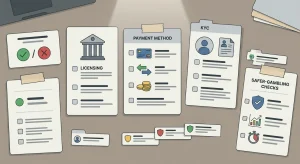
Hi-Lo choices depend on the visible reference card, with rules and decisions varying across live, reel-based and draw formats.
How Hi-Lo Turns a Card into a Higher-or-Lower Decision
Hi-Lo centres on a comparison between a visible card and the next card to be revealed. The visible card supplies the reference point: the player predicts whether the coming card will rank higher or lower. Some versions also permit a prediction that it will have the same value. The decision is therefore about the relationship between two cards, not simply about naming the next card.
That distinction makes the exposed card important. A prediction cannot be assessed in isolation; its meaning depends on what is already visible. A card that sits relatively low in the ordering leaves many possible cards above it, while a relatively high card leaves many below it. The same direction can consequently describe different prospects from one decision to the next. The game’s basic tension comes from making a directional choice when the reference point changes.
In some Hi-Lo formats, the card carried forward is the winning card from the preceding hand. It remains exposed and becomes the reference card for the next round. The new decision is thus connected to the previous result: the last winning card does not merely close one hand, but also sets the comparison for the next prediction. A change in the reference card can alter which direction appears more plausible, even though the choice remains framed as higher or lower.
When choosing a UK hi lo casino, it can help to consider how quickly withdrawals are listed as being processed. The entries below provide a brief reference point on payout timing.
1. NightLuck
Payout speed: 1-3 business days NightLuck lists a payout speed of 1–3 business days.
2. Jetsetspins
Payout speed: 1-3 business days Jetsetspins lists a payout speed of 1–3 business days.
3. SpinFormula
Payout speed: 1-3 business days SpinFormula lists a payout speed of 1–3 business days.
4. Revery Play
Payout speed: 1-3 business days Revery Play lists a payout speed of 1–3 business days.
5. WinBeast
Payout speed: 1-3 business days WinBeast lists a payout speed of 1–3 business days.
6. x3bet
Payout speed: 1-3 business days x3bet lists a payout speed of 1–3 business days.
7. SlotoSport
Payout speed: 1-3 business days SlotoSport lists a payout speed of 1–3 business days.
8. BeOnBet
Payout speed: 1-3 business days BeOnBet lists a payout speed of 1–3 business days.
9. Zombillion
Payout speed: 1-3 business days Zombillion lists a payout speed of 1–3 business days.
10. NightWin
Payout speed: 1-3 business days NightWin lists a payout speed of 1–3 business days.
This continuing reference point is what separates Hi-Lo from a sequence of unrelated guesses. Each prediction has a local context, established by the current card. The game does not ask for a broad forecast about a whole deck; it asks whether one forthcoming card will fall on one side or the other of the card already shown. Where a same-value choice is offered, that possibility forms a further outcome rather than changing the central comparison.
The simplicity of the question should not be confused with certainty about the result. Seeing a card makes the terms of the next prediction clear, but it does not establish what the next card will be. The exposed card gives the player a basis for comparing possible outcomes; it is not itself a guarantee or a complete description of what remains unseen. The precise significance of that comparison depends on the particular version of Hi-Lo being played.
For someone considering a Hi-Lo casino game in the UK, the first useful distinction is therefore between the decision’s general structure and the rules of a particular format. The shared premise is a higher-or-lower prediction against a visible reference card, with some versions including a same-value option. Other details should not be assumed from that premise alone. In particular, the fact that a card is exposed and used again as the next reference applies to the described sequence in which a previous hand’s winning card carries forward; it should not be treated as a universal rule for every game called Hi-Lo.
Live Baccarat Online Casinos in the UK: How It Works
This basic comparison explains why the card on display matters more than the label of the choice. “Higher” and “lower” have no fixed meaning without a reference. Once the reference is established, the player’s task is to choose a direction for the next card.
How a Live Hi-Lo Round Uses the Shoe
A live Hi-Lo round depends on two separate things: the card used as the reference point and the card revealed as the next result. In the described live format, the winning card from the previous hand remains exposed and serves as the reference for the next round. The dealing procedure then determines which card becomes the next result.
A specialist review describes the game as using six decks of 48 cards, with tens removed from each deck. That account also notes that the exact deck count could not be confirmed in writing. The setup should therefore be treated as a description of a reported version, not as a settled specification for every live Hi-Lo game. The removal of tens is relevant to the composition of the cards available, but the reported information does not establish whether every provider or table uses the same arrangement.
Live Hi-Lo Setup
A reported version of the game uses six decks of 48 cards each, with tens removed from every deck.
The stated sequence includes a burn before the next winning card is revealed: three cards are set aside, then the card that determines the result is shown. Those burned cards are not the round’s revealed winning card. This distinction matters when following the sequence, since the reference card and the result card have different roles. The reference is already visible from the previous hand; the winning card is the new card that follows the burn.
The cards are handled through a continuous shuffler. After a round, its cards are returned to the machine immediately rather than being kept out until a larger batch of hands has finished. The live procedure is therefore not simply a matter of drawing from a visibly shrinking group of cards and leaving every used card aside. The return to the shuffler is part of the stated process, alongside the burn and the exposure of the next result.
Taken together, the described sequence can be understood as a repeating cycle. A previous winning card remains visible as the next reference. Three cards are burned before the new winning card appears. The new result settles that hand and then becomes the exposed reference for the following round. Cards from the previous round go back into the continuous shuffler. This explains how the game can retain a visible card between hands while still returning dealt cards to the machine.
The term “shoe” can suggest a fixed set of cards being depleted in a predictable order. That picture is incomplete for this reported live format. The stated use of a continuous shuffler, with cards returned immediately, means the procedure is different from a game in which used cards remain out of play for the rest of a shoe. The reported deck description does not, by itself, establish the exact order in which cards emerge or how the machine handles them internally.
Live Blackjack Online Casinos in the UK: How They Work
The exposed reference card is also not the same as a card newly drawn from the machine. It belongs to the previous hand’s result and is carried forward as the comparison point. Meanwhile, the three burned cards intervene between that reference and the next revealed result. A viewer following a live round should therefore distinguish the visible reference, the cards burned, and the card that determines the current outcome; treating them as one continuous face-up sequence would obscure the stated dealing process.
This procedure describes one reported live Hi-Lo setup, not a universal template for every live casino version. The deck count and composition come from a specialist review, and the count was not confirmed in writing. The three-card burn and continuous-shuffler process are also specific to the described format. They provide a useful account of how that round is presented, but do not establish that all live Hi-Lo tables use the same shoe or dealing sequence.
Live Hi-Lo Decisions: Payouts, Ties and Proposition Bets
A live Hi-Lo wager is not judged by the direction alone. The amount offered for a winning Higher or Lower bet also matters: the stated recommendation is to choose whichever side carries the larger payout. This is a comparison of the two available returns, not a claim that the better-paying side is more likely to win. A larger payout does not remove the uncertainty of the next result.
Payout Strategy
When choosing between Higher and Lower, it is recommended to select the side that carries the larger payout.
The comparison is useful when the exposed card makes one direction appear more attractive. A high reference card may make Lower seem intuitive, while a low one may make Higher seem intuitive. The payout table adds another consideration, but it does not establish which result will occur. Assessing the displayed return and predicting the next card remain separate parts of the decision.
How a tie affects a directional bet
In this live format, a tie means that the next card matches the exposed reference card. It is not a neutral result for a Higher or Lower wager: either directional bet loses if the same card appears again. That distinction matters because “higher” and “lower” do not include an unchanged value. A prediction can therefore fail without the next card moving in the opposite direction.
This also means that the apparent choice between two directions is not simply a choice between upward and downward movement. The possibility of the reference value recurring sits outside both directions, while still affecting the result of either bet. The payout comparison should therefore be understood alongside the rules for a matching card, rather than as a complete account of the wager.
Proposition bets and the exposed card
Proposition bets involve specified outcomes beyond a simple Higher or Lower choice. Their evaluation must account for the card already visible. Once exposed, that card is no longer in the shoe, so an outcome that would have won if that card were still available cannot be treated as having the same possibilities.
Live Casino Lightning Roulette UK: How It Works
The practical implication is to avoid a proposition bet whose winning condition includes the exposed card. That card cannot be drawn again from the shoe in the described live game. This is a different issue from comparing the offered payouts: the payout tells how much a successful bet returns, while the exposed card affects whether a stated winning outcome remains possible.
The distinction is particularly important when the proposition is framed around a particular value or a set of values. A listed outcome may look relevant to the current decision, but the visible reference card has already been removed from the available possibilities. Ignoring that removal can make the bet appear more favourable than it is.
Reading the decision as a whole
For a live Hi-Lo casino game, the decision can be separated into three checks: compare the returns on Higher and Lower, account for the fact that a matching card loses either directional bet, and exclude the exposed card when considering a proposition wager. These points describe different parts of the same decision and should not be collapsed into a single claim that one side is always preferable.
A larger payout is not a guarantee of a win, and an intuitive direction does not change the tie rule. Nor does the payout comparison make an unavailable card possible again. Any wrong guess will void all winnings collected in that game, so the consequence extends beyond the immediate wager. The stated decision rules apply to the described live game; the label “live” alone does not establish that every live Hi-Lo game uses identical bets or settlement terms.
Live Hi-Lo Decision
- Compare the returns offered for Higher and Lower
- Account for the fact that a matching card results in a loss for directional bets
- Exclude the exposed reference card when considering a proposition wager
What Makes an Online Hi-Lo Game Different
An online Hi-Lo game can use the same basic choice as a live card game: predict whether the next revealed card will rank above or below the current one. The central difference is not the direction of the guess, but how the particular version defines card values, keeps track of winnings and handles the deck. Those mechanics need to be considered together, since the card sequence affects what may appear next and the pot records the outcome of successive decisions.
A higher guess is therefore a prediction that the next card’s value will exceed the current card’s; a lower guess predicts the reverse. The decision is framed around the two directions, rather than the proposition bets that may appear in other forms of Hi-Lo.
The game’s pot provides a running record of successful guesses. When a prediction is correct, the resulting winnings are added to the pot. A wrong prediction has a broader consequence than simply missing out on that turn: the money placed on the guess is lost, and all winnings accumulated in that game are void. The pot should therefore not be treated as a guaranteed balance available for collection after every correct decision. Its value depends on continuing to make predictions without an incorrect one ending the run.
These are materially different arrangements: in the first, a card already revealed cannot recur in the same game, while continuous shuffling returns used cards to circulation. Neither setup should be assumed to define every online Hi-Lo game.
Crazy Time Live Casino Game Show in the UK
This distinction also prevents the online description from being confused with a live game using a shoe. In the live procedure, the previous winning card remains exposed as the reference for the next round, while burned cards and a continuous shuffler form part of the dealing process.
For anyone comparing hi-lo online casinos in the UK, the name of the game alone does not settle these mechanical differences. A displayed card value, the treatment of used cards and the consequence of a wrong prediction each affect how a session unfolds. In particular, a single-deck game without replacement has a different card pool over time from a continuously shuffled version. The two descriptions should remain distinct rather than being combined into one assumed set of online rules.
Comparing Hi-Lo Games by Their Stated Returns
A return percentage can help compare two stated approaches to Draw Hi-Lo, but it is not a ranking of casinos or a promise about an individual session. The figures available for this game describe estimated outcomes under different strategies. They should therefore be read as model-specific calculations, not as a measure of which online casino is best.
A specialist review reports a return of 96.07% when following basic strategy. It reports 100.36% under a card-counting strategy. The difference is substantial in interpretation: the first figure is below the amount staked in the long-run calculation, while the second is above it. Neither figure means that a player will receive that proportion of their money back in a particular game, nor does the higher estimate establish that card counting will produce a profit in practice.
Basic Strategy
A rule-based approach to the choices available in the game, with a reported return of 96.07%.
Card Counting
A strategy that uses the changing composition of the remaining deck to inform decisions, with a reported return of 100.36%.
The two percentages are not competing estimates for the same method. They correspond to different ways of making decisions. Basic strategy provides a rule-based approach to the choices available in the game. Card counting takes account of which cards have already appeared and uses the changing composition of the remaining deck to inform later decisions. Since cards are not returned to the deck during a Draw Hi-Lo game, earlier reveals can affect what remains possible. The counting figure depends on that feature and should not be transferred to a version that uses a different deck procedure.
The return of 96.07% is the more relevant of the two reported figures for a comparison based on basic strategy. It indicates a calculated expectation under that approach, rather than a guaranteed recovery of 96.07% of every stake. Results from individual games can depart from a long-run estimate. A correct decision does not ensure a net gain across a session, and a series of correct decisions cannot be inferred from the percentage alone.
The card-counting estimate requires more qualification. A reported return above 100% is not evidence that a player can reliably earn money. It describes the result attributed to a particular strategy and game model in a specialist review. The figure does not, by itself, establish how the estimate was calculated, how much variation surrounds it, or whether the same result applies to every implementation of Draw Hi-Lo. It is therefore more accurate to treat it as a reported theoretical outcome than as a practical expectation.
Monopoly Live Casino UK: Evidence and Game Guide
The game’s settlement rules also matter when interpreting any return. A correct guess is paid according to the pay table, while a tie pushes. An incorrect guess loses the stake; under the stated game constraint, a wrong guess also voids winnings accumulated in that game. The possibility of collecting accumulated winnings after an earlier decision does not remove the risk attached to continuing. A percentage aggregates outcomes across a model and does not show the sequence of wins and losses that a player may encounter.
This distinction is relevant when comparing Hi-Lo games online. A game with the same name may not share the same deck, card-return procedure, pay table or settlement rules. In the described Draw Hi-Lo model, the deck is finite and used cards stay out of play, which is central to the rationale for counting. The figures should not be applied to a game whose rules differ, or to a live or reel-based version simply because it also involves a higher-or-lower choice.
Nor do these returns identify the best Hi-Lo casino or establish that one site offers better value than another. They concern a game strategy, not an operator’s licence, terms, payment arrangements or overall product range. A casino comparison would require evidence on those separate matters, and the return figures alone provide none of it. They also cannot show that a particular operator makes the same Draw Hi-Lo game available under identical rules.
For a restrained comparison, the basic-strategy figure is the clearer baseline, while the counting figure is a separate, conditional estimate. Both come from a specialist review, and neither should be presented as a universal return for all Hi-Lo games. The gap between them reflects the reported effect of changing strategy within the described model; it does not eliminate uncertainty or convert an estimated return into a guaranteed outcome.
Attention Return percentages are model-specific calculations based on strategy and do not guarantee a profit or a specific recovery of stakes in an individual session.
Hi-Lo as a Reel-Based Higher-or-Lower Game
A reel-based Hi-Lo casino game uses a different comparison from card formats: the decision concerns where one reel stops, rather than whether a newly revealed card ranks above or below a reference card. In the version described by a specialist review, the player selects either higher or lower. The bet wins if the reel lands on a number in that direction; landing in the opposite direction or tying the reference number makes the bet lose.
That tie rule matters because a matching value is not treated as a neutral result. The selected direction must be judged against the reel’s stopping number, and a tie counts against the wager. This differs from card games in which a tie may have another settlement, so rules from one Hi-Lo format should not be assumed to apply to another.
The same specialist review describes a choice after a win: collect the result and begin again, or parlay the original stake together with the winnings into another play. Collecting ends that run with the accumulated amount taken; a parlay keeps the amount in play and exposes it to the next outcome. If a later guess is wrong, winnings accumulated in that game are void. The choice therefore changes whether the result is secured or remains at risk; it does not alter the higher-or-lower rule for the reel.
American Roulette at UK Online Casinos: Rules and Play
The review reports a highest return of 96.23% for betting higher than 4 or lower than 10. This figure is tied to those stated choices in that particular description, not a general return for every reel-based Hi-Lo game. It should not be treated as a guaranteed outcome for an individual session: a return figure describes expected results across repeated play under the specified rules, while any single stop can still win or lose.
The format is best understood as a compact sequence of directional choices, with the tie acting as a losing result and a win opening a choice between collecting and continuing. Its mechanics should not be merged with card-based Hi-Lo simply because both use higher-or-lower decisions. A reel’s numbered positions and the described collect-or-parlay option define this version; card values, deck composition and card-removal strategy belong to other formats.
Draw Hi-Lo: A Finite Deck and Changing Decisions
Draw Hi-Lo uses a single standard deck of 52 cards, with aces ranked low. The player receives a random starting card, then predicts whether the next card will rank higher or lower when the choice is not obvious. A correct prediction pays according to the pay table; a tie pushes, while a wrong guess loses the stake and voids winnings accumulated in that game.
The defining feature is that dealt cards stay out of play. Once a card has appeared, it cannot appear again during that game. The deck’s composition therefore changes as decisions proceed: a rank that has already been drawn is no longer among the possible outcomes, and the remaining cards affect the balance between higher and lower results. This is different from making each prediction as if the full deck were still available.
Draw Hi-Lo Deck Mechanics
In Draw Hi-Lo, a single standard deck of 52 cards is used with aces ranked low. Dealt cards stay out of play, meaning the pool of available cards changes after every decision.
After the first decision, the player can stop and collect the winnings accumulated so far. Continuing means making another prediction with a smaller pool of unseen cards. That changing pool is why a card-counting approach can produce a different reported return from a basic strategy, although neither figure guarantees an individual result.
A specialist analysis reports a return of 96.07% for basic strategy and 100.36% for a card-counting strategy. These are reported theoretical outcomes for this specific finite-deck model, not universal figures for every Hi-Lo casino game. The difference depends on using information about cards already removed from the deck; it should not be read as a promise that a player will obtain a positive return in a session. The pay table and the sequence of cards remain material to the result.
The finite deck also makes the model distinct from versions in which cards are replaced or continuously shuffled. In Draw Hi-Lo, prior cards have lasting relevance within the game because they cannot return. That constraint gives the decisions a memory of earlier draws, while the option to stop provides a point at which accumulated winnings can be taken rather than exposed to another guess.
How to Play a Hi-Lo Round
A Hi-Lo round begins with a random starting card. That card is the reference for the next decision: the player predicts whether the next card will rank higher or lower. The choice is made before the next card is revealed, so the round turns on comparing its value with the one already visible.
Online European Roulette in the UK: Rules and Odds
If the direction is not clear from the available information, either prediction can be selected. Once the choice is made, the next card determines the result. A higher card supports a Higher guess; a lower card supports a Lower guess. If the revealed card matches the starting card, the outcome is a tie rather than a win for either direction.
Settlement follows the game’s stated rules and pay table. A correct prediction is paid at the amount specified there. A tie pushes, meaning the bet is returned rather than treated as a win or loss. An incorrect prediction loses the bet; in the described game, a wrong guess also voids winnings accumulated during that game. The distinction matters when a round allows decisions to continue after an earlier win: a later mistake can remove those collected winnings.
The basic sequence is therefore: receive the starting card, choose Higher or Lower, reveal the next card, and settle the result against the reference card. The exact card values and payment terms depend on the particular Hi-Lo version, so the game’s displayed rules and pay table govern the round.
Checking a Hi-Lo Casino Site’s UK Licence
A Hi-Lo game may be presented as a card game, a reel-based game or another higher-or-lower format, but its format does not determine whether the casino is authorised to offer it. In Great Britain, commercial gambling is overseen by the UK Gambling Commission, which is the sole regulator for that activity. Its remit includes online casinos and remote gambling supplied to consumers in Great Britain.
Legal Requirement
Online gambling in the UK is legal only through sites that hold a current operating licence from the UK Gambling Commission.
The location of a casino’s servers or other key equipment does not, by itself, place its remote service outside that regulatory scope. The relevant question is whether the operator offers gambling to consumers in Great Britain. A business serving that market must hold the appropriate Commission licence; being based elsewhere does not remove that requirement. Online gambling in the UK is legal only through licensed and regulated sites, and a legal online casino serving UK players must have a current operating licence.
Business licences and individual licences
The Commission issues two distinct kinds of licence. An operating licence authorises a business to provide specified gambling services. This is the central authorisation to check when assessing an online casino: the licence must belong to the business responsible for the site and cover the gambling activity being offered.
A personal licence applies to an individual who performs certain roles in gambling operations. It is not a substitute for the business’s operating licence, nor does an employee’s personal licence make an otherwise unauthorised casino lawful. The two forms of authorisation concern different holders and responsibilities: one applies to a business, the other to an individual working in the sector.
This distinction matters where a site displays a licence reference or a regulatory logo without making clear which company holds the authorisation. The name on the site’s terms or account information may differ from its trading name. The operator’s identity should therefore be matched against the business recorded by the regulator, rather than inferred from the site’s branding alone.
Checking the public register
Before depositing, the licence number should be checked against the UK Gambling Commission’s public register. A number printed on a casino page is a claim made by the site; the register is the place to confirm whether the authorisation is recorded by the regulator. The check should establish that the licence is current, that the named business corresponds to the operator, and that the permission relates to the gambling service in question.
Deal or No Deal Casino UK: Game and Offers
A mismatch deserves attention. A licence belonging to a different company, an expired authorisation, or a reference that cannot be located does not establish that the casino is licensed. Nor should a site’s use of the words “UK”, “licensed” or “regulated” be treated as proof. Those descriptions need to be consistent with the register entry.
The register check is also separate from assessing the game itself. A casino’s licence concerns the operator’s authorisation to provide gambling; it does not, on its own, establish the merits of a particular Hi-Lo game or guarantee a particular outcome. Regulatory status and game mechanics are different questions.
Limits of the regulatory check
The Commission’s role is specific to gambling regulation. A licence check can establish whether an operator is authorised within the relevant system, but it does not replace reading the casino’s rules or understanding how a game settles a bet. It is also not enough to see that a business holds some form of licence: the relevant operating permission must apply to the service being offered to consumers in Great Britain.
Live Roulette UK with English-Speaking Dealers
The Gambling Act 2005 governs gambling in England, Wales and Scotland, while Northern Ireland is outside that Act’s territorial scope. Accordingly, the Commission’s role in regulating commercial gambling should be understood in its Great Britain context, even though it is commonly associated with UK online casino regulation. For a remote casino serving Great Britain, the location of its key equipment does not alter the need for the relevant Commission authorisation.
A careful review therefore centres on the registered business, the status of its operating licence and whether the permission matches the service. Personal licences may be relevant to individuals working in gambling operations, but they do not replace the operator’s authorisation. These checks provide a more reliable basis for assessing a Hi-Lo casino site than its own promotional wording.
Material created by the team NationalBet Casino UK