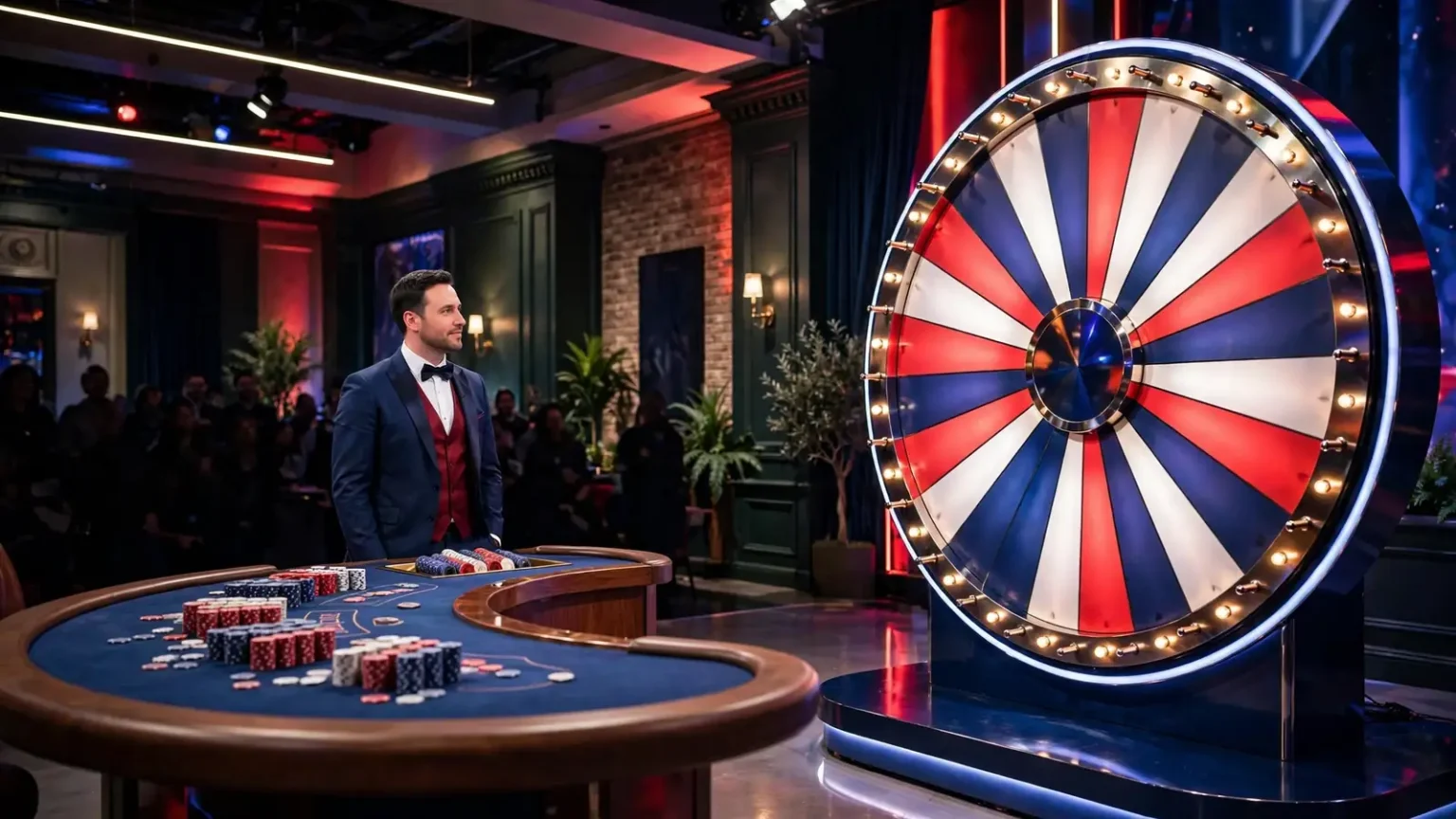
A live dealer conducts each round on stream while the betting interface records wagers, making play follow the pace of the presentation.
How Online Live Casino Play Works
A live casino game is presented as a real-time stream from a studio, where a human dealer conducts the game. Bets are made through an on-screen interface while the broadcast is under way. This differs from a digital game, in which the game itself is generated by software rather than shown as a live studio presentation.
The screen combines the video stream with controls for placing bets. The dealer’s actions are visible in the broadcast, while the interface provides the means to submit a wager. The two elements work together: the stream shows the live activity, and the interface records the player’s choices. A clear connection matters because the experience depends on receiving the broadcast while interacting with the betting controls.
This format can affect the pace of play. Live games generally move more slowly than digital versions because the sequence is conducted by a human dealer and shown in real time. There is less scope for rapid repetition than in a software-based game. The pace may therefore feel more measured, but it also means that each round takes place within the timing of the live presentation rather than at the speed of a player’s own clicks.
Choosing a site for Crazy Time in the UK means checking the practical details as well as the game itself. This reference highlights the payout information available for each operator.
1. NightLuck
Payout speed: 1-3 business days NightLuck lists a payout speed of 1–3 business days, a useful detail to consider when choosing where to play.
2. Jetsetspins
Payout speed: 1-3 business days Jetsetspins lists a payout speed of 1–3 business days, giving players a clear expectation for payouts.
3. SpinFormula
Payout speed: 1-3 business days SpinFormula lists a payout speed of 1–3 business days. This is the available practical detail to weigh when considering the operator.
4. Revery Play
Payout speed: 1-3 business days Revery Play lists a payout speed of 1–3 business days, which may help players assess its payout timing.
5. WinBeast
Payout speed: 1-3 business days WinBeast lists a payout speed of 1–3 business days. The stated timing offers a concrete point to consider when choosing a site.
6. x3bet
Payout speed: 1-3 business days x3bet lists a payout speed of 1–3 business days, providing a clear detail about its payouts.
7. SlotoSport
Payout speed: 1-3 business days SlotoSport lists a payout speed of 1–3 business days. This timing is the available factual detail for players to consider.
8. BeOnBet
Payout speed: 1-3 business days BeOnBet lists a payout speed of 1–3 business days, helping set expectations around payouts.
9. Zombillion
Payout speed: 1-3 business days Zombillion lists a payout speed of 1–3 business days. Players can use this stated timing as one practical consideration.
10. NightWin
Payout speed: 1-3 business days NightWin lists a payout speed of 1–3 business days, giving players a clear piece of information about payouts.
Minimum bets are another practical difference. Live tables have higher minimum bets than digital versions, so the amount required to participate may be less flexible. The applicable minimum is a table condition, not a feature that can be inferred from the fact that a game is live. It should be visible in the game interface or its rules before a wager is placed. A game title alone does not establish the table’s limits or other conditions.
The stream also makes connection quality relevant to play. A stable internet connection is needed to keep the live video and betting interface usable together. If the broadcast is interrupted or delayed, it may be harder to follow the sequence as it unfolds. This is a practical distinction from many digital games, which do not rely on a continuous studio stream. Connection problems can affect access to the live presentation, although they do not change the rules of the game.
For someone looking for Crazy Time at an online casino, the phrase can describe an interest in playing a named game through an online casino interface. That wording alone does not explain the game’s specific mechanics or establish the conditions under which it is offered. The general live-casino format is clearer: a studio stream is shown in real time, and bets are submitted through on-screen controls. Details such as table limits and the way a particular title operates need to be checked in the game itself rather than inferred from the broader label of live casino.
Deal or No Deal Casino UK: Game and Offers
The distinction between the broadcast and the interface is useful when considering what “live” means. The video is not simply an animation of a dealer; it shows a human dealer conducting play in a studio. At the same time, the online participant does not place a physical wager at the table. The wager is entered electronically through the interface, while the live stream supplies the view of the game in progress.
Because the pace is slower and minimum bets are higher than in digital versions, live play may require a different approach to time and budget. A session is shaped by the table’s round-by-round rhythm, and the minimum stake can determine whether a particular table is suitable. These are structural features of the format rather than evidence that one version is more favourable than another. No staking approach can be inferred from the presence of a live dealer.
The practical checks are straightforward: establish that the stream is playing smoothly, locate the displayed table minimum, and understand how the interface registers a wager before taking part. A stable connection supports the viewing and betting process, while the table information clarifies the immediate conditions of play. These checks describe how to use a live casino interface; they do not establish the rules or availability of any individual game.
Live Casino Preparation
- Establish that the stream is playing smoothly
- Locate the displayed table minimum
- Understand how the interface registers a wager
- Ensure a stable internet connection
Crazy Time at a UK-Licensed Casino
The phrase “Crazy Time live casino” describes a game being sought in a live-casino setting, but it does not establish which operators offer it or whether a particular version is available to customers in the United Kingdom. The relevant legal question is whether the casino operator holds the required UK Gambling Commission licence for the gambling it provides to people in the British market. Live-dealer casino play is legal in the UK when offered by an operator holding that licence.
This distinction matters because a game’s name, presentation or online listing does not itself demonstrate that the site offering it is authorised to serve British customers. Nor does the existence of a UK-licensed casino establish that every game mentioned in connection with it is available there. Licensing applies to the operator’s regulated activity; it should not be treated as independent confirmation of a particular game’s current availability, rules or presentation.
What the licence establishes
The UK Gambling Commission regulates remote gambling operators that serve consumers in Great Britain. An operator selling gambling to customers in the British market must hold the relevant Commission licence, regardless of where the company is based. Consequently, the licensing status of the operator—not simply the branding or location of a website—is central to the legal context for a live casino.
The Gambling Act 2005 governs gambling in England, Wales and Scotland. Northern Ireland is outside the Act’s scope, so a description of the British licensing framework should not be read as a detailed account of Northern Ireland’s separate legal position. In the market context relevant to British consumers, online casino gambling is lawful at licensed and regulated sites. A UK-licensed live-dealer casino therefore operates within a different regulatory framework from an offshore casino that lacks a UK Gambling Commission licence.
Live Dream Catcher Casino in the UK: What to Know
A licence is not a general endorsement of a particular game, nor does it make every claim made by a casino accurate. It identifies the operator as subject to the applicable UK regulatory regime for the licensed gambling activity. The regulatory point is narrower than a product review: it concerns whether the operator is authorised to provide gambling to the relevant market, not whether a specific game is suitable or appealing.
Applying that distinction to Crazy Time
A search for a UK casino offering Crazy Time may bring together two separate issues: the game being named and the operator’s authority to provide gambling. Those issues should not be collapsed. A site could describe a live casino product in promotional terms, but that description alone is not evidence of a UK Gambling Commission licence. Conversely, an operator’s licence does not prove that Crazy Time appears in its catalogue at a given time.
The same caution applies to references to “Crazy Time casinos” or a “Crazy Time live casino” in general. Such phrases do not identify a particular licensed operator, confirm the operator’s current status, or establish the terms under which a named game might be offered. Availability can only be established from reliable, current information about the specific operator and its offering. A licence, by itself, answers a regulatory question rather than every product question.
This is why the UK licensing context should be kept separate from claims about the game’s mechanics or features. The legal status of live-dealer casino play does not verify any particular account of how Crazy Time works. No conclusions about its rules, betting options, studio presentation or outcomes follow from the fact that licensed live casinos may operate in the UK.
A game’s name or online listing does not demonstrate that the site offering it is authorised to serve British customers.
The scope of the regulatory point
For a UK-facing live casino, the key distinction is between an operator holding the relevant UK Gambling Commission licence and one operating without it. Offshore location does not remove the licensing requirement when an operator sells remote gambling into the British market. A foreign address or an overseas licence is not a substitute for the UK authorisation required to serve that market.
This framework does not amount to a recommendation to use any particular casino. It also does not establish a ranking, a guarantee of game availability or an assurance about a specific transaction. Those are separate matters and require evidence relating to the operator and the relevant product. The defensible conclusion is limited: live-dealer casino gambling is legal in the UK when provided by a properly UK-licensed operator, while a reference to Crazy Time alone cannot establish that condition.
This material is for entertainment purposes only and is not gambling advice.
Casino Sites, Slots and the Limits of Comparison
The word “casino” can describe a venue, an online operator or a category of gambling, so its presence in a game’s name does not establish how that game is classified. Crazy Time is often discussed alongside casino play, but that wording alone is not a basis for treating it as an online slot. Nor does it establish that a particular casino site offers it.
This distinction matters because slots and live-dealer games are not interchangeable categories. Live-dealer casino games stream gameplay from a studio, where a human dealer is present, and bets are placed through an on-screen interface. Online slots, by contrast, are subject to specific rules in Britain about how they may be played. Those rules should not be applied to a game merely because a site describes it as casino entertainment; the game’s actual format must first be established.
French Roulette Online Casinos in the UK: Rules and Play
What the UK slot rules cover
For online slots in Britain, autoplay is prohibited, and each spin must last at least two and a half seconds. Stake limits also apply per game cycle: the maximum is £5 for customers aged 25 and over, and £2 for those aged 18 to 24. The £5 limit for all adults came into effect on 9 April 2025.
These restrictions concern online slot play. They are not general limits for every game offered by an online casino, and they do not by themselves identify Crazy Time as a slot. A site’s menu placement or promotional wording is not a substitute for understanding the format being offered. The category determines which specific rules are relevant.
Searches for casino sites offering Crazy Time can also mix several separate questions: whether a site lists the game, whether it is a live-dealer or slot product, and whether a particular offer applies to it. Those questions require separate answers. A casino’s general description of its games does not establish every title’s mechanics, and a site listing does not by itself make the game comparable with slots.
The same care is needed with requests for “scores”. In a slot context, the term may suggest results, ratings or a record of play; in a live game context, it may refer to a score within a particular format. These meanings are not equivalent. A score or rating found on a casino page should not be treated as evidence that previous results predict future outcomes, or that a tracker can improve the chance of a particular result.
Do
- Identify the actual game format
- Use reliable information for game category
- Treat gambling as paid entertainment
Don’t
- Apply slot rules to live-dealer games
- Use promo wording to determine format
- Exceed a pre-set gambling budget
Comparing sites without assuming a slot format
A ranked list of “best” sites would imply that the operators and their offerings had been assessed on a consistent basis. The phrase alone does not establish that comparison. It is more precise to distinguish a site’s availability of a title from the game’s category, rules and any conditions attached to play. Those details should not be inferred from a slot label or from a score displayed in promotional material.
Casino offers raise a related issue, but an offer’s presence does not demonstrate that it applies to every game on a site. The applicable terms determine which games qualify and how play is treated. A bonus advertised near a game title should therefore not be read as proof of eligibility.
Online gambling in Britain is for adults aged 18 and over, and operators must verify a customer’s age before allowing deposits. Gambling should be treated as paid entertainment rather than a source of income; a budget set in advance should not be exceeded. This information is for entertainment purposes only and is not gambling advice.
Where Live Casino Games Can Be Played
Finding a place to play Crazy Time in the UK involves two separate checks: whether an operator offers the game and whether that operator is authorised to provide online gambling to people in the market. A game’s appearance in a search result, advert or catalogue is not, by itself, evidence that the operator is licensed.
Live Baccarat Online Casinos in the UK: How It Works
The relevant regulator is the UK Gambling Commission. Live-dealer casinos can operate legally in the UK when they hold a UK Gambling Commission licence. Remote gambling operators selling into the British market are required to hold the appropriate licence, regardless of where the business is based. A foreign address or an overseas licence does not replace that UK requirement.
This gives a practical way to assess claims about where Crazy Time can be played. First, establish whether the operator holds a current UK Gambling Commission operating licence. The regulator’s public register can be used to check an operator’s licensing status. The check should relate to the company providing the gambling service, rather than relying only on a brand name or a statement on a promotional page.
Next, establish whether the game is actually offered by that operator. A licence authorises an operator to provide gambling under regulatory conditions; it does not establish that every particular game is available. Game catalogues can differ, and availability can change. Accordingly, the existence of a licensed casino does not prove that Crazy Time is among its live games. The operator’s own current catalogue is the relevant place to confirm that point.
The same distinction applies to references to a Crazy Time casino wheel or a live version of the game. Such wording can describe what a person is trying to find, but it cannot establish that a particular site provides access or that the site is lawful for UK play. Licence status and game availability are different questions, and both need to be resolved before treating a site as a suitable destination.
Verifying a Site
Check Licensing
Use the UK Gambling Commission’s public register to confirm the operator holds a current operating licence.
Confirm Availability
Check the operator’s current game catalogue to ensure Crazy Time is actually offered.
Resolve Regulatory Status
Verify that the company providing the service is the one holding the licence, rather than relying on brand names.
No ranking is needed to make this distinction. A prominent listing or a claim that a site is a leading choice does not substitute for confirmation of its UK Gambling Commission licence. Nor does a licence alone demonstrate that the named game is currently listed. Where either point remains unclear, the available information does not support a reliable conclusion that the game can be played there legally.
In short, a UK player looking for Crazy Time should distinguish between an operator’s regulatory authorisation and its current game selection. The legal basis is the UK Gambling Commission licence; access to the specific game depends on whether the licensed operator actually offers it.
Assessing a Casino Site Without a Ranked List
A “best” label is not meaningful unless the evidence and criteria behind it are clear. For a UK assessment of a casino offering Crazy Time, the first check is the operator’s regulatory status: live-dealer casinos may operate legally in the UK when they hold a UK Gambling Commission licence. A site’s own statement is not a substitute for confirming that the licence belongs to the operator providing the gambling service.
The game page is a separate source of information. Before placing a bet, the table rules and paytable should be available and readable. These explain the conditions that apply to the specific game and how its listed outcomes are treated. A general casino review cannot stand in for those details, and a page describing one table should not automatically be taken as evidence about another. If rules or payout information are difficult to locate, that is a limitation in the information available for assessing the offer.
Hi-Lo Casino UK: How the Game Works
Claims about Crazy Time results also need careful interpretation. A record of previous outcomes describes what has already happened; it does not establish what will happen in a later round. Statistics pages and trackers cannot make future results more predictable. A site that presents historical figures as a way to identify a coming outcome is making a claim that the figures themselves do not support.
The same distinction applies to strategy claims. A guide may describe a betting approach, but its presence on a casino site does not demonstrate that it changes the underlying outcomes or removes the risk of losing money. Promotional language about a “best” approach should therefore be separated from information that can be checked directly, such as the operator’s licence and the rules shown for the table.
Searches may also describe Crazy Time as a slot. That label alone does not establish the game’s category or settle whether a particular casino’s description is accurate. The relevant site information should identify the game being offered and provide its applicable rules and paytable. Claims about a slot’s features or results should not be treated as confirmed simply because they appear beside the game’s name.
A responsible comparison can therefore be limited to evidence that is visible and specific: whether the operator holds the required UK licence, whether the game’s table rules and paytable can be reviewed, and whether claims about past results are kept distinct from predictions. This does not produce a defensible universal ranking of the best Crazy Time casinos. It provides a way to assess what a particular site actually discloses, without turning advertising or historical outcomes into proof of quality or future performance.
Historical results and statistics trackers describe what has already happened and cannot make future results more predictable.
Live Casino Mechanics and Betting Systems
A betting system changes how stakes are arranged; it does not change the rules of a casino game or remove its house edge. This distinction matters when considering claims about a Crazy Time strategy. A sequence of bets may look systematic, but that alone is not evidence that it improves the chance of a profitable result.
Martingale is one example: after a loss, the stake is increased in an attempt to recover the amount lost when a win occurs. The approach can still result in losses. A run of losing bets can make the required stakes grow, while a later win does not guarantee that the overall session ends ahead. The system changes exposure to wins and losses, not the underlying advantage held by the casino.
Blackjack provides a useful example of the difference between rules and staking. The aim is to beat the dealer with a hand worth 21 points or less. Decisions are made within that game objective, but the house edge remains. A staking pattern such as Martingale does not remove it. These blackjack mechanics should not be treated as instructions for Crazy Time: they describe a different game.
The same distinction applies to records of past results. A tracker can organise historical outcomes, but a record is not a mechanism for influencing what happens next. Past results and statistics trackers do not affect future spins or Lightning Numbers. A pattern visible in a history display therefore does not, by itself, establish a predictive method.
Claims about a game’s history also need to be separated from claims about strategy. Historical information may describe how a game has changed or been presented, but it does not demonstrate that a staking system can overcome the house edge. Nor does a strategy label establish that an approach is effective. The relevant question is whether the claim is supported by evidence about the game’s rules and probabilities, rather than by a sequence of past outcomes or a betting progression.
For any live casino session, a predetermined budget provides a practical boundary on spending. It should not be treated as a means of improving the odds, and losses should not be chased by raising stakes beyond that boundary. Table rules and the paytable should be reviewed before play, since the terms and mechanics of a particular game determine how bets are settled.
This account is for entertainment purposes only and is not gambling advice. Neither a betting progression nor a record of previous outcomes should be presented as a way to guarantee or engineer a win.
Live Casino Rules and Table Formats
Live dealer roulette uses a physical wheel spun by a dealer. The result comes from where the ball settles, rather than from a Random Number Generator, which determines outcomes in computerised roulette. Both formats present roulette outcomes, but the mechanism producing them is different.
The wheel layout affects the odds. European Roulette has a single green pocket, marked 0. American Roulette has two green pockets, 0 and 00. With the additional pocket, the chance of winning is lower in American Roulette: the stated odds are one in 38, compared with one in 37 in European Roulette. The comparison concerns the chance of a winning outcome, not a guarantee that any particular bet will succeed.
European Roulette
Features a single green pocket (0), resulting in odds of one in 37.
American Roulette
Features two green pockets (0 and 00), resulting in lower odds of one in 38.
A basic roulette wager involves selecting a number; a win occurs when the ball lands on that chosen number. The wheel’s pocket arrangement is therefore relevant to how the game is structured, even when the betting interface looks similar across formats. Before play, the table rules and paytable should be reviewed so the applicable layout and terms are clear.
These distinctions describe roulette, not Crazy Time. Nor does calling a casino game a “top slot” establish that it is a slot: game format needs to be identified from reliable information about that specific game.
For a comparison of live and computerised roulette, the relevant distinction is physical dealing versus computer-generated outcomes; the number of green pockets is a separate distinction between American and European wheel formats. Keeping those points separate avoids treating a change in format as a change in betting advice.
This material is for entertainment purposes only and is not gambling advice. Roulette outcomes remain uncertain, and a past result does not establish what will happen on a later spin. A set budget should be established before play and kept unchanged; losses or winnings should not lead to extending it.
Free Play and What It Does Not Establish
A free-play label can refer to access without a cash stake, but it does not, by itself, show that a game offers a practice mode or that play can produce withdrawable money. For Crazy Time, neither a free-play option nor real-money payouts through such an option can be inferred from the game’s name or from a general description of live casino play.
Free spins are a separate promotional format, commonly associated with slot games. The phrase does not establish that spins are available for Crazy Time, or that a promotion mentioning free spins can be used on a live game. The terms of an offer determine which games qualify and whether any resulting balance is subject to restrictions. A free-play feature, where one is offered, should therefore be distinguished from a real-money game rather than treated as an equivalent route to winnings.
A review may describe what an operator displays, but a favourable review or a “safe” label is not proof that a particular free mode exists or that it pays cash. Those claims require specific, current terms from the operator. The distinction matters because a demonstration of gameplay and a real-money gambling service have different purposes: the former may allow observation or practice, while the latter involves stakes and is governed by the operator’s applicable terms.
For real-money online gambling in the UK, the operator must hold a UK Gambling Commission licence, and customers must be at least 18. Operators must verify age before allowing deposits. These requirements do not turn free access into a cash prize, nor do they establish that a particular game has a free version. Any offer described as “free” still needs to be understood according to what it permits: access to play, promotional spins on eligible games, or a real-money wager are not interchangeable.
The cautious interpretation is therefore narrow. Searches for a free Crazy Time game or free spins should not be treated as evidence of a demo, a promotion applicable to the game, or a way to earn real money without staking funds. No free-play label alone establishes a payout. This article is for entertainment purposes only and is not gambling advice.
No free-play label alone establishes a payout or a way to earn real money without staking funds.
GamStop Searches and UK Licensing
Descriptions such as “not on GamStop” or “without GamStop” concern an operator’s relationship to a self-exclusion programme; they do not, by themselves, establish whether a casino is legally permitted to serve customers in Great Britain. The same distinction applies when a site is associated with Crazy Time or with Evolution: a game or provider name is not evidence of an operator’s regulatory status.
For real-money live-dealer casino play, the relevant legal test in Great Britain is whether the operator holds the required current operating licence from the UK Gambling Commission. Remote gambling operators serving consumers in Great Britain must hold the relevant Commission licence, irrespective of where the business is based. A description of a casino as outside GamStop does not replace that requirement, and it should not be treated as proof that the site is licensed.
The reverse inference is also unwarranted. A claim about GamStop status alone does not establish that an operator is licensed, that a particular live game is available there, or that the site is suitable. These are separate questions and require separate evidence. In particular, no general claim about the GamStop status of casinos offering Crazy Time can be made on the basis of the game’s name or a promotional description.
The Gambling Act 2005 governs gambling in England, Wales and Scotland, while Northern Ireland has a separate framework. For customers in Great Britain, the UK Gambling Commission’s licensing requirements provide the relevant check for remote operators. Where a site’s licensing position cannot be confirmed through the regulator, a “not on GamStop” label does not resolve the uncertainty.
This distinction matters because the phrase can be presented as a feature, although it says nothing conclusive about regulatory oversight. It should not be read as a recommendation or as an alternative measure of legality. For live-dealer casino play in Great Britain, the decisive issue remains the operator’s UK Gambling Commission licence; claims about self-exclusion status do not substitute for it.
Bonuses, Wagering Terms and Live Tables
A casino bonus does not necessarily apply to every game in the same way. Live-table games may count for only a small share of wagering requirements; a stated weighting of 10%, for instance, means that only a limited part of qualifying live play contributes to the required turnover. The precise treatment depends on the offer’s terms, so a bonus advertised alongside a live casino game should not be assumed to fund play on that table.
A specialist review describes most UK welcome offers as free spins on slots, which are not usable at live tables. That description is not a guarantee that every operator’s offer follows the same pattern. Offer details can differ, and the bonus terms are the relevant evidence for whether a particular promotion applies to Crazy Time or another live game.
Before opting in, the terms should be checked for the wagering requirement, the contribution assigned to each game category and any maximum bet while bonus funds are active. These conditions affect how the promotion can be used; the headline bonus alone does not establish that a live game qualifies or how much it contributes. If the listed weighting for live games is low, the bonus may have little practical relevance to live-table play.
Searches for a Crazy Time casino bonus, including a no-deposit or deposit offer, do not establish that such a promotion is available or that it can be used on the game. Availability and eligibility need to be confirmed in the operator’s current terms. Bonus funds also do not establish likely payouts or guarantee a return.
Promotional terms are separate from the game’s outcome. They should be read before acceptance, including any restrictions on eligible games and betting while wagering conditions remain active. This information is for entertainment purposes only, not gambling advice.
How do you play live roulette?
Place a bet through the on-screen interface, then watch the dealer spin a physical wheel. You win if the ball lands on a number you selected.
How can you win live dealer roulette?
You win when the ball lands on a number you selected with your bet.
What is the difference between European and American Roulette?
European Roulette has one green pocket, 0, while American Roulette has two, 0 and 00. The odds of winning are 1 in 37 in European Roulette and 1 in 38 in American Roulette.
Material created by the team NationalBet Casino UK