A practical guide to single-zero rules, payouts, betting formats and how European roulette differs from American roulette.
European Roulette’s Single-Zero Wheel and House Edge
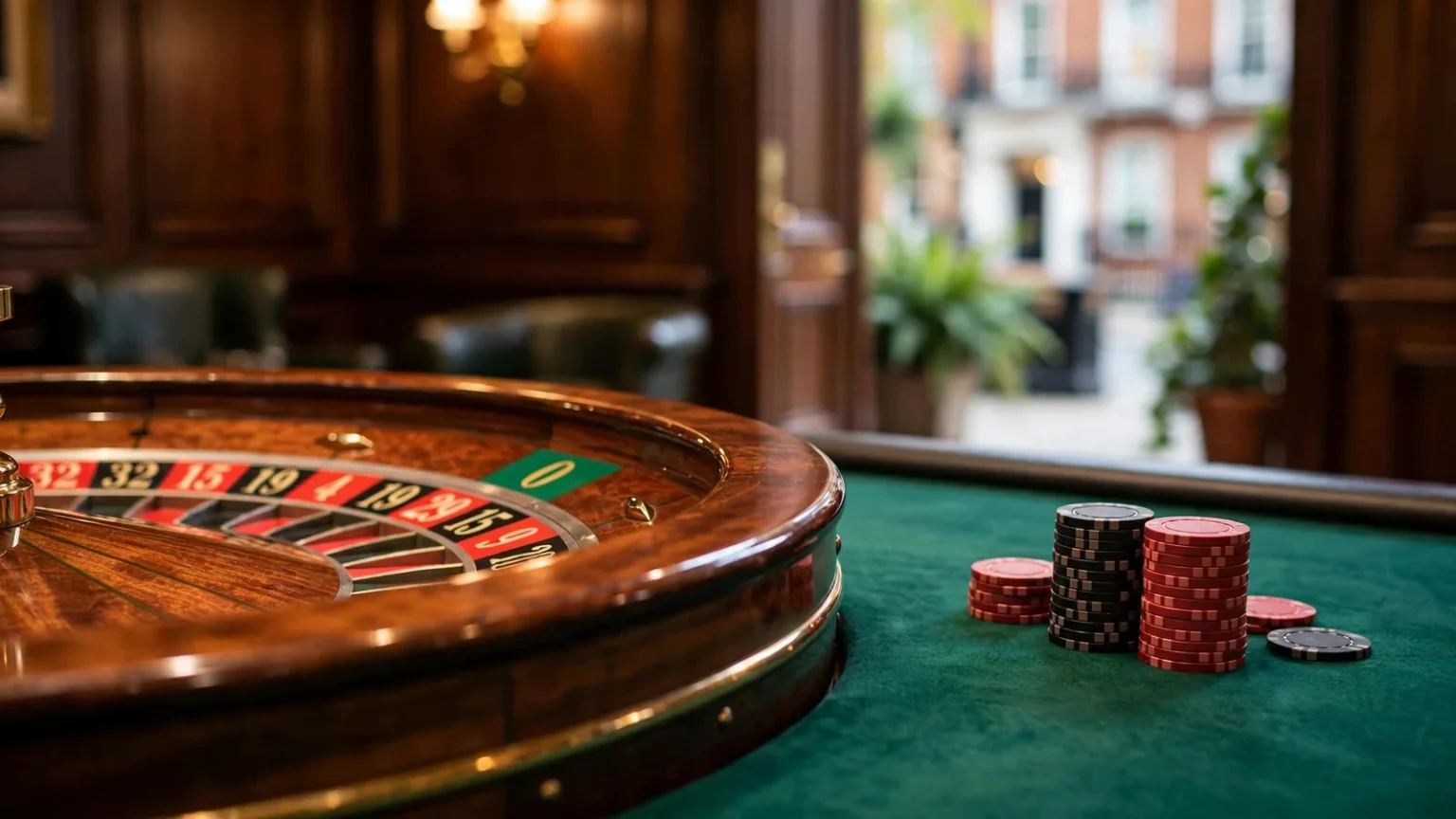
European roulette is defined by a wheel with 37 pockets: the numbers 1 to 36 and one zero. That single-zero structure is the central feature of the game. It determines the set of possible outcomes and, together with the rules for settling wagers, produces the standard house edge of 2.70%. The wheel may be presented in a digital casino game or as a physical wheel, but the defining European arrangement remains the same.
The zero is not an additional number that can be disregarded when considering the game’s mathematics. It is a pocket in its own right and forms part of the outcome set alongside the numbered pockets. A spin can therefore finish on any of the 37 pockets. The presence of zero matters because the standard settlement rules do not return the same value to the player as the total amount staked across all possible outcomes. This difference is what gives the game its built-in edge.
The house edge is a theoretical measure of the casino’s advantage over repeated play. At 2.70%, it describes the expected proportion of stakes retained by the house over a sufficiently large volume of wagers under the standard rules. It is not a prediction that a particular session will produce that result. Individual spins can produce outcomes that differ substantially from the long-run expectation, and the edge does not determine what happens on the next spin.
When considering online European roulette in the UK, it is useful to check practical details such as how quickly winnings may be paid out. The verdicts below focus on the payout information available for each operator.
1. NightLuck
Payout speed: 1-3 business days NightLuck is listed with a payout speed of 1–3 business days.
2. Jetsetspins
Payout speed: 1-3 business days Jetsetspins is listed with a payout speed of 1–3 business days.
3. SpinFormula
Payout speed: 1-3 business days SpinFormula is listed with a payout speed of 1–3 business days.
4. Revery Play
Payout speed: 1-3 business days Revery Play is listed with a payout speed of 1–3 business days.
5. WinBeast
Payout speed: 1-3 business days WinBeast is listed with a payout speed of 1–3 business days.
6. x3bet
Payout speed: 1-3 business days x3bet is listed with a payout speed of 1–3 business days.
7. SlotoSport
Payout speed: 1-3 business days SlotoSport is listed with a payout speed of 1–3 business days.
8. BeOnBet
Payout speed: 1-3 business days BeOnBet is listed with a payout speed of 1–3 business days.
9. Zombillion
Payout speed: 1-3 business days Zombillion is listed with a payout speed of 1–3 business days.
10. NightWin
Payout speed: 1-3 business days NightWin is listed with a payout speed of 1–3 business days.
This distinction is important when assessing European roulette online. A casino game may reproduce the familiar wheel and numbered outcomes, but the standard house edge is a property of the game’s rules, not a promise of a particular result. Short sequences can appear favourable or unfavourable to a player without changing the underlying mathematics. Over a limited number of spins, variation is expected; the house edge becomes meaningful as a theoretical average across repeated wagering, rather than as a description of every session.
The single zero distinguishes the standard European structure from variants that add further green pockets. For European roulette, there is one such pocket, and it is included in the 37-outcome set. This is why the phrase “single-zero” is a useful description rather than a decorative label: it identifies a defining part of the wheel and signals the structure on which the standard calculation is based.
The house edge should also be distinguished from the likelihood of any one spin producing a particular result. It expresses the relationship between the game’s possible outcomes and its settlement rules in aggregate. It does not mean that the casino collects a fixed share from each wager or that a player’s balance will decline at a steady rate. Results remain variable, while the edge describes the mathematical expectation built into the game.
For casino roulette in the UK, the European wheel is often treated as a reference point because its single-zero structure is clearly defined. The same baseline applies whether the game is encountered through an online casino interface or on a physical table, provided the standard European rules are in use. The display and delivery of a game can differ, but neither changes the wheel’s defining count or the standard edge by itself.
Live Casino Lightning Roulette UK: How It Works
That does not mean every game carrying a European roulette label should be assumed to have identical rules in every respect. The standard 2.70% figure applies to the conventional single-zero game. Any additional rule that changes how a result is settled can alter the mathematical return for the wagers to which it applies. The relevant game information therefore matters when identifying whether a particular online European roulette version follows standard rules or includes a variation.
The house edge is a comparison of expected returns, not a measure of entertainment value, speed, or fairness in the everyday sense. A lower edge does not make outcomes predictable, and a familiar wheel does not remove chance. The single-zero format provides a clear mathematical baseline: 37 pockets, including numbers 1 to 36 and one zero, with a standard house edge of 2.70%. Those features explain what the European variant is and how its basic advantage is expressed, without implying certainty about any individual spin.
Assessing UK Roulette Casinos Without an Unsupported Ranking
A credible assessment of a European roulette casino separates regulatory status from evidence about the games it offers. A UK Gambling Commission (UKGC) licence is a threshold for a real-money operator serving Great Britain, not a rating of roulette quality. The Commission regulates online casino activity in Great Britain; its oversight does not establish that one operator’s roulette selection is better than another’s.
Legal Compliance
An operator without a valid UKGC licence cannot legally offer real-money online casino play to British residents.
The licence can be checked against the UKGC public register before depositing. The operator’s name and licence details should correspond with the register entry, rather than relying solely on a logo or licensing claim displayed on a casino site. An operator without a valid UKGC licence cannot legally offer real-money online casino play to British residents. A licence therefore supports a conclusion about regulatory accountability, not about whether roulette rules are clear, game information is accessible or a particular table is suitable.
Game information and RTP transparency
An assessment of European roulette should establish whether the game’s own information is available before play. In particular, roulette RTP information should be accessible and identifiable for the relevant game, rather than buried in a general statement about casino products. RTP is a game statistic, not a prediction of an individual session’s result, and its presence alone does not show that the operator provides a better roulette experience.
The published rules should also make it possible to identify which version of roulette is being offered and how its rules apply. Similar-looking game names do not, by themselves, demonstrate that tables use identical terms. Clear game information allows the operator’s claims to be checked against the specific title and table, without treating a casino-wide description as proof about every roulette product.
A review can record whether these details are readily accessible and consistent across the operator’s pages. If the game information is difficult to locate or does not identify the relevant roulette product, the resulting assessment should remain limited: claims about transparency or game quality would not be established by the operator’s licence alone.
French Roulette Online Casinos in the UK: Rules and Play
Player protections and account controls
Regulatory checks should include the practical safeguards available through the account, not merely the licence status. UKGC-licensed live casino operators must offer deposit limits, loss limits, session time reminders, reality checks, cool-off periods and GamStop self-exclusion. These tools provide distinct forms of control, so an assessment should establish whether the options are present and accessible rather than referring generally to “responsible gambling features”.
Remote operators must prompt new customers to set a financial limit before their first deposit and provide accessible account-level limit controls. Operators must also verify a customer’s age before allowing funds to be deposited into a gambling account. These are relevant indicators of how the account process is structured, but their presence does not establish that roulette outcomes are more favourable.
A further point is whether the operator provides an internal complaints process and access to an approved Alternative Dispute Resolution service. These routes concern the handling of disputes, not the quality of a roulette game. They are nevertheless part of the broader evidence needed to assess how an operator meets its obligations to customers.
Payment arrangements can also be checked for compliance. UKGC-licensed casinos cannot accept credit cards for gambling, including through a wallet that permits credit-card funds to be used for gambling. This is a regulatory safeguard rather than a roulette feature, and should not be presented as evidence that one casino has better games than another.
What a comparison can support
A defensible comparison uses distinct criteria and does not combine them into an unexplained claim that a casino is “best”. Regulatory standing, accessible roulette information, account safeguards and complaint routes answer different questions. A strong showing in one area does not automatically prove strength in another.
Do
- Verify the licence against the UKGC public register
- Check for specific game RTP and rules
- Confirm available account-level limit controls
Don’t
- Rely solely on a logo or licensing claim
- Treat a casino-wide description as proof for every game
- Infer game quality from licensing status alone
Operator-specific judgments should be tied to observable details: whether the licence matches the public register, whether the relevant game’s RTP information and rules can be found, and whether required account protections are available. Where the evidence supports only a narrow finding, the conclusion should remain narrow. For instance, accessible game information supports a statement about transparency; it does not establish superior roulette odds or overall game quality.
The phrase “best European roulette casino” has no single technical meaning unless the criteria are stated. A comparison may prioritise regulatory accountability or clarity of game information, but those measures should not be treated as interchangeable. Separating them produces a more reliable assessment than inferring quality from licensing status or relying on an unsupported overall ranking.
Roulette Bets, Payouts and Betting Systems
European roulette offers bets with different payout ratios, from a wager on one number to broader outside bets. The ratio describes the profit paid relative to the stake when a bet wins; the original stake is returned as well. These fixed payouts describe the rules of the wager, not a method of changing the chance of a result.
A straight-up bet selects a single number. If that number wins, the payout is 35:1. A split covers two adjacent numbers and pays 17:1 if either is selected. A street covers a horizontal row of three numbers and pays 11:1. These are inside bets, with outcomes tied to a small group of numbers. Their larger payouts reflect that narrower coverage; they do not make a particular result more predictable.
Live Dream Catcher Casino in the UK: What to Know
Outside bets cover broader categories. Red or black, even or odd, and high or low each pay 1:1 when successful. They may appear less volatile because they cover more numbers than a single-number bet, but the payout is correspondingly lower. A winning result remains uncertain, and the payout ratio alone does not establish that one bet is preferable in every circumstance.
When learning how to play European roulette, the useful distinction is between the selection made and the payout attached to it. The chosen bet must be placed before the result is known, and its stated terms determine what is paid if it wins. Players comparing tables should therefore read the displayed rules rather than assume that every product label describes identical conditions. A European VIP roulette casino may present a particular table or service tier, but “VIP” by itself does not specify a bet’s payout.
Betting systems are different from bet types. They prescribe how a stake changes from one spin to another; they do not alter the wheel’s chance-based outcome. The Martingale system, for instance, calls for doubling the stake after each loss. A subsequent win may recover earlier losses under some sequences, but a losing streak can put substantial pressure on a bankroll. The system does not predict when a win will occur or ensure that losses will be recovered.
This distinction matters when choosing to play European roulette online in the UK, whether at a standard table or one presented as a VIP option. The payout schedule sets the return for a winning bet, while a staking plan only changes the amounts put at risk across successive spins. Neither the name of a system nor a larger stake changes the result of an individual spin. Roulette outcomes are determined by chance, so no betting pattern can reliably identify the next number or colour.
Betting Systems
Staking plans like the Martingale system do not alter the wheel’s chance-based outcomes or predict when a win will occur.
The same bet categories and stated ratios can help structure practice as well as real-money play, but practice does not make a system predictive. In either setting, the clearest comparison is between the bet’s coverage and its published payout. That keeps the arithmetic separate from claims that a particular sequence can overcome chance.
RNG, Auto-Roulette and Live Wheel Formats
European roulette can be delivered through software or through a physical wheel, and those formats differ in how each spin is produced. In RNG roulette, a random number generator determines the result; the animation represents the simulated spin rather than a ball travelling around a real wheel. This format can support quicker play and lower entry stakes. Descriptions of RNG games report minimum stakes as low as 10p, although the available minimum depends on the particular table.
Auto-roulette uses a physical wheel but does not require a dealer to conduct every stage of play. The wheel operates automatically, while players place their bets through the online interface. It therefore sits between RNG and a staffed live table: the result comes from a real wheel, but the game’s operation is automated. The distinction matters when comparing formats, because a simulated result and a physical ball landing in a pocket are not produced in the same way, even when both are presented as European roulette.
Speed roulette is another format label used for faster rounds. A specialist review reports that speed roulette can exceed 150 spins per hour, compared with 80–100 spins per hour at a standard table. These are reported rates, not a fixed pace guaranteed across operators or sessions. The number of rounds completed also depends on the time available for betting and the interval between spins. A faster format reduces that interval; it does not change the chance-based nature of each result.
Live Baccarat Online Casinos in the UK: How It Works
Minimum stakes also vary by delivery format. A specialist review reports UK live roulette minimums starting at 10p, while auto-roulette and speed formats sometimes begin at 5p. These figures describe reported table options, not a universal schedule: the minimum shown on a particular game is the relevant condition. RNG roulette is separately described as offering stakes that can be as low as 10p. Comparing those figures requires care, since a low entry point does not establish that every table in a format offers it.
For someone choosing among online casinos with European roulette, the format name alone does not settle what is available. A game labelled live involves a streamed physical wheel; auto-roulette also uses a physical wheel, but automates its operation; RNG roulette simulates spins using a random number generator. Those differences help explain variation in pace and minimum stake without implying a difference in the underlying roulette rules.
The result is a practical distinction between delivery and game structure. The green-zero European wheel may be represented by software or used in an automated or live setting, but the format determines how the spin is generated and presented. Reported pace and stake figures are useful as indicators, while the specific table’s rules and displayed minimum remain the more precise basis for comparing play conditions.
Reading the Single-Zero Table and the La Partage Rule
A European roulette table pairs a single-zero wheel with a betting area where players can choose among different wagers. The green zero matters even when no bet is placed directly on it: it is the outcome that gives the house its mathematical advantage on bets covering many numbers. La Partage changes the consequence of that outcome for a specific group of wagers, rather than changing the wheel or removing zero.
La Partage Rule
This rule reduces the house edge from 2.70% to 1.35% on qualifying even-money bets by returning half the stake if the ball lands on zero.
The rule applies to even-money bets, such as red or black, odd or even, and low or high. If the ball lands on zero, half of a qualifying stake is returned and the other half is lost. If the selected side wins, the bet receives its ordinary even-money return. La Partage therefore softens the loss associated with zero, but does not make the wager immune to it.
That distinction is important when comparing the standard European roulette house edge with the edge under La Partage. Without the rule, the single-zero game has a house edge of 2.70%. On qualifying even-money bets with La Partage, the edge falls to 1.35%. The reduction reflects the partial refund when zero appears; it does not mean that the wheel has different pockets or that the chance of zero has changed.
The effect is limited to the covered bet category. A wager on a particular number or another selection that is not an even-money bet does not receive the half-stake refund under this rule. La Partage should therefore be treated as a condition attached to eligible wagers, not as a general improvement to every betting option on a European table. The precise scope is determined by the table’s stated rules.
The rule also differs from a full win on zero. When a qualifying even-money bet meets zero, the player does not keep the whole stake and receive a winning return; only half the stake is returned. The remaining half is lost. That treatment reduces the cost of the zero result while preserving a house advantage.
Monopoly Live Casino UK: Evidence and Game Guide
A table description may identify the game as European roulette without making La Partage clear in the name alone. The relevant information is the rule text attached to the game or table. Where the rule is in force, it should specify that the half refund applies to even-money bets when zero is the result. Without that provision, the standard single-zero house edge remains the appropriate baseline for those wagers.
La Partage thus links a feature of the single-zero wheel to a narrower betting condition. It changes how zero is settled for eligible even-money bets, not how spins are generated, how the table is arranged, or the underlying number of outcomes. The practical comparison is between the standard 2.70% edge and the 1.35% edge on qualifying bets when the rule applies.
Free Play, Real-Money Roulette and Bonus Terms
Free European roulette provides a way to practise without staking cash. A demo table can show how a round proceeds and allow familiarity with the interface, but play in that mode does not itself produce withdrawable winnings. Real-money European roulette is different: wagers use funds in a gambling account, and outcomes can result in losses as well as wins. The distinction matters even when the displayed game looks identical, since practice play does not establish how a real-money session will affect a bankroll.
A demo may be labelled as free online roulette or as a European roulette demo. Those descriptions refer to practice access rather than a promise of prizes. The term “slot demo” describes a different product category; it should not be treated as another name for a roulette table. When moving from practice to real-money play, the relevant terms are those applying to the cash balance and any bonus funds attached to the account.
Game Weighting Examples
A specialist review reports that live roulette may receive a game weighting of 10% or 20%, whereas RNG roulette may count fully towards wagering requirements.
Bonus wagering requirements specify how much qualifying play is required before bonus funds or associated winnings can be withdrawn. Roulette’s game weighting determines how much of each qualifying wager counts towards that requirement. The rate is not uniform across operators or formats. A specialist review reports that live roulette may receive a game weighting of 10% or 20%, while RNG roulette may count fully. These figures should not be assumed to apply to every promotion: the terms for the specific offer determine which roulette games qualify and at what rate.
A separate market estimate puts roulette’s contribution at 10% to 20% for most UK operators. Read alongside the reported variation between live and RNG play, this range is a broad indication rather than a reliable rate for an individual bonus. A low game weighting means that only a fraction of the stake advances the wagering requirement, so roulette can take longer to clear a bonus than a game with full weighting. Exclusions may also matter: a game can be available for real-money play yet not qualify for a particular promotion.
A specialist review also reports that a UK-wide limit of 10 times the bonus amount for wagering requirements began in January 2026. Because this is a time-sensitive regulatory claim reported through a secondary source, it should not be confused with the terms of any particular offer. The stated multiplier alone does not show how quickly a requirement can be met; game weighting, qualifying-game rules and other conditions remain relevant.
Live Blackjack Online Casinos in the UK: How They Work
For a sound comparison, the bonus terms need to be read alongside the table’s real-money rules. Free play can clarify the interface, but it cannot establish whether a live or RNG roulette wager qualifies, how much it contributes, or what withdrawal conditions apply. Those details belong to the promotion’s own terms.
How the Roulette Table Layout Organises Bets
A European roulette table pairs a numbered betting grid with spaces for broader wagers. The grid is a practical map of the betting surface, not a diagram of the wheel’s physical sequence: numbers appear in rows and columns, while the wheel’s pockets follow a separate order. This distinction matters when a bet is placed by position on the cloth rather than by reference to where a number sits beside another on the wheel.
The numbered area contains 1 to 36, arranged in three columns. Each number has a marked space, and the boundaries between spaces show where a wager can cover more than one number. A chip placed within one space designates that number; placement on a shared line or corner designates the numbers meeting at that point. These marked boundaries make the grid legible as a set of betting positions, rather than as a miniature wheel.
The single zero is set apart from the numbered columns, commonly in its own green space at one end of the grid. It is part of the European layout but does not belong to the red or black groups, nor to the even or odd groups. Its separate position helps distinguish it from the numbered betting areas, although its relationship to even-money wagers depends on the applicable table rule. The layout alone does not establish which special rule is in force.
Grid vs Wheel
The betting grid is a practical map for placing wagers; it is not a diagram of the physical sequence of numbers on the wheel.
Outside the grid, labelled areas organise wagers that cover groups of numbers. These include red or black, odd or even, low or high, and columns or dozens. Their placement signals that they refer to sets across the numbered field, rather than to one particular square. A chip in an outside-bet box therefore has a different scope from a chip placed inside the numbered grid, even when both refer to numbers shown on the same table.
A European roulette casino table layout may vary in screen design or physical shape, but its functional distinction remains: the inner grid marks number-based positions, while surrounding boxes identify grouped wagers. On a digital table, labels and boundaries serve the same purpose as printed lines on felt. They also reduce ambiguity when a chip is close to a dividing line; the accepted position, not the apparent intention, determines the wager.
This structure is relevant to any discussion of European roulette strategy, but it does not itself provide a method for forecasting a spin. Roulette outcomes are determined by chance, and moving a wager to another marked area changes what is covered, not the likelihood of the wheel’s result. Reading the table accurately is therefore a matter of identifying the intended betting area, not finding a privileged position on the cloth.
Roulette-Themed Slots: A Separate Game Category
A roulette image or title does not make a product a roulette table. A roulette-themed slot is a slot game: its play is organised around the slot product, rather than bets placed on the outcome of a physical or simulated roulette wheel. The visual theme may borrow the wheel, its colours or casino imagery, but that resemblance alone does not establish how the game works.
Deal or No Deal Casino UK: Game and Offers
This distinction matters when interpreting labels such as “European roulette slot”, or descriptions that refer to a 3D, gold or platinum version. Such wording may describe a theme or presentation, but it is not enough to identify the game’s rules, return information or relationship to standard European roulette. Those details depend on the specific slot and its published game information. Without that information, no particular mechanic or slot title can be inferred from the label.
The odds associated with European roulette should not be applied to a slot merely because its graphics resemble a roulette wheel. In a roulette table game, the wager concerns a wheel outcome; a slot is a different product category. Its theme does not establish the probabilities or payouts governing play. Any comparison requires the slot’s own rules and return information, rather than assumptions drawn from roulette.
The same separation applies to access and regulation. A slot’s roulette styling does not turn it into a live or automated roulette table, and its format should be identified from the game itself rather than its artwork. For real-money online gambling in Great Britain, the operator must hold the relevant UK Gambling Commission licence. The rules for slots also differ in some respects: online slot autoplay is banned in Britain, and each online slot spin must last at least 2.5 seconds.
Consequently, “roulette-themed” is best treated as a description of presentation, not as evidence of roulette mechanics. A product described as a 3D European roulette slot may look closer to a table game, while gold or platinum wording may distinguish branding; neither phrase, by itself, confirms the presence of a roulette wheel or standard roulette odds. The game’s own information is needed to establish what is being played.
Theme vs Mechanics
A roulette-themed slot is a slot game, not a roulette table; its graphics do not establish the probabilities or payouts of standard European roulette.
Live European Roulette and the Dealer Experience
Live European roulette brings a physical wheel into an online casino through a studio stream. A human dealer sets the game in motion, spins the wheel and releases the ball; the result comes from that physical sequence rather than a random-number generator simulating a spin. The streamed view makes the dealer and ball drop part of the game, while bets are placed through the online interface.
That format differs from simulated roulette in how each result is produced. It also means play is organised around a live table and dealer rather than a succession of independently generated digital spins. A live European roulette casino may present the same named wheel variant across different tables, but the stream itself does not establish how an operator handles customer funds, safeguards accounts or resolves disputes. Those are matters of regulation and the operator’s published terms, not features that can be inferred from a video feed.
In Great Britain, operators offering real-money live roulette must hold a relevant UK Gambling Commission licence. A platform without a valid UKGC licence cannot legally offer real-money live roulette to British residents. The operator must verify a customer’s age before permitting deposits; online gambling is legal for people aged 18 and over at UKGC-licensed sites. Licence status can be checked on the Commission’s public register before depositing.
Player protections apply to the account as well as the game. UKGC-licensed live casino operators must provide deposit and loss limits, session time reminders, reality checks, cool-off periods and GamStop self-exclusion. They must also offer an internal complaints process and access to an approved Alternative Dispute Resolution service. These safeguards do not alter the wheel’s result, but they are part of the regulated context for real-money play.
The streamed format may appeal to those who value seeing the physical wheel and dealer activity. It should not be treated as evidence of improved chances: the presence of a human dealer does not make outcomes predictable. Nor does a live table remove the need to check the operator’s regulatory status and account conditions. The relevant distinction is between observing a real wheel through a stream and relying on the protections required of a UKGC-licensed operator.
European and American Roulette: Pocket Counts and Odds
The clearest distinction between European and American roulette is the number of pockets on the wheel. European roulette has 37: the numbers from 1 to 36 and one zero. American roulette has 38, adding a double-zero pocket to the same numbered range. That extra pocket changes the probability of a winning result and raises the house edge.
On a standard European wheel, the house edge is 2.70%. On an American wheel, it is 5.26%. The difference does not depend on a particular betting system: it follows from the wheel’s pocket count and applies to the game’s standard bets. A European roulette casino game therefore has a lower house edge than its American counterpart, all else being equal. This is a mathematical comparison, not a claim about the quality of a particular casino or table.
The American basket bet, covering the zero, double zero and the first two numbers, has a still higher house edge of 7.89%. It is therefore distinct from the standard American roulette figure. Comparing only the headline edge can obscure this difference: the bet selected also matters.
Some UK online tables may add a third green pocket marked 000. A specialist review has reported such a configuration with a house edge of 7.69%; this is a reported table variation, not a defining feature of American roulette across the market. Its presence should be established from the table rules rather than assumed from the game label.
For anyone comparing an online European roulette casino game with an American table, the useful checks are the displayed wheel pockets and the applicable rules. The labels alone do not establish whether a table uses the standard American wheel or a version with 000. The single-zero European wheel has the lower stated house edge; American roulette carries the higher standard edge, with the basket bet higher still. These figures describe long-run mathematical expectation, not the result of an individual spin.
Should I play American or European roulette if I’m in the UK?
European roulette has the lower house edge: 2.70%, compared with 5.26% for standard American roulette. Some American tables with a third green pocket have a 7.69% edge.
What is the house edge on European roulette compared to American roulette?
The standard house edge is 2.70% on European roulette and 5.26% on American roulette. An American basket bet has a 7.89% edge.
What is the difference between European and American roulette wheels?
European roulette has 37 pockets: numbers 1 to 36 and one zero. American roulette has 38 pockets, adding a double zero; some tables also include a third pocket marked 000.
Are real-money roulette sites in the UK safe?
A valid UK Gambling Commission licence provides regulatory accountability for an operator serving Great Britain. Check the operator’s name and licence details against the Commission’s public register before depositing.
Material created by the team NationalBet Casino UK