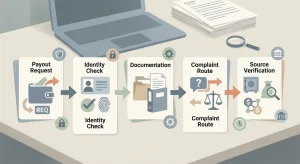
The guide explains how UK licensing differs from offshore arrangements, including complaint routes, exclusion boundaries and payment risks.
What a UKGC Licence Covers
A UK Gambling Commission licence is the regulatory requirement for an operator serving customers in Great Britain. The requirement applies regardless of where the operator is based: a company’s overseas headquarters do not remove the need for a UKGC licence when it provides gambling services to this market.
This makes the licence relevant to the operator’s activity, not simply to its country of incorporation. A business may be located outside Britain and still fall within the licensing requirement if it serves customers here. Conversely, a casino’s name, website presentation or general description does not by itself establish that the operator holds the necessary permission. The central question is whether the business supplying the service to customers in Great Britain is licensed by the UK Gambling Commission.
The regulator and the licensed market
The UK Gambling Commission is the public authority responsible for licensing gambling operators in Great Britain. In the online casino context, its licence marks an operator as authorised to serve this market under the British regulatory system. It is therefore more than a label used in advertising: it identifies the regulatory framework under which the operator is permitted to conduct the relevant business.
For UK readers considering casinos not licensed by the UK Gambling Commission, this list offers a concise reference point. Check the relevant terms and licensing information before deciding whether to play.
1. NightLuck
Payout speed: 1-3 business days NightLuck lists a payout speed of 1–3 business days.
2. Jetsetspins
Payout speed: 1-3 business days Jetsetspins lists a payout speed of 1–3 business days.
3. SpinFormula
Payout speed: 1-3 business days SpinFormula lists a payout speed of 1–3 business days.
4. Revery Play
Payout speed: 1-3 business days Revery Play lists a payout speed of 1–3 business days.
5. WinBeast
Payout speed: 1-3 business days WinBeast lists a payout speed of 1–3 business days.
6. x3bet
Payout speed: 1-3 business days x3bet lists a payout speed of 1–3 business days.
7. SlotoSport
Payout speed: 1-3 business days SlotoSport lists a payout speed of 1–3 business days.
8. BeOnBet
Payout speed: 1-3 business days BeOnBet lists a payout speed of 1–3 business days.
9. Zombillion
Payout speed: 1-3 business days Zombillion lists a payout speed of 1–3 business days.
10. NightWin
Payout speed: 1-3 business days NightWin lists a payout speed of 1–3 business days.
The requirement concerns operators, rather than the physical location of their servers, offices or owners. A company cannot avoid it solely by placing its operations elsewhere. Where the service is directed to customers in Great Britain, the operator’s base does not change the licensing rule.
The distinction between an operator and a casino brand also matters. A website may present itself under a consumer-facing name, while the company responsible for the gambling service is a separate legal entity. The licence relates to the regulated operator. For that reason, describing a site as “licensed” is meaningful only insofar as the relevant operating business is covered by the required permission. A brand name alone is not a substitute for the operator’s regulatory status.
What the licence establishes
At its most basic, a UKGC licence establishes that the operator has the required authorisation to serve customers in Great Britain. It provides a defined regulatory basis for the operator’s presence in the market. Without that basis, the service is not part of the UKGC-licensed online casino sector, even if the website is accessible or presents itself as available to British customers.
This is why “UKGC-licensed online casino” is best understood as a description of the operator’s status, rather than a general assessment of a website’s design, game selection or commercial appeal. Those features do not establish whether the business is licensed. Nor does the mere fact that a site accepts registrations or displays gambling products demonstrate that it has the required permission.
A licence also has a specific territorial context. The UK Gambling Commission’s requirement concerns operators serving Great Britain. It should not be treated as a general statement about every part of the United Kingdom, because the Gambling Act 2005 applies in England, Wales and Scotland, but not Northern Ireland. The regulated-market baseline described here is therefore the one applicable to Great Britain.
Malta-Licensed Online Casinos in the UK: MGA vs UKGC
Reading licensing claims accurately
References to “UKGC licensed online casinos” can create the impression that a casino website itself holds a licence in the same way a company does. In practical terms, the relevant status belongs to the operator supplying the gambling service. A clear assessment therefore distinguishes the public-facing casino brand from the company responsible for running it.
The same distinction applies when a search or directory presents a list of licensed casinos. Inclusion in a list is not, on its own, the licensing act; the underlying question remains whether the operator serving Great Britain holds the required UK Gambling Commission licence. A list may be useful as an index, but the word “licensed” refers to the operator’s authorisation, not merely to a listing or a claim made on a website.
The scope of this baseline is deliberately narrow: it identifies who must hold a UKGC licence to serve the British market and why the operator’s location does not alter that requirement. It does not make every casino-related claim interchangeable with licensing status. A site’s branding, accessibility or commercial wording cannot replace the relevant authorisation. In the regulated British market, the licence requirement attaches to the operator providing the service.
What “Non-UKGC” Means in Practice
“Non-UKGC” describes a casino’s relationship with the UK Gambling Commission (UKGC): the site operates without oversight from that regulator. The label is therefore about regulatory supervision, not a particular style of website, type of game or payment method. A casino can look similar to a UKGC-licensed casino while belonging to a different regulatory system.
Non-UK Licence Casinos: What Licensing Means
The phrase “casino sites without a UKGC licence” is often used as shorthand, but the key distinction is broader than the wording of a licence claim. A non-UK-regulated casino is an online gambling site that does not operate under UKGC oversight. It may be licensed by another jurisdiction; such sites are typically associated with regulators in Malta, Curaçao, Gibraltar or Anjouan. The term does not, by itself, identify which of those jurisdictions applies to a particular site.
The regulator, not the label
A casino’s description of itself is not enough to establish its regulatory status. Words such as “international”, “global” or “licensed” do not specify whether the UKGC supervises the operation. Likewise, calling a site a non-UKGC casino says only that UKGC oversight is absent; it does not name the authority that may license it.
This distinction matters because “non-UKGC” is a broad category rather than the name of a single regulator. A casino licensed in Malta and one licensed in Anjouan may both fall within the category if neither operates under UKGC oversight. Their shared classification does not make their licences interchangeable, or establish that their regulatory arrangements are the same.
The term is also not a description of where a company’s offices, staff or servers are located. It refers to the oversight under which the online gambling site operates. A site’s name, branding or apparent connection to a country cannot settle that question on its own. The relevant distinction is whether the UKGC oversees the casino, rather than whether the business presents itself as British or serves an English-language audience.
Why other jurisdictions appear
Non-UK-regulated casinos are commonly licensed in jurisdictions including Malta, Curaçao, Gibraltar and Anjouan. These names identify places whose authorities may issue gambling licences; they do not mean that every casino associated with a jurisdiction has a licence from its regulator. Nor does the presence of a jurisdiction’s name establish that a licence belongs to the particular website being described.
Curacao Casino Licence in the UK: What It Means
The phrase “licensed outside the UKGC” can therefore refer to more than one arrangement. It may describe a site holding a licence from one of these jurisdictions, but the broad term alone does not reveal the issuing authority. A casino described as non-UKGC may also be discussed simply as a site outside the UKGC system. Those expressions point to the same basic distinction: UKGC oversight is not the framework governing the site.
It is useful to keep the category separate from claims about quality or reliability. “Non-UKGC” is a regulatory classification, not a verdict that a casino is safe, unsafe, reputable or disreputable. The label alone does not establish the terms a site applies, how it handles a particular transaction, or what process it uses to address a complaint. Those matters require separate information and should not be inferred from the regulator’s name.
A limited description
The category is not a complete account of a casino’s status. It identifies the absence of UKGC oversight, while leaving open which other jurisdiction, if any, licenses the site. “Typically licensed” is not the same as “always licensed”: the broad description does not establish that every site in the category holds a current foreign licence.
Malta
One of the jurisdictions where non-UK-regulated casinos are commonly licensed.
Curaçao
An authority that frequently issues licences to casinos operating outside UKGC oversight.
Gibraltar
A jurisdiction commonly associated with non-UK-regulated gambling operators.
Anjouan
An issuing authority for licences to casinos that are not overseen by the UKGC.
For the same reason, “non-UKGC casino sites” should not be treated as a single uniform group. The jurisdictions commonly associated with them are distinct, and the phrase does not say which regulator applies to an individual operation. It is a useful starting classification, but a more specific description requires naming the relevant licensing jurisdiction.
In practical terms, the label separates UKGC-supervised casinos from online gambling sites outside that regulator’s oversight. It does not, on its own, provide a full account of a site’s licence or operating arrangements. A non-UKGC casino may be licensed elsewhere, commonly in one of the jurisdictions listed above, but the general term does not establish which one.
The UK Legal Position on Overseas Gambling Sites
The legal position turns on the operator’s activity, not simply on where a company is incorporated. Under the Gambling Act 2005, a remote gambling operator supplying services to customers in Great Britain must hold a licence from the UK Gambling Commission. This requirement applies even when the operator is based abroad. A licence issued by another jurisdiction does not replace the British operating licence for services offered into that market.
That distinction matters when interpreting the phrase “non-UKGC casino”. It describes a site outside the UK Gambling Commission’s regulatory system; it does not, by itself, settle whether the operator is meeting its obligations in relation to British customers. If an operator supplies gambling services into Great Britain, its location overseas does not remove the licensing requirement. The relevant question for the operator is whether its activity brings it within the rules for serving the British market.
Casino Without a Swedish Licence: UK Guide
The framework therefore concerns more than the operator’s registered address or the jurisdiction named in its terms. An overseas company may hold a licence elsewhere, but that fact alone does not establish that it is authorised to serve customers in Great Britain. Equally, a site’s accessibility from Britain should not be mistaken for proof that its operation complies with British licensing rules. Availability and authorisation are separate matters.
Operators and individual players
The Act’s focus on operators should be distinguished from the position of individual users. The legislation targets businesses supplying gambling services into the UK market, rather than making the customer the object of that licensing duty. British law does not expressly bar citizens from using gambling services that are licensed in other countries. These points can coexist: the operator may be subject to a British licensing requirement when serving the market, while the legal rule described here is directed at the operator rather than at the player.
This distinction should not be turned into a broader claim that every overseas-licensed site is lawful for British customers to use, or that a foreign licence gives an operator permission to target the British market. Nor does the absence of an express prohibition on citizens using another country’s service amount to confirmation that the service is authorised in Great Britain. The legal position of the operator and the position of the individual customer are related, but they are not interchangeable.
British law does not expressly bar citizens from using gambling services that are licensed in other countries, though the operators themselves must hold a UKGC licence to supply services into the Great Britain market.
The term “British citizens” can also obscure the market-based nature of the operator rule. The licensing obligation concerns supplying services into Great Britain; it is not framed simply as a rule about the citizenship of each customer. A company’s overseas base does not, on its own, determine whether the British requirement applies. The relevant point is whether it is supplying gambling services into the market covered by that requirement.
What the distinction does—and does not—establish
For non-UKGC casinos UK users may encounter online, three propositions should be kept separate. First, operators serving customers in Great Britain require the relevant UK Gambling Commission licence, irrespective of where they are based. Second, a licence from another country does not itself satisfy that requirement. Third, British law does not explicitly prohibit citizens from using gambling services licensed abroad. None of these propositions changes the others.
The label “non-UKGC” alone cannot establish the operator’s precise activities, the terms under which a service is offered, or how a particular situation would be treated. Likewise, the fact that a service is licensed abroad does not establish that it has UKGC authorisation.
The practical implication is that statements about the customer should not be confused with statements about the operator. Saying that the Act’s licensing target is the business does not mean the service is authorised for the British market. Saying that citizens are not expressly prohibited from using a foreign-licensed service does not remove the operator’s obligation where it supplies gambling services into Great Britain. Any assessment of a specific service also requires attention to the applicable local law and to the implications of using a service operating outside the British licensing framework.
Non-GAMSTOP Curaçao Casino Sites: What Claims Mean
Assessing Claims About the “Best” Non-UKGC Casinos
A label such as “best” implies that operators have been assessed against consistent criteria and that the evidence supports a comparison. Without comparable, current information about their offers and how those offers work in practice, a ranking of non-UKGC casinos cannot be substantiated. A prominent bonus or an assertion that a site is trusted does not, by itself, establish that it offers better terms or a more reliable experience.
Bonus figures need particular care. A specialist review has reported offshore welcome offers with wagering requirements of 35x or more. That figure should be treated as a report about an offer, not as a standard applying across non-UKGC casinos. The terms can vary between operators and promotions, and a headline figure does not explain how much must be wagered before winnings become withdrawable.
The calculation base matters. A specialist review has reported an offer with a 40x wagering requirement, while noting that the multiplier may apply to the bonus and deposit together, to the bonus alone, or to the bonus and free spins collectively. Those arrangements produce different obligations even when the displayed multiplier is identical. Comparisons that state only “40x” therefore omit information necessary to understand the offer.
The terms attached to a promotion should be read as a set, rather than reduced to its headline amount or multiplier. In particular, the wording should make clear which funds or winnings are subject to wagering and what must happen before a withdrawal can be made. If the offer describes several components, such as a deposit bonus and free spins, it is important to establish whether they are treated separately or combined. A large advertised offer cannot be evaluated on its face when the applicable calculation is unclear.
Do
- Compare the headline offer with the specific wagering rule.
- Establish if the multiplier applies to the bonus, deposit, or both.
- Check if free spins are treated separately or combined with the bonus.
Don’t
- Accept a ranking of “best” casinos without transparent criteria.
- Rely on a headline bonus figure without reading the full terms.
- Assume a reported multiplier is a standard applying to all sites.
This also limits what can be concluded from “trusted” or “legit” descriptions. Such labels are not measurements. A ranking would need transparent criteria, evidence that the same criteria were applied to each casino, and terms sufficiently clear to support a like-for-like comparison. Without that foundation, ordering sites from best to worst risks presenting an editorial judgement as a verified finding.
A more useful assessment focuses on the exact promotion and its written conditions. The headline offer should be compared with the wagering rule that governs it, including whether the deposit is part of the calculation and whether free spins are included. The distinction is material: the same multiplier can represent a different wagering obligation depending on its base. Claims should also be treated as time-sensitive, since promotions and their terms may change; a review describing an earlier offer cannot establish what is available now.
Accordingly, claims about the best non-UKGC casino sites in the UK should not be accepted as a ranking unless the comparison explains its method and supports it with current, comparable terms. Where those elements are absent, the more defensible conclusion is limited: the promotion may be attractive in presentation, but its value cannot be determined from the headline alone. A reported multiplier is a detail to scrutinise, not proof that one casino is superior to another.
Non-UKGC Casinos and GamStop: What the Exclusion Boundary Means
GamStop is the UK Gambling Commission’s self-exclusion scheme. Casinos outside it are not connected to that scheme, so a GamStop exclusion does not apply across every gambling website. In particular, it does not block access to a non-UK-regulated casino simply because an exclusion has been registered.
Non-Gamban casinos in the UK: what exclusion means
This is a limit of the scheme’s reach, not evidence that a site is part of the UK-regulated system. The expressions “UKGC casino without GamStop” and “UKGC casino not affected by GamStop” can blur two separate questions: whether a casino is within the Commission’s regulatory framework and whether it participates in GamStop. A casino’s absence from the scheme does not, by itself, establish its regulatory status. The wording should not be treated as proof that a site is UKGC-licensed.
For someone who has self-excluded, the practical distinction is important. GamStop applies within its participating network; it is not a universal block on gambling services. A site outside the scheme may remain accessible, and the exclusion does not automatically carry over to it. Descriptions such as “not blocked by GamStop” refer to this boundary. They do not mean the site has been assessed or approved by the Commission, or that the exclusion has stopped working at participating operators.
The limitation also concerns safeguards. Playing at an offshore casino means losing access to the UK’s Financial Ombudsman Service and to responsible-gambling tools that are mandatory within the UK regulatory system. The absence of a GamStop connection should therefore not be confused with an equivalent alternative. A site may describe its own controls, but that is distinct from participation in the UK scheme and does not establish that the same protections apply.
Self-exclusion is intended to create a barrier to gambling, but a boundary around participating services cannot prevent access to every site outside it. This can make an exclusion less effective if gambling continues through accounts or services beyond the scheme. The distinction is particularly relevant when a site’s marketing foregrounds its availability to people seeking a way around a block: availability is not a safeguard, and it does not restore access to UK complaint or protection arrangements.
Playing at an offshore casino means losing access to the UK’s Financial Ombudsman Service and mandatory responsible-gambling tools required by the UK regulatory system.
Accordingly, “casinos not on GamStop” describes a relationship to the self-exclusion scheme, not a quality rating or a guarantee about how a particular operator handles gambling harm. Likewise, “UKGC casinos outside GamStop” is an ambiguous label rather than a reliable description of licensing. The relevant point is whether the service participates in GamStop; if it does not, the exclusion should not be assumed to cover it.
The boundary matters most when self-exclusion is being relied on as a protective measure. It is not a general internet filter, nor does it make every non-participating site subject to UK safeguards. The scheme’s reach and the protections available at an individual casino are separate matters, and the first does not establish the second.
Anjouan Licensing: Scope, Complaints and Dispute Resolution
An Anjouan casino licence has a defined territorial scope: it does not authorise an operator to serve customers in the United Kingdom or in other markets listed as restricted. A licence issued there should therefore not be treated as permission to operate in every country where a website can be accessed. The distinction is relevant when assessing non-UKGC-regulated casinos: the presence of an Anjouan licence does not make an operator UKGC-regulated or establish that it is authorised for the British market.
The framework also sets limits on what its authority does when a player disputes an outcome or an account decision. The Anjouan authority does not handle, mediate or adjudicate individual player complaints. Anjouan-licensed casinos are not required to offer an independent dispute-resolution process comparable to the approved alternative dispute resolution services associated with UKGC-regulated casinos. A complaint made to the operator is therefore not equivalent to an appeal to an independent adjudicator.
Under the framework, an operator must respond to a complaint within 30 calendar days. This is a response requirement, not a guarantee that the complaint will be resolved in the player’s favour. Nor does it establish an independent route for reviewing the operator’s decision. Where the response is unsatisfactory, the stated arrangements do not provide the equivalent of a UKGC-approved ADR service to take the dispute forward.
This difference matters when interpreting non-UKGC casino reviews or claims that a site has a formal complaints process. The existence of a procedure for submitting a complaint says little on its own about who examines it, whether that person or body is independent, or what recourse follows an unresolved dispute. For an Anjouan-licensed operator, the framework’s stated response period should not be presented as evidence that the regulator will intervene in an individual case.
The licence’s limits also affect how promotional descriptions should be read. Terms such as “licensed” identify a regulatory status only within the scope of the licence concerned; they do not establish authorisation in the United Kingdom. In particular, describing a site as a non-UKGC-regulated casino does not itself explain whether its licence permits service in a particular market. Anjouan’s restriction on UK operation is explicit, so its licence cannot be relied on as UK authorisation.
No Independent Redress
Anjouan-licensed casinos are not required to offer an independent dispute-resolution process, and the authority does not handle or adjudicate individual player complaints.
For complaints, the relevant distinction is between an operator’s internal response and external dispute resolution. Anjouan’s framework requires the former within the stated period, but does not require the latter through an independent service comparable to UKGC-approved ADR. The authority itself does not take on the role of mediator or adjudicator. Consequently, the framework provides a narrower complaint pathway than one in which an independent body can review a dispute. It is important not to conflate the existence of a licensing framework with the availability of independent redress: in this case, those are separate matters, and the stated arrangements do not make the Anjouan authority a forum for player complaints.
How Offshore Safeguards Differ from UKGC Standards
A UKGC-licensed casino operates under the UK Gambling Commission’s regulatory framework. A non-UK-regulated casino sits outside that system, so the protections attached to a UKGC licence cannot be assumed to apply. This distinction matters for responsible-gambling measures and for the handling of personal information.
The available evidence supports a qualified comparison: non-UK-regulated casinos may apply less stringent responsible-gambling and data-protection rules than operators licensed by the UKGC. “May” is important. Standards can differ between operators and licensing jurisdictions, so the category alone does not establish exactly which safeguards a particular site provides. Nor does a claim to hold a foreign licence show that its protections are equivalent to UK requirements.
Responsible-gambling safeguards concern the measures available to reduce or manage gambling activity. At a non-UK-regulated casino, their scope and operation may not match the mandatory tools associated with a UKGC-licensed casino. A policy page can describe a site’s own procedures, but that description does not by itself demonstrate that the procedures meet UKGC standards or are enforced in the same way. Players at such sites also do not have access to the UK’s mandatory responsible-gambling tools.
Data protection is a separate issue. Less stringent rules may affect how a casino is expected to handle personal information, but that possibility should not be treated as proof that every non-UK-regulated operator mishandles data. Conversely, the presence of a privacy statement is not evidence that the protections are equivalent to those required of a UKGC-licensed operator. The relevant question is what rules govern the operator and what commitments it makes, rather than whether its wording sounds reassuring.
These limits make broad comparisons unreliable. A non-UK-regulated casino might describe safeguards on its own terms, while the UKGC framework sets requirements for licensed operators serving Great Britain. Without evidence about a particular operator’s governing rules and practices, it is not possible to establish that its protections are equivalent. A foreign licence should therefore not be read as a substitute for UKGC oversight, and the absence of that oversight has practical significance for both gambling-related protections and personal data.
Offshore Payments and the Limits of “Safe” Claims
Payment options at offshore non-UKGC casinos can include credit cards, e-wallets, bank transfers and cryptocurrencies. Some transactions are handled through alternative processors rather than directly by a familiar payment brand. The range of methods may make an account appear accessible, but it does not establish that the casino is regulated in the UK or that a payment will be protected if a dispute arises.
Cryptocurrency has a specific relationship to UK payment rules: crypto payments can bypass the UK ban on gambling funded by credit cards. That describes how a payment route may work; it is not evidence that the casino has stronger oversight or that the transaction carries the protections associated with a regulated service. Nor does the availability of a deposit method, by itself, show that the same method can be used to withdraw funds.
Cryptocurrency payments at offshore casinos can be used to bypass the UK ban on gambling funded by credit cards.
The word “safe” is therefore too broad to infer from a cashier page. A displayed card, e-wallet or cryptocurrency option indicates that the operator says it accepts that method. It does not, on its own, establish the operator’s regulatory status, the handling of funds, or the outcome of a complaint. The same caution applies to labels such as “trusted”: payment convenience is not a substitute for evidence about the operator.
This distinction matters when comparing offshore services with UKGC-licensed real-money casinos. A familiar processor may be involved in both settings, but the presence of that processor does not make an offshore casino equivalent to a UK-regulated one. Payment arrangements describe the route by which money may move; they do not determine which regulatory framework applies.
Accordingly, payment availability is a limited fact, not a general assurance. It can identify possible ways to fund an account, including routes that do not use a credit card. It cannot, on its own, support a conclusion that a non-UK-regulated casino is safe or that deposited funds will necessarily be recoverable.
Risks at Casinos Outside UKGC Regulation
Using a casino that lacks a UK Gambling Commission licence does not, by itself, make a player’s conduct a criminal offence under UK law. That legal point does not remove the financial risks of gambling with an operator outside the UKGC system. A player may have limited practical recourse if the operator withholds funds or ceases trading; the specific exposure depends on the operator and the terms governing the account.
The risk is particularly clear where an operator holds an Anjouan casino licence. That licence does not guarantee that customer funds are kept separate from the operator’s own money. If the business fails, players are unsecured creditors rather than holders of protected or segregated funds. Recovery can therefore depend on what remains available to creditors and how the failure is handled; repayment of a balance cannot be assumed.
Non-UK regulated casinos: UK licensing explained
This distinction matters when interpreting claims about legality and safety. The absence of a criminal offence for the player is not a guarantee that deposits or winnings can be recovered. Nor does a foreign licence provide the same position as a UKGC licence for services supplied to the British market. The central concern is the player’s exposure if the operator cannot or will not pay, especially where funds have not been ring-fenced.
Checking an Online Casino Licence and Its Complaint Process
A licence claim should be checked against the regulator’s own records, rather than accepted from a badge or statement on a casino website. For an operator presenting itself as licensed by the UK Gambling Commission, the register should show a current operating licence, and the listed company should match the business named in the casino’s terms. This is the relevant check for online casino sites serving customers in Great Britain.
For a site outside the UKGC system, the same basic questions apply: which company holds the licence, which authority issued it, and is the authorisation still current? The licence holder and the operator named in the site’s legal documents should correspond. A licence number alone does not establish that the casino is authorised to serve customers in the UK.
Anjouan claims require particular care. The Anjouan casino licence does not permit operation in the United Kingdom or other restricted markets. Its presence therefore cannot be treated as evidence of UKGC authorisation. The public register entry, licence status and company name should all be checked before relying on the claim.
The complaints route also needs to be read separately from the licence claim. Under Anjouan’s framework, an operator must respond to a complaint within 30 calendar days. That response requirement does not provide access to the UK Gambling Commission’s complaint process or amount to a UKGC-approved independent dispute route. A stated timeframe is not, by itself, evidence that a complaint will be resolved in the player’s favour.
Is it legal for a UK player to gamble at an Anjouan-licensed casino?
UK law does not explicitly prohibit players from using gambling services licensed abroad, and players do not commit a criminal offence by gambling on an unlicensed site. However, an Anjouan licence does not authorise an operator to serve the UK market.
What happens if I have a dispute with an Anjouan-licensed casino as a UK player?
The Anjouan authority does not mediate or decide player complaints, and these casinos do not offer an independent dispute-resolution route comparable to UKGC-approved ADR. Under Anjouan’s framework, the operator must respond to complaints within 30 calendar days.
Are Anjouan-licensed casinos safe and fair?
An Anjouan licence does not guarantee RNG testing, audits or segregation of player funds. If the operator fails, players may be unsecured creditors.
Are sites that are not on GamStop legal for players in the UK to access?
UK law does not explicitly prohibit players from using gambling services licensed abroad, and players do not commit a criminal offence by gambling on an unlicensed site. Operators serving customers in Great Britain are nevertheless required to hold a UKGC licence, and casinos not on GamStop are outside that self-exclusion scheme.
Can UK players legally play at casinos licensed in Anjouan?
UK law does not explicitly prohibit players from using gambling services licensed abroad, and players do not commit a criminal offence by gambling on an unlicensed site. An Anjouan licence does not authorise the casino to serve the UK market.
Are Anjouan casinos connected to the GamStop self-exclusion scheme?
No. Casinos not on GamStop are not part of the UK Gambling Commission’s self-exclusion scheme.
Material created by the team NationalBet Casino UK