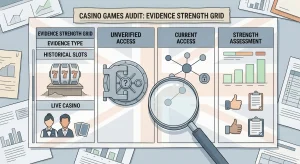
Licensing, game information, costs, payment timing and player-protection tools offer evidence beyond a site’s design or promotions.
What Makes a Casino Site Suitable for Slot Play?
A useful comparison of online casino sites begins with evidence about how they are authorised and how their games are tested. Design, range and promotional presentation may distinguish one platform from another, but they do not establish that slot outcomes are generated fairly or that a service is suitable for the British market. Those questions require evidence of a different kind.
Licensing is the first threshold
For real-money casino services offered to customers in Great Britain, a current operating licence from the UK Gambling Commission is a basic condition of legal operation. The Commission’s regulatory framework sets requirements intended to support fair play, transparency and player protection. A general assessment should therefore distinguish between a platform’s own claims and its status as a licensed operator.
A licence is a threshold, not a complete verdict. It establishes that an operator falls within the UK regulatory system; it does not show that every feature will suit every player, or that a particular slot will produce a favourable result. Nor does a broad label such as “regulated” explain which activity is covered. Comparisons are more informative when they refer specifically to UK Gambling Commission authorisation rather than relying on an unqualified assurance of oversight.
Choosing a UK slots site involves more than finding games; it is also worth checking practical details such as how quickly payouts are listed to take. Use these entries as a concise reference when considering your options for 2026.
1. NightLuck
Payout speed: 1-3 business days NightLuck lists a payout speed of 1–3 business days. That is the available practical detail for assessing it here.
2. Jetsetspins
Payout speed: 1-3 business days Jetsetspins lists a payout speed of 1–3 business days. This provides a simple point of reference when considering the site.
3. SpinFormula
Payout speed: 1-3 business days SpinFormula lists a payout speed of 1–3 business days. No other operator details are available for this verdict.
4. Revery Play
Payout speed: 1-3 business days Revery Play lists a payout speed of 1–3 business days. This is the only specific detail available to note.
5. WinBeast
Payout speed: 1-3 business days WinBeast lists a payout speed of 1–3 business days. Keep this stated timeframe in mind when reviewing the site.
6. x3bet
Payout speed: 1-3 business days x3bet lists a payout speed of 1–3 business days. That is the available detail to guide a practical assessment.
7. SlotoSport
Payout speed: 1-3 business days SlotoSport lists a payout speed of 1–3 business days. No further specifics are provided here.
8. BeOnBet
Payout speed: 1-3 business days BeOnBet lists a payout speed of 1–3 business days. This is the only stated operator attribute available.
9. Zombillion
Payout speed: 1-3 business days Zombillion lists a payout speed of 1–3 business days. This offers one concrete detail for a reader to consider.
10. NightWin
Payout speed: 1-3 business days NightWin lists a payout speed of 1–3 business days. No other specific information is available for this entry.
This distinction also prevents a common error in recommendation language. Calling a site one of the best UK online casinos can imply that a single ranking captures legal status, game quality, transparency and personal suitability at once. These are separate questions. A defensible comparison should state what evidence supports each judgement and avoid turning one verified feature into a claim about the whole service.
Independent testing and what it establishes
UKGC-licensed operators must use a certified random number generator examined by an independent testing house approved for that work. This is relevant evidence for slot play because the random number generator is part of the mechanism that determines game outcomes. Independent examination is a stronger basis for assessing that mechanism than an operator’s unsupported statement that its games are fair.
The scope of that evidence should nevertheless be described carefully. Certification and examination relate to the tested system and the standards applied to it; they do not predict the outcome of a future spin, guarantee a win, or establish that a player will have a positive experience. A general recommendation should not treat a testing reference as proof of every broader claim about a casino.
The quality of the evidence matters as well as its presence. A comparison can distinguish between a specific statement about a certified random number generator and a vague assurance that games are “independently verified”. It can also avoid implying that a named testing body has examined a platform unless that relationship is established. Without clear supporting detail, the weight of a claim cannot be assessed reliably.
Separate verifiable features from preferences
Suitability is partly dependent on what a player values. One person may place greater importance on a clear presentation of game information; another may prioritise the range of slots or the usability of the account interface. Those preferences can inform a comparison, but they should not be presented as objective evidence of fairness or regulatory standing.
5-Reel Slots in the UK: Free Play and Real-Money Rules
A useful review therefore separates observable facts from evaluative language. Licensing and independent testing are matters that can be checked against identifiable evidence. Descriptions such as “easy to use” or “strong selection” involve judgement and need a stated basis, such as the features examined or the comparison being made. Without that explanation, such labels are difficult to reproduce or compare.
The same care applies to recommendations framed around “best” slot sites. A ranking is meaningful only in relation to stated criteria. If the criteria combine regulatory status, testing evidence and subjective preferences without explaining their relative importance, the resulting order may look more conclusive than the underlying evidence permits. A general recommendation can identify relevant distinctions; it cannot establish that the same platform is the best choice for all players.
The limits of a general recommendation
A comparison can show whether an operator is authorised and whether its games rely on the required certified and independently examined random-number technology. It can also make clear which statements are supported and which remain matters of judgement. These points provide a more useful basis for comparing gambling casino sites in the UK than an unqualified endorsement.
Attention: Regulatory status and testing evidence are not guarantees of a positive experience or a favorable result for an individual player.
They do not settle every question about an individual account, game or future experience. Regulatory status and testing evidence should be understood within their scope, rather than as guarantees. A careful assessment is therefore explicit about what has been established, avoids claims that extend beyond that evidence, and treats “suitable” as a reasoned comparison rather than a universal conclusion.
How UK Rules Shape Online Slot Gambling
Online slot gambling in Great Britain operates within a licensing system rather than a general permission to offer games. Remote operators that provide gambling to people in England, Scotland or Wales must hold the relevant licence from the UK Gambling Commission (UKGC), even when the operator is based elsewhere. A site without that authorisation is outside the British regulatory system; the fact that it can be accessed online does not make it a licensed service for local players.
The legal framework has a territorial distinction. The Gambling Act 2005 governs gambling in England, Wales and Scotland, but not Northern Ireland. Across Great Britain, a current UKGC operating licence is required for an online casino to serve players legally. The rules therefore apply to the service being offered, not simply to where a company has its headquarters. For instance, a platform wishing to make Book of Kings available to players in the UK needs UKGC authorisation.
Classic Slots Online in the UK: How Play Works
Age is another condition of access. Online gambling is legal for people aged 18 and over when it takes place through a UKGC-licensed operator. Operators must establish a customer’s age before allowing a deposit into a gambling account. This makes age verification a prerequisite to funded play, rather than a check that can be postponed until a withdrawal is requested. Slot play is also subject to different stake limits for younger adults: the maximum stake per game cycle is £2 for customers aged 18 to 24, compared with £5 for those aged 25 and over. The £5 limit for all adults took effect on 9 April 2025.
The stake restriction applies to online slots, not to casino games generally. Roulette and blackjack are not subject to these slot-specific limits. This distinction matters because a casino platform may offer several game types under the same account, while the regulatory limit depends on the game being played. It would therefore be inaccurate to treat a site’s overall casino offering as though every game followed the slot stake rule.
The pace and automation of play are regulated as well. In Britain, an online slot spin must last at least 2.5 seconds, and autoplay is banned. A player cannot set a sequence of spins to run automatically, nor can a game complete a spin faster than the minimum duration. These requirements shape the mechanics of online slots rather than the outcome of any individual round. They apply to the way games are presented and played, not as a promise about winnings.
Payment rules also constrain how gambling accounts can be funded. UK-licensed casinos cannot accept credit cards for gambling, including where credit-card funds are routed through a money service business. Operators must also refuse wallet payments when the wallet permits credit-card funds to be used for gambling. The restriction concerns the source of funds, not merely the payment label displayed during a transaction.
Credit Card Ban
UK-licensed casinos cannot accept credit cards for gambling, including funds routed through a money service business or wallets that permit credit-card use.
For new customers, remote operators must prompt the setting of a financial limit before the first deposit and make account-level limit controls accessible. This is part of the operating environment, rather than a substitute for the statutory rules on age, licensing, stake size or game speed. Deposit and session limits also form part of the wider player-protection framework, but they do not alter what constitutes a licensed casino service.
Taken together, these requirements define the conditions under which online slots may be offered in Great Britain: the operator needs the appropriate UKGC licence, customers must meet the age requirement, and the game must comply with rules on stake size, spin duration and autoplay. The rules concern the service and its operation; they do not establish that every licensed game has the same features or produces the same results.
Real-Money Slots: Understanding RTP and House Edge
Return to Player (RTP) and house edge are two ways of expressing the same underlying proportion. RTP describes the share of stakes that a game is designed to return over time; house edge describes the share retained by the game. The terms therefore present the relationship from opposite perspectives, rather than measuring separate features.
A 90% RTP means that, across the play represented by the calculation, £90 is returned for every £100 bet. The remaining share corresponds to the house edge. This is a theoretical proportion, not a promise that an individual player will receive a particular amount back. It does not predict the result of a session, a spin or a sequence of spins. Results can vary, and a short period of play may differ substantially from the proportion stated.
Fruit machine slots in the UK: how online play works
This distinction matters when interpreting figures shown alongside real-money slots. An RTP percentage describes an expected return across play under the game’s mathematical model. It does not say that a player will recover that proportion of their own deposits, nor does it provide a timetable for returns. The measure is meaningful as a description of the game’s theoretical balance, but it is not a forecast for an individual account.
The UK Gambling Commission permits gambling risks to be communicated using RTP or house-edge percentages. Either can be informative, but a percentage may be difficult to interpret without understanding what it refers to. RTP is not a personal refund rate, while house edge is not a separate charge added to each spin. Both express the relationship between stakes and theoretical returns in a different form.
A 2014 UK Gambling Commission study found that some people unfamiliar with the gambling industry did not understand how RTP works. The study identified complex terminology, mathematical concepts and formulations, and information presented in English as factors that could contribute to misunderstanding. This is relevant because a figure can appear precise while its meaning remains unclear to someone reading it.
Clarity depends partly on how the percentage is explained. A bare RTP figure may invite an incorrect assumption that the same share of a player’s money will come back during their own play. Describing it as a long-run theoretical measure helps distinguish the statistical concept from an expected personal outcome. The house-edge framing can also make the retained share more visible, but it still requires the same understanding of the calculation.
For real-money online slot play in Great Britain, these figures can support comparisons between theoretical game characteristics. They cannot establish whether a casino site is suitable overall, and they do not show what will happen in a particular session. The percentage concerns the game’s return model; it should not be treated as evidence about account terms, customer support or other aspects of a platform.
Return to Player (RTP) and house edge are theoretical measures of a game’s mathematical model and do not predict the outcome of any individual session or spin.
Free slot machine play can display the same kind of theoretical game information, but it does not turn the stated RTP into a prediction of results. Whether play involves cash or no cash, the percentage remains a description of the game model rather than a guarantee about an individual run. Keeping that distinction in view is central to reading RTP and house edge without mistaking a statistical measure for a personal outcome.
Slot Machines and the Cost of Progressive Jackpots
A progressive jackpot is funded in part by wagers made on the slot that carries it. A specialist review describes each wager as contributing a share to the accumulating prize pool, rather than directing the whole stake towards the base game. It puts that contribution at between 1% and 3% of the total bet. This is a figure reported by that type of source, not a fixed rate established for every progressive slot.
The distinction matters because the jackpot contribution changes how the game’s return is divided. The base game pays for its own outcomes, while the amount taken from wagers for the pool is reserved for the progressive prize. A specialist review says this can leave the base-game Return to Player (RTP) in the 88–92% range, with the remainder going towards the jackpot. That range should be treated as the review’s description, not as a universal RTP for progressive games: individual game information may differ.
For someone comparing online slot machines in Great Britain, it is therefore important to distinguish the base-game figure from the jackpot element. A lower base-game RTP does not by itself show that the entire game’s theoretical return has been calculated on the same basis. The published description needs to make clear whether it refers to base-game play alone or accounts for the jackpot contribution and prize. Without that distinction, figures can appear to describe the same thing while representing different parts of the game.
The contribution is not a separate charge added after a spin. It is taken from the wager and routed into the shared pool as part of the game’s operation. That means the portion available to fund ordinary slot outcomes is smaller than it would be if the whole stake were allocated to the base game. In return, the pool can grow as eligible wagers are made. The size of the eventual prize is linked to that accumulation, but the contribution itself does not establish when a jackpot will be won.
Mega Moolah is an example of a progressive jackpot slot. Its presence in a casino catalogue does not, on its own, establish the contribution rate or the base-game RTP offered for a particular version. Those details belong to the game information shown for that version, rather than being safely inferred from the game’s name or jackpot format.
This structure also affects how a progressive slot should be compared with a non-progressive one. Looking only at the headline jackpot can obscure the share of each wager allocated to the pool; looking only at base-game RTP can omit the jackpot component. The relevant comparison is between clearly described figures on the same basis. If the published information does not separate those components, the contribution and return cannot be assessed precisely from the headline figures alone.
Progressive Jackpot Funding
Each wager contributes a share (typically 1% to 3% according to specialist reviews) to the accumulating prize pool. This reallocation can result in a base-game RTP in the 88–92% range, with the remainder funding the jackpot.
The jackpot is thus not simply an additional prize layered over an otherwise unchanged slot. Its funding mechanism reallocates part of the wager, affecting the base game’s stated return while building the pool. That cost-and-prize relationship is the central feature of progressive jackpot play.
Responsible Gambling Tools and Jackpot Chasing
Responsible gambling controls are relevant to slot play because outcomes are uncertain and a run of losses does not make a win more likely. A jackpot can intensify this pressure: its advertised size may encourage continued play, but each further spin remains a separate gamble. Continuing to spend in an attempt to recover losses or reach a particular prize can therefore increase financial harm without improving the chance that the next spin will win.
All UK Gambling Commission-licensed sites offer deposit limits, time-outs and self-exclusion. These controls serve different purposes. A deposit limit restricts how much can be added to an account; a time-out provides a temporary break; and self-exclusion blocks access to gambling for a chosen period under the applicable arrangements. Licensed operators must also provide loss limits, session reminders and access to support organisations. Their presence does not remove the risk of gambling, but it gives players ways to set boundaries and interrupt activity.
A limit is most useful when it is established before a session rather than adjusted in response to losses or jackpot progress. Remote operators must prompt new customers to set a financial limit before their first deposit and provide accessible account-level controls. Limits can help define a spending boundary, while session reminders can make elapsed play more visible. Neither changes the odds of a slot or guarantees that a set amount will be sufficient.
High-Volatility Slots UK: Features and Payouts
Jackpot chasing can undermine these safeguards when the prize becomes the reason to keep playing. A player may treat earlier losses as an investment that must be recovered, even though past spins do not determine the result of the next one. A pre-set limit can make that escalation harder, but it is not a prediction of when a jackpot will be won. If a limit is reached, continuing through another payment method or removing a safeguard would defeat its protective purpose.
Self-exclusion is a more substantial step than a time-out. It is intended to prevent gambling access rather than simply pause a session, and may be appropriate where temporary breaks have not controlled play. Support is also available through organisations such as GamCare and Gamblers Anonymous. Seeking support is distinct from changing account settings: controls address access and spending, while support can help with difficulties associated with gambling.
These measures apply to gambling through mobile sites as well as other access routes; using a phone does not make slot outcomes more predictable or remove the need for boundaries. Reviews of online casinos may describe account features, but their presence alone cannot establish that gambling is risk-free or that a jackpot is attainable within any particular session. A responsible assessment therefore considers whether the controls are accessible and usable, while recognising that they reduce neither uncertainty nor the possibility of loss.
Casino Apps, Deposits and Withdrawal Timing
Using a casino through an app or a mobile browser does not remove the need to check its payment terms. Deposit minimums and withdrawal estimates are set out in the account and payment information, and may depend on the payment method. The figures should therefore be treated as conditions reported for particular services, not as a fixed standard across Great Britain.
Minimum Deposits
Typically range from £5 to £10; lower amounts are more common with e-wallets, while higher amounts often apply to card payments.
Withdrawal Timing
Estimates vary from instant processing to five business days, often clustering at zero to 24 hours for e-wallets and one to three days for cards.
Verification
Age must be verified before the first deposit, and identity should be verified before the first withdrawal to avoid delays.
A specialist review of casino payment terms reported minimum deposits ranging from £5 to £10, with the higher amount more commonly associated with card payments and the lower one with e-wallets. That account provides a reference point, rather than a guarantee that a particular app will accept the same minimum. The amount shown before a deposit is made is the relevant condition for that account and method.
Withdrawals require a separate check. The same kind of specialist review described quoted timeframes ranging from instant processing to five business days. Its reported figures clustered at one to three days for cards and from zero to 24 hours for e-wallets. These are reported estimates, not a promise that funds will be available within a stated period. An app’s display may refer to processing by the operator; it should not be read as confirmation of when the receiving payment service will make funds accessible.
Account verification is also relevant to timing. Operators must verify age before allowing a customer to deposit, and identity should be verified before the first withdrawal to avoid preventable delays. Completing requested checks before making a withdrawal can reduce the risk of the payment being held while the account is reviewed.
Payment options are subject to restrictions. UK-licensed casinos cannot accept credit cards for gambling, including credit-card funds routed through a money-service business. They also cannot accept wallet payments where the wallet allows credit-card funds to be used for gambling. A payment method appearing on a device does not, by itself, establish that it can be used for a gambling transaction.
Bonus Buy Slots in the UK: How They Work
A practical comparison of casino apps should therefore focus on the minimum shown for the intended deposit method, the stated withdrawal estimate, and the verification requirements attached to the account. These details are more useful than a general claim that an app offers fast payments: the terms can differ between methods, while the estimates reported by a specialist review do not establish a current timetable for every operator.
Slot Availability and How Game Information Is Published
Slot information is not presented uniformly across online casinos. A game’s title and rules may be available while its Return to Player (RTP) figure is absent. Some software developers publish RTP figures for their slot machines; others do not. This difference limits how readily a player can compare games using published percentages alone. An unlisted figure should not be treated as evidence that a game has no RTP, or that its return is higher or lower than another game’s.
Where an RTP is shown, it describes a theoretical return over play, not a prediction of what a particular player will receive. Results in an individual session can differ from that long-term measure. Actual returns are therefore not interchangeable with a game’s stated theoretical RTP, even when both are expressed as percentages. The distinction matters when information is presented without explaining which kind of figure is being reported.
A specialist review has reported that a growing minority of UK operators publish monthly actual RTP figures alongside theoretical returns, separated by game category. This is a report about a developing practice, not evidence that such reporting is standard across UK online gambling. Its usefulness also depends on what the figures cover and how clearly the reporting method is described. A category-level result does not necessarily show the actual return for a particular slot, and it should not be read as a forecast of future results.
Do
- Distinguish between theoretical RTP and actual recorded returns
- Check the reporting period and category for actual RTP figures
Don’t
- Treat an unlisted RTP as evidence of a higher or lower return
- Mistake a category-level result for a specific slot’s forecast
For UK online slot gambling, game pages and operator information can therefore be checked for the type and scope of any published figure. A theoretical RTP belongs to the game information; an actual figure refers to recorded outcomes over a stated reporting period. If the period, category or method is unclear, comparisons may be difficult to interpret. Where the developer does not publish RTP, the absence of a figure leaves less information for comparison, rather than supplying a basis for an estimate.
These distinctions apply whether a slot is accessed through a casino website or another interface. The availability of a game and the availability of detailed performance information are separate matters. UK Gambling Commission licensed casinos operate within the British regulatory framework, but that status alone does not establish that every game’s RTP is published or that reported actual returns will match theoretical expectations over a short period. Published information is most useful when its meaning is explicit and its limits are kept in view.
Free Slots, Free Spins and Their Limits
Free slot play and free-spin offers are not the same as unrestricted cash winnings. A game in a free-play mode can allow its features to be explored without placing a cash stake, but any balance shown in that mode does not thereby become withdrawable money. Free spins, by contrast, are promotional rounds attached to an offer. Their terms determine whether winnings can be withdrawn and whether a cap applies.
The distinction matters because the headline number of spins does not describe the value that can be taken out. A promotion may award winnings from the rounds while limiting the amount eligible for withdrawal. A specialist review reports that free-spin winnings can be capped between £50 and £100, and says that such a cap rules out a jackpot payout. This is a report about the terms described in that review, not a universal rule for every offer. The applicable promotion terms remain decisive.
No-deposit offers also require separate scrutiny. A specialist review reports maximum withdrawal caps between £50 and £100 for winnings from these offers. That figure should not be treated as a market-wide standard: the cap is a condition attached to a particular promotion and can differ between offers. The relevant question is not simply whether an offer is described as free, but what happens to winnings after play and what maximum amount, if any, can be withdrawn.
“Free” therefore describes how the promotional play is provided, not necessarily the status of its proceeds. A cash balance may remain conditional, be subject to a stated ceiling, or fail to qualify for withdrawal under the offer’s rules. The wording of the promotion should be read alongside its full terms, especially any clause specifying a maximum cash-out or excluding jackpot winnings. A claim that spins are free does not establish that all resulting winnings are payable.
Free online slots can also refer to games played without a promotional offer. That is distinct from free spins credited to an account and from no-deposit promotions that may produce a withdrawable balance subject to conditions. These categories should not be conflated when assessing what an offer provides.
Attention: Free spins and no-deposit offers often include withdrawal caps (reported between £50 and £100) and may specifically exclude jackpot winnings.
In Great Britain, online gambling is legal for players aged 18 and over when the operator holds a UK Gambling Commission licence. That legal condition does not remove promotion-specific restrictions. The practical value of a free offer depends on its written terms, including the treatment of winnings and any withdrawal cap—not on the number of spins alone.
Bonus Offers and the Turnover They Require
A casino bonus is not simply an amount added to a balance. Where wagering requirements apply, the bonus terms set a turnover target: the total value of qualifying stakes that must be placed before a withdrawal can be made. Turnover is not the same as money lost, but meeting the target still requires gambling activity, and the result of that activity is uncertain.
The calculation depends on the multiple and on which funds it applies to. A specialist review gives the example of a 100% match to £50 with wagering of 35 times the bonus only. On those terms, the bonus is £50, and the required turnover is £1,750 before withdrawal. The deposit is not included in that calculation because the stated requirement applies to the bonus alone. A requirement applied to both the deposit and bonus would produce a different target.
A separate specialist review describes wagering requirements of 40 to 60 times as standard and illustrates the effect with a £10 bonus: the stated turnover would be £400 to £600 before withdrawal. This is a reported description, not a guarantee that every offer uses those terms. The offer’s own conditions determine the actual calculation, so a headline match percentage cannot establish the amount of play required.
The distinction between bonus-only and deposit-plus-bonus wagering is especially important. A requirement can look modest when expressed as a multiple, yet the eligible balance used in the calculation may make the turnover substantial. Terms should also be read for rules on which games count, whether different games contribute differently, how long the offer remains available, and what happens if the requirement is not completed. These conditions cannot be inferred from the bonus amount alone.
JetX Casino Game in the UK: What to Know
The same caution applies to no-deposit casino offers. The absence of a deposit requirement does not, by itself, establish that winnings can be withdrawn without conditions. Any wagering requirement and withdrawal restrictions need to be assessed from the offer terms. A useful comparison therefore records the bonus basis, the qualifying turnover, and the conditions attached to withdrawal, rather than relying on the advertised match alone.
Assessing Newly Launched UK Casino Sites
A new online casino has little operating history to assess, so its own claims carry less evidential weight than verifiable regulatory and testing information. In Great Britain, operators serving players must hold the relevant UK Gambling Commission licence. The licence establishes that the operator is authorised within the British regulatory system; it does not, by itself, show how a newly launched platform will perform over time.
UKGC-licensed operators must use a certified random number generator (RNG) examined by an independent testing house approved by the Commission. Evidence of that examination can support a specific conclusion: the RNG has undergone independent testing. It cannot establish every aspect of the casino’s operation, nor does it amount to a record of how the site has handled customers over an extended period.
A specialist review describes RNG certificates as typically lasting 12 months, with spot checks during the certificate period. That is a reported practice, not a universal guarantee about every certificate or operator. Certificate information should therefore be read in context: it may indicate the scope and status of testing, but it cannot replace confirmation that the operator’s licence is current.
For newly launched UK casino sites, the distinction between a documented requirement and a broader promotional claim matters. A statement about a certified RNG can be checked against testing evidence; claims about reliability or long-term service cannot be established merely by a launch announcement or a certificate. Limited operating history leaves those wider questions open, even where licensing and testing requirements are met.
Material created by the team NationalBet Casino UK