GamStop applies to UKGC-licensed gambling businesses, while casinos outside that jurisdiction may fall under different rules and protections.
What “Not on GamStop” Means in the UK
GamStop is a self-exclusion service for people who want to block their access to participating gambling businesses. A person who registers with the service is restricted from gambling with establishments licensed by the UK Gambling Commission (UKGC). The scheme is therefore tied to the UKGC’s regulatory jurisdiction, rather than being a register that covers every casino available online.
The phrase “casinos not registered with GamStop” can be misleading. It is players who register with GamStop; gambling operators are required to participate in the scheme when they hold a UKGC licence. In ordinary usage, a casino described as “not on GamStop” is one that does not take part in the service. The label does not identify a separate UK licence category, nor does it explain by itself where an operator is based or what rules apply to it.
This distinction matters because GamStop’s reach follows the licensing framework. UKGC-licensed operators must participate, so their services are subject to GamStop restrictions for registered users. A casino outside the UKGC’s jurisdiction is not included in that scheme. Accordingly, the question of which casinos are not registered with GamStop is not answered simply by looking for a missing entry in a universal operator register: the relevant distinction is whether the casino falls within the UKGC system and is required to participate.
If you are considering a casino site not registered with GamStop, take time to check whether it is suitable for you and what gambling safeguards it offers. The details below provide a limited point of reference, not a substitute for checking the site’s terms and your own needs.
1. NightLuck
Payout speed: 1-3 business days NightLuck lists a payout speed of 1–3 business days.
2. Jetsetspins
Payout speed: 1-3 business days Jetsetspins lists payouts as taking 1–3 business days.
3. SpinFormula
Payout speed: 1-3 business days SpinFormula’s stated payout speed is 1–3 business days.
4. Revery Play
Payout speed: 1-3 business days Revery Play lists a payout timeframe of 1–3 business days.
5. WinBeast
Payout speed: 1-3 business days WinBeast’s listed payout speed is 1–3 business days.
6. x3bet
Payout speed: 1-3 business days x3bet states a payout speed of 1–3 business days.
7. SlotoSport
Payout speed: 1-3 business days SlotoSport lists payouts as taking 1–3 business days.
8. BeOnBet
Payout speed: 1-3 business days BeOnBet’s stated payout speed is 1–3 business days.
9. Zombillion
Payout speed: 1-3 business days Zombillion lists a payout timeframe of 1–3 business days.
10. NightWin
Payout speed: 1-3 business days NightWin lists a payout speed of 1–3 business days.
The term also does not describe a player’s registration status. Someone may be registered with GamStop while a particular casino does not participate; conversely, a casino’s participation does not mean every person using it has self-excluded. The scheme links a registered person’s exclusion to participating establishments, not to every gambling service that may be accessible online.
For UK regulation, a separate point must be kept clear: operators offering real-money gambling to customers in Great Britain are required to hold the relevant UKGC licence. Thus, “not on GamStop” should not be read as meaning that an operator is authorised to serve the British market. It describes the operator’s relationship to the self-exclusion scheme, while licensing determines whether it is operating within the UK regulatory framework.
In short, GamStop covers registered users in relation to UKGC-licensed gambling establishments, and UKGC-licensed operators must take part. The phrase “not on GamStop” refers to services outside that participation requirement; it is not a guarantee of a particular licensing status, level of protection or suitability for someone who has chosen to self-exclude.
The Regulatory Limits of Non-GamStop Casinos
Casinos not registered with GamStop may appear accessible to people in the UK, but access and an operator’s legal authority are separate questions. A site can be outside GamStop’s exclusion system because it is not regulated by the UK Gambling Commission (UKGC). That explains why a GamStop registration may not prevent an account being opened there; it does not establish that the operator is entitled to serve customers in Great Britain.
Casino Without a Swedish Licence: UK Guide
The distinction matters because the UKGC’s rules apply to remote gambling operators serving the British market, regardless of where those operators are based. An operator offering online gambling to people in England, Scotland or Wales must hold the relevant UKGC licence. A casino licensed elsewhere but without a UKGC licence is outside that licensing framework and cannot lawfully offer its services to UK residents. The location of the company or the jurisdiction named on its website does not, by itself, remove that requirement.
Why GamStop may not apply
UKGC-licensed operators are required to participate in GamStop. Casinos licensed outside the UK, by contrast, are not legally required to connect to the scheme. They operate beyond the UKGC’s regulatory reach, do not share their customer data with GamStop, and do not apply its exclusion measures through the service. As a result, a person’s GamStop status may not be visible to such an operator.
This is a limit of the scheme’s reach, not evidence that a casino has been approved as a suitable alternative. A casino not registered with GamStop may be accessible in a technical sense, but its lack of connection to the scheme also means the central exclusion does not protect a registered person on that site. The term “not on GamStop” describes this relationship with the service; it is not a licence category or a mark of regulatory quality.
Being outside the GamStop scheme does not mean a casino is a suitable alternative or has been approved; the central exclusion does not protect a registered person on such sites.
Searches for UK casinos not registered with GamStop can also blur two different meanings of “UK”. A casino may accept customers who live in the UK, or present itself as serving the UK, without being a UK-licensed operator. In regulatory terms, a casino serving the British market without a UKGC licence is not a UK-regulated casino. The same distinction applies to a casino described as Welsh-facing: a site’s wording or accessibility does not establish that it holds the licence required to serve customers in Wales.
Player access and operator legality
The legal position is not identical for the customer and the operator. Using a non-GamStop site is not itself a criminal offence for a UK player. However, this does not make the operator’s activity lawful. Where an operator offers online gambling to UK residents without a valid UKGC licence, it is acting illegally under the British licensing framework.
Accordingly, statements that UK players can gamble at casinos licensed outside Great Britain should not be read as a claim that those casinos are authorised to target or serve them. A player may be able to reach a site and attempt to use it, while the operator still lacks the permission required to offer the service in the UK. Practical availability does not equal regulatory approval.
This distinction also prevents an inaccurate conclusion in the opposite direction. The absence of a UKGC licence does not mean that a player commits a criminal offence merely by using the site. It does mean the operator is not subject to the UKGC framework that governs licensed casinos serving the British market. The legal responsibility described here concerns the operator’s right to offer the service, not a criminal penalty for a player.
What the regulatory gap means
Consumer protections associated with a UKGC licence cannot be assumed at a casino outside that system. A non-GamStop casino does not provide those protections by virtue of being accessible to UK customers, and the presence of a licence from another jurisdiction does not turn it into a UKGC-licensed operator. Its relationship with GamStop and its authority to serve the British market are separate issues, but both are relevant when assessing its status.
For someone who has self-excluded, the difference has an immediate practical consequence: the exclusion registered through GamStop does not extend automatically to casinos that do not participate. That is not a reason to treat such sites as substitutes for UK-licensed operators. It indicates that the UK exclusion mechanism cannot enforce the chosen restriction beyond the system it covers.
Phrases such as “safe casinos not registered with GamStop” therefore make a claim that cannot be established by GamStop status alone. Being outside the scheme says only that the casino does not apply its exclusions through that service. It says nothing that would make the operator lawful in Great Britain without a UKGC licence, or provide the consumer protections attached to that licence. The same reasoning applies to descriptions of slots or slot sites as not registered with GamStop: the relevant issue is the operator and its regulatory status, not an individual game’s connection to an exclusion service.
How GamStop Restrictions Can Be Circumvented—and Why That Matters
GamStop’s restrictions can be bypassed when someone who has self-excluded accesses gambling through an establishment that does not cooperate with the service. This is the basic distinction between exclusion from participating operators and a restriction that blocks every possible route to gambling. Casinos not on GamStop do not receive the registration through the scheme, so it cannot apply the exclusion on their behalf.
Legal Risk
An operator offering online gambling to UK residents without a valid UKGC licence is acting illegally under the British licensing framework.
That distinction does not make bypassing a self-exclusion a neutral choice. GamStop is intended to create a barrier during a period when a person has decided not to gamble. Seeking another route can undermine that barrier and expose someone to gambling when they had chosen to stop. It also does not change the regulatory position of an operator offering gambling to people in Great Britain without the required UK licence.
A report by neconnected.co.uk describes cryptocurrency gambling services that do not require registration or verification of client data as another possible route around GamStop. That is a reported possibility, not evidence that such services are a general or stable feature of the market. The absence of identity checks should not be read as a safeguard: it may instead make it harder to establish who is operating a service or what protections apply.
The same domain reports the use of another person’s personal details to register. This involves misuse of someone else’s identity and can create consequences beyond gambling, while doing nothing to address the reasons for self-exclusion. These reported routes should therefore be understood as risks, not practical suggestions.
The underlying concern is that a self-exclusion can be weakened if gambling continues through channels outside its reach. Non-participating operators do not apply the GamStop registration, and safeguards available through the UK system cannot be assumed to carry over. A person who is trying to maintain an exclusion may need support that addresses access to gambling more broadly, rather than relying on the scheme alone.
GamStop Exclusion Periods and Their Limits
GamStop is available to people who live in the UK. Its exclusion options have fixed durations: six months, one year or five years. The selected period determines how long the self-exclusion remains in force; it is not a temporary account setting that can be shortened when circumstances change.
A key limit is that an exclusion cannot be cancelled early. Once a period has been selected, it remains in place until that period ends. This means that choosing between the available durations has a lasting effect: a shorter option and a longer option do not provide equivalent flexibility. The exclusion cannot be brought to an end simply because a person later decides they want to gamble again.
This fixed-term structure matters when searches for non-GamStop online casinos in the UK are considered alongside self-exclusion. Looking for alternatives does not alter the term selected through GamStop. Nor does the availability of different services change the fact that GamStop itself cannot be ended early. The service is designed as a commitment for a chosen period, rather than as a restriction that can be switched off on request.
The available durations should therefore be understood as the framework’s defined choices, not as estimates or suggested waiting times. A person considering registration needs to distinguish the period they select from the point at which it ends: the exclusion continues for the full selected term. The UK-residency condition also defines who can use the service; it is not a restriction available to people outside that group.
These limits describe GamStop’s own self-exclusion arrangement. They do not establish what policies another gambling service may have, and they do not make a separate service equivalent to GamStop. The practical consequence is narrow but important: for a UK resident who registers, the selected exclusion period cannot be reduced or withdrawn before it has run its course.
Bonuses, Wagering Requirements and Voluntary Limits
A bonus is not defined by its headline value alone. Its conditions determine what must be done before winnings can be withdrawn and whether the offer can be used without breaching its rules. For online casinos not on GamStop, those conditions need to be read as part of the offer itself, rather than treated as minor qualifications.
A wagering requirement sets a turnover condition linked to bonus funds or winnings. A specialist review source describes 30x to 40x as an industry-average range and characterises requirements above 50x as generally predatory. These are assessments, not regulatory thresholds or guarantees of value. The calculation and the funds to which it applies can affect the burden substantially, so the multiplier should be considered alongside the rest of the terms. A comparatively low figure does not by itself establish that a bonus is favourable.
Conditions that can change an offer
A specialist review source also identifies several kinds of restrictions that may appear in bonus terms. These include a cap on the amount that can be wagered on an individual bet while the bonus is active, a time limit for completing the required wagering, and a ceiling on withdrawals made from bonus winnings. Such conditions can reduce the practical value of an offer even where its advertised amount or wagering multiplier appears attractive.
The maximum-bet rule matters because a wager above the stated cap may breach the bonus conditions. The completion deadline matters because unfinished wagering may affect eligibility to withdraw bonus-related winnings. A maximum withdrawal cap can limit the amount payable even after the wagering condition has been met. The effect of each condition depends on its wording, so broad descriptions of a promotion are not a substitute for its full terms.
Other provisions may specify which funds count towards wagering or how the bonus is treated if a player stops using it. Those details should not be assumed from the headline offer. If the terms are unclear, the value and consequences of accepting the bonus cannot be assessed with confidence. A promotion that is difficult to interpret is not necessarily beneficial simply because it is prominently presented.
Comparisons between new sites and established ones are therefore limited if they rely only on the advertised bonus. A useful comparison would need to account for the wagering condition, bet cap, completion deadline and withdrawal cap together. Without examining those elements, describing any offer as one of the best available would exceed what the headline information can show.
Limits and reminders
A specialist review source reports that some casinos not on GamStop provide tools such as deposit caps, loss caps, session-duration controls and reality checks. These are described as voluntary features, rather than protections required of those operators by UK rules. Their presence should not be read as evidence that they are consistently available, applied in the same way, or equivalent to tools required within the UK Gambling Commission framework.
A deposit limit constrains the amount deposited, while a loss limit concerns losses; they are not interchangeable measures. A session control concerns time spent gambling, and a reality check is a prompt that interrupts or marks continued play. The details of how any such feature works depend on the operator’s own terms and settings. Merely listing a tool does not establish how easily it can be changed or whether it will prevent further gambling.
Do
- Check the full terms for bet caps
- Verify the completion deadline
- Review the withdrawal ceiling
Don’t
- Rely on the headline bonus value
- Assume a low multiplier is always favourable
- Trust promotional labels alone
These distinctions are important because non-UK casinos operate outside the UKGC regulatory framework and may not provide the mandatory responsible-gambling protections associated with a UKGC licence. Operators offering real-money gambling to people in Great Britain without the relevant UKGC licence are acting unlawfully, even though using such a site is not itself a criminal offence for the player. Voluntary limits do not alter that regulatory position or make consumer protection comparable.
A bonus and a limit feature serve different purposes. Bonus terms govern the conditions attached to an incentive; voluntary limits are controls an operator may choose to make available. Neither should be treated as proof that a site is suitable for someone who has self-excluded, nor as a substitute for the protections within the UKGC system. A careful assessment rests on the actual wording of the promotion and the stated operation of any controls, not on promotional labels alone.
Payments, Verification and Withdrawal Delays
A withdrawal is not necessarily processed as soon as it is requested. The casino may first need to review the account and approve the transaction; the payment provider then has its own processing stage. These steps can make the time taken to receive funds differ from the time an operator quotes for handling a withdrawal. For casinos not on GamStop, procedures depend on the operator, so a general estimate should not be treated as a guarantee for an individual account.
A specialist gambling review describes e-wallet withdrawals as generally faster than card withdrawals, while noting that casino-side processing can take up to 24 hours. That figure concerns the operator’s processing, not necessarily the entire journey of the funds. A delay may therefore arise before the payment provider begins its part. The distinction matters when comparing payment methods: a shorter casino processing stage does not establish how quickly a bank or other provider will complete the transfer.
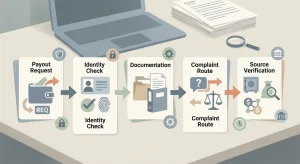
Identity checks are another possible stage. A specialist review advises completing know-your-customer (KYC) verification early, since an outstanding check can delay a later withdrawal. Verification may involve confirming account information and identity, but the exact documents and procedure vary by operator. An account that has not completed the required checks may not be ready for a withdrawal review when one is requested. Completing checks earlier can reduce that particular source of delay, though it cannot guarantee that a payment will be processed without further review.
Cryptocurrency withdrawals present a different set of considerations. A specialist gambling review reports that they may be fast, but the value of winnings can change as the cryptocurrency’s price moves. The amount received in ordinary currency may consequently differ from the amount expected when the withdrawal was initiated. Speed alone does not determine the final value of a payment.
Cryptocurrency transfers also carry a practical risk that is separate from price movement: they are irreversible. If funds are sent to an incorrect wallet address, the mistake may result in permanent loss. This makes address accuracy consequential, while the irreversible nature of a transfer limits the scope for correcting an error after it has been sent.
These transaction procedures sit within a wider difference in oversight. Casinos not on GamStop operate outside the UK Gambling Commission’s regulatory framework and may not provide the responsible-gambling tools required of UKGC-licensed operators. Their account checks and payment processes should not therefore be assumed to offer the same protections. Players using such sites may also lack access to UK-based support services.
Claims about fast withdrawals need to be read with these distinctions in mind. An operator’s processing time, a payment provider’s transfer time, verification status and, for cryptocurrency, price movement are separate factors. A stated processing period does not settle how long the full transaction will take or what the funds will be worth on receipt. Nor does a payment method by itself establish the reliability of the operator handling the account.
How to Interpret Claims About Online Casino Lists
A list presented as covering casinos not registered with GamStop can describe a broad category, but that label does not establish whether any particular operator is entitled to serve customers in Great Britain. GamStop participation and legal permission to offer online gambling are separate matters. A casino’s absence from the self-exclusion scheme does not, by itself, confirm its licensing position or make it lawful for that operator to target UK residents.
The distinction matters because the legal position differs for players and operators. It is not illegal for a UK player to use a non-GamStop casino. However, an operator offering online gambling services to UK residents must hold a valid UK Gambling Commission licence. A foreign licence, or a statement that a casino is available to UK players, does not replace that requirement. An operator providing services to UK residents without the required UKGC licence is acting illegally.
What a list can establish
A published list may indicate that its compiler regards certain sites as outside GamStop. That classification is not equivalent to evidence about an operator’s current licence, business identity or legal right to accept customers in Great Britain. Nor does inclusion establish that an operator has been independently checked. The title of a list, its length and the confidence of its descriptions cannot resolve those questions.
The same caution applies to claims that a casino is “available in the UK”. Availability may refer to a site being accessible, rather than to the operator holding the licence required to serve the British market. Access and authorisation are not interchangeable. A site’s ability to load or accept a registration does not establish that its operation complies with UK requirements.
Lists can also become outdated as operators change their services or circumstances. A past description should therefore not be treated as proof of a present status. Without reliable, current details identifying the operator and its licence, a list remains a set of claims rather than a dependable account of legal authorisation.
Reading claims about individual sites
A claim that an online casino is not registered with GamStop addresses only its relationship with that exclusion service. It says nothing, on its own, about whether the operator is licensed by the UKGC. Likewise, a claim of overseas licensing does not establish permission to offer gambling to UK residents. The relevant question for British market access is whether the operator holds the UK licence required for that activity.
This distinction prevents two opposite errors. A player’s use of a non-GamStop site should not be described as a criminal offence; the legal responsibility at issue is the operator’s obligation to hold the appropriate licence when offering services to UK residents. But the fact that players are not criminalised does not make an unlicensed operator lawful, or place its service within the UK regulatory framework.
Regulatory Status
- GamStop participation does not equal legal permission to serve UK customers
- A foreign licence does not replace the requirement for a UKGC licence
- Using a non-GamStop site is not a criminal offence for the player
- Operators without a UKGC licence act illegally when serving the British market
Accordingly, a list of casinos described as outside GamStop should not be read as an endorsement or as confirmation of UK authorisation. Its category label may explain why the sites are being grouped together, but it cannot substitute for operator-specific licensing information. Where that distinction is not made, the list risks presenting a self-exclusion status as though it were a legal status.
What “Reputable” and PayPal Claims Can—and Cannot—Establish
Calling a casino “reputable” is a judgement, not a regulatory status. The word may describe a publisher’s assessment, user opinions or an operator’s own presentation, but it does not by itself establish how disputes are handled, what safeguards apply or whether a particular claim has been independently checked. The label should therefore be separated from evidence about the operator and the protections available.
This distinction matters for casinos not on GamStop. Such sites operate outside the UK Gambling Commission’s framework and do not provide the consumer protections associated with a UKGC licence. A positive reputation claim cannot make those protections equivalent. Nor does it establish that responsible-gambling tools are mandatory or that UK-based support services will be available. The practical position may depend on the operator and the arrangements it offers; the label alone cannot resolve that.
PayPal claims require the same care. A statement that a casino accepts PayPal concerns a payment option, not the operator’s regulatory position or the quality of its consumer safeguards. Even if a payment method is presented on a website, that alone does not establish the conditions under which it can be used, whether it is available to a particular customer, or how a payment dispute would be treated. Payment branding should not be read as an endorsement of the casino.
The phrase “reputable casinos not registered with GamStop” can therefore obscure two separate questions: what evidence supports the operator’s standing, and what protections apply to its customers. Likewise, a claim about PayPal availability answers neither question by itself. A sound assessment would need to distinguish independently checkable information from promotional language and consider the terms and protections that actually govern the service. Where those details are unclear, the reputation or payment claim remains limited evidence.
For UK players, the legal distinction also needs to remain clear. Playing at a site outside GamStop is not, in itself, a criminal offence for the player. That does not mean the site is authorised to offer online gambling to people in Great Britain, or that it falls under UKGC oversight. The absence of criminal liability for the player should not be mistaken for an assurance about the operator or the safeguards available.
“Reputable” and “PayPal accepted” may be useful descriptions when backed by specific, verifiable information, but neither phrase is a substitute for assessing regulatory status and consumer protection. Neither establishes that a casino is safe, comparable to a UKGC-licensed operator, or suitable for someone who has self-excluded.
Overseas Licences and Differences in Regulatory Protection
A casino’s licence identifies the regulator responsible for overseeing its operation; it does not, by itself, establish that the casino is authorised to serve customers in Great Britain. Non-UK casinos may hold licences from jurisdictions such as Malta, Gibraltar or Curaçao. These locations are sometimes associated with searches for casinos not registered with GamStop, but the location of a regulator does not determine whether the operator falls within the UK regulatory framework.
For online gambling offered to customers in England, Scotland and Wales, the relevant distinction is whether the operator holds a UK Gambling Commission licence. A licence issued elsewhere does not substitute for that authorisation. Remote operators selling into the British market must hold the relevant UK licence, irrespective of where they are based. Consequently, a casino licensed in a European jurisdiction is not necessarily authorised to offer gambling to British residents.
The same distinction applies to GamStop. UK-licensed online casinos are required to participate in the self-exclusion scheme. A casino regulated abroad is outside the UK Gambling Commission’s system, and an overseas licence does not require it to connect to GamStop. The fact that a site accepts customers from the UK, or displays a licence from another jurisdiction, does not make it part of the UK scheme.
This difference has practical consequences for protection. Casinos operating outside the UK Gambling Commission’s framework do not provide the consumer protections associated with a UKGC licence. An overseas regulator may impose its own requirements, but the presence of a foreign licence should not be treated as evidence that those requirements match the British system. In particular, a Malta, Gibraltar or Curaçao licence does not establish that UK safeguards apply.
The legal position also distinguishes the player from the operator. Playing on a site that is not part of GamStop is not, in itself, a criminal offence for the player. That does not make the operator’s activity lawful in Great Britain: an operator offering remote gambling to British customers without the required UKGC licence is acting outside the licensing rules. These statements concern different parties and should not be collapsed into a general claim that an overseas casino is “legal in the UK”.
Accordingly, descriptions such as “European casino” or “Curaçao casino” identify, at most, a claimed regulatory connection. They do not establish UKGC authorisation, GamStop participation or equivalent consumer protection. The licence jurisdiction and the operator’s status in the British market are separate matters.
Online Slots and Bonus Game Weighting
Bonus wagering rules can treat different game categories differently. A specialist review reports that table games may count less towards a wagering requirement than slots, and some may make no contribution at all. The precise weighting depends on the terms attached to the offer; the category name alone does not establish how much progress a game will make.
This distinction matters when a bonus balance is subject to wagering conditions. If a game contributes only partially, playing it may move the requirement forward more slowly than playing slots. If it contributes nothing, wagers on that game will not reduce the remaining requirement. A stated wagering target therefore does not, on its own, show how much qualifying play is needed: the contribution rules also affect the calculation.
The offer’s terms should be read together rather than treating the headline bonus as a complete description. A specialist review also notes that conditions may specify a maximum bet while wagering is in progress, a deadline for completing the requirement, or a cap on withdrawals from bonus winnings. These conditions can affect whether winnings remain eligible for withdrawal, even when the wagering target has been met. The applicable rules are those set out for the particular offer, not a general assumption about how every casino handles bonuses.
For online slots at casinos not registered with GamStop, the same distinction applies: slot play may receive a different contribution from table-game play, but this does not establish that every slot contributes fully or that a particular offer is favourable. Contribution rates and restrictions need to be checked in the relevant terms before play. Where the terms do not clearly explain a game’s weighting, the amount of progress that play will generate cannot be confidently inferred.
Bonus wagering is separate from the regulatory status of the casino. A casino outside the UK Gambling Commission framework is not subject to the same mandatory UK protections, and any bonus conditions it offers should not be taken as evidence of equivalent oversight.
Are casinos that bypass GamStop illegal for UK players to use?
No, using a non-GamStop site is not itself a criminal offence for a UK player. However, an operator offering gambling to people in Great Britain without a valid UKGC licence is acting illegally.
What are casinos not on GamStop?
They are gambling sites that do not participate in GamStop, typically because they operate outside the UKGC’s jurisdiction. Their absence from GamStop does not mean they are licensed to serve customers in Great Britain.
How can players get around Gamstop?
A GamStop exclusion may not block access to gambling businesses that do not participate in the scheme, including some overseas sites. But using such a site bypasses the protection you chose, and those operators may not provide UKGC consumer protections.
What’s the fastest way to get my winnings out?
E-wallet withdrawals are generally faster than card withdrawals, and casino processing can take up to 24 hours. Completing KYC verification early can help avoid delays; cryptocurrency withdrawals may be fast but their value can fluctuate.
What gambling sites are not on Gamstop?
Sites outside the UKGC system are not required to join GamStop; some are licensed in jurisdictions such as Malta, Gibraltar or Curaçao. A foreign licence does not authorise a site to serve customers in Great Britain without a UKGC licence.
Is it safe to play at non-GamStop gambling sites?
They do not provide the consumer protections associated with a UKGC licence, and they do not apply your GamStop exclusion. Some may offer limits or reminders voluntarily, but these are not guaranteed by UKGC rules.
Can I reverse a self-exclusion from GamStop early?
No. A GamStop exclusion cannot be shortened or cancelled before the period you selected has ended.
Material created by the team NationalBet Casino UK