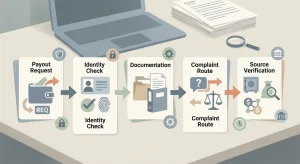
A UKGC licence is the starting point, alongside checks on funds, account handling, fairness and personal data.
What Makes a Casino Site Safe for UK Players?
A casino’s claim that it is “safe” is not, by itself, evidence that it is legally permitted to serve people in Great Britain. For real-money online gambling, the central distinction is whether the operator holds the required UK Gambling Commission (UKGC) licence. The Commission regulates gambling operators serving British players, and a casino must hold its licence to operate legally for them. A reassuring design, familiar games or confident wording cannot replace that regulatory status.
This is a useful starting point when assessing safe casino sites in the UK, but it is not a complete measure of every risk. A UKGC licence establishes that an operator is within the relevant regulatory system; it should not be read as a guarantee that every aspect of a site is risk-free, or that a particular player will have a positive experience. “Safe” can refer to several different things, including legal authorisation, responsible handling of accounts and funds, fair treatment, and the security of personal information. These are related, but not interchangeable.
Choosing a safe online casino in the UK means looking beyond the name and considering the information available to you. Use this list as a starting point when reviewing each option.
1. NightLuck
Payout speed: 1-3 business days NightLuck lists a payout speed of 1–3 business days. This gives you a stated timeframe to consider when reviewing the operator.
2. Jetsetspins
Payout speed: 1-3 business days Jetsetspins lists a payout speed of 1–3 business days. This provides a stated timeframe to keep in mind when assessing it.
3. SpinFormula
Payout speed: 1-3 business days SpinFormula lists a payout speed of 1–3 business days. Consider this stated timeframe as part of your review.
4. Revery Play
Payout speed: 1-3 business days Revery Play lists a payout speed of 1–3 business days. That is the available detail to consider when reviewing this operator.
5. WinBeast
Payout speed: 1-3 business days WinBeast lists a payout speed of 1–3 business days. This stated timeframe is a useful point to note when reviewing it.
6. x3bet
Payout speed: 1-3 business days x3bet lists a payout speed of 1–3 business days. Keep this stated timeframe in mind when assessing the operator.
7. SlotoSport
Payout speed: 1-3 business days SlotoSport lists a payout speed of 1–3 business days. This is the available payout detail for your review.
8. BeOnBet
Payout speed: 1-3 business days BeOnBet lists a payout speed of 1–3 business days. Use this stated timeframe as one point of reference when reviewing it.
9. Zombillion
Payout speed: 1-3 business days Zombillion lists a payout speed of 1–3 business days. This gives you a stated payout timeframe to consider.
10. NightWin
Payout speed: 1-3 business days NightWin lists a payout speed of 1–3 business days. This is the available information to note when reviewing the operator.
The licence question comes first because it determines whether the casino is authorised to offer real-money gambling to British players. If that status cannot be established, descriptions such as “trusted”, “secure” or “fully regulated” remain claims made by the site. They do not demonstrate that the operator is licensed for this market. By contrast, a valid UKGC licence is a specific regulatory status that can be checked against the Commission’s official register.
Licence information should be accompanied by a working link to the regulator’s registry. That link matters because it gives the reader a route to an independent record rather than asking them to rely solely on an operator’s own presentation. A badge or statement on a casino website may be a useful signpost, but it is not the same as confirmation in the regulator’s records. The relevant question is whether the operator’s status can be verified, not how prominently the site displays a licence claim.
This distinction also helps explain why broad labels such as “trusted online casino” are difficult to assess without evidence. Trust is an overall judgement, whereas licensing is a defined legal condition. A site may use polished design or describe its service as secure, but those features do not establish its right to offer gambling in Great Britain. Nor does an attractive selection of online slots make an operator safer. The legal status of the casino and the qualities of its games are separate matters.
Merkur Casino Online UK: Games and Site Checks
The same caution applies to phrases such as “best safe casino sites”. A ranking can communicate preference, but it does not establish that every listed operator has been checked against the regulator’s records or that a particular site is suitable for every player. Comparisons are most useful when they distinguish verifiable information from general promotional language. In this context, the clearest baseline is whether the operator is licensed by the UKGC to serve the market.
A licence is therefore a necessary threshold, rather than a universal endorsement. It identifies the regulatory framework under which the operator is authorised to act. It does not remove the need to consider what “safe” means in a given context, and it cannot support conclusions about every technical or commercial feature of a website. A careful assessment avoids turning one verified fact into a broader promise.
It is also important not to confuse the casino’s presentation with the regulator’s role. The operator supplies the service and makes claims about its own site; the UKGC regulates operators serving British players. The two sources of information are not equivalent. When a casino provides a route to the official registry, the registry is the appropriate place to confirm the licence status rather than treating the casino’s own wording as conclusive.
For people comparing secure casino sites, this approach narrows the initial question without pretending to settle every later one. A casino that cannot demonstrate the required UKGC status should not be treated as legally authorised to serve British players merely because it describes itself as safe. Conversely, confirmation of a licence establishes the relevant legal permission, not a guarantee of flawless service or an absence of risk.
A valid UKGC licence is a specific regulatory status that can be verified through the Commission’s official register, rather than relying on a site’s own claims of being "trusted" or "secure."
The term “safe online gambling” is most useful when its meaning is kept precise. At the outset, it should mean that the casino has the legal authorisation required to offer real-money play in Great Britain. Other aspects of safety need their own evidence and should not be inferred from marketing language or from licensing alone. Where a site is presented through a partner link, the publisher may receive a commission if a reader registers; that commercial relationship does not change the need to distinguish an operator’s claims from verifiable regulatory status.
Real-Money Play and the Cost of Bonus Wagering
A deposit and a bonus are not necessarily treated as the same funds. When an incentive has a wagering requirement, the terms determine what balance must be wagered and which games count towards completing it. A requirement may be calculated against the bonus alone or against the deposit and bonus together. That difference can substantially alter the required turnover, even when the headline offer is unchanged.
For clarity, consider a hypothetical offer in which a £100 deposit receives a £100 bonus. At a wagering multiple of 35x, applying the calculation to the bonus alone would mean £3,500 in turnover before withdrawal. Applying it to the combined £200 would mean £7,000. These figures illustrate the arithmetic, not a permitted UK bonus term: wagering requirements attached to incentives must not exceed 10x. The example should not be read as evidence that a 35x offer can lawfully be made by a UKGC-licensed operator.
Anjouan casino licence in the UK: what it means
The exact wording matters. Terms should identify the balance to which the requirement applies, the games that contribute, any maximum eligible stake and the point at which the bonus expires or is forfeited. The calculation is based on qualifying stakes, not on a promise that a player will recover those stakes or finish ahead. Turnover can consume a real-money deposit while the requirement remains incomplete.
Why the game mix changes the calculation
Game contribution rates affect how quickly qualifying turnover accumulates. A specialist review gives slots a full contribution for each pound staked, while describing table-game contributions as typically falling between 5% and 10%. Those rates are not a universal rule for every offer: the operator’s terms for the specific incentive determine which games count and at what rate.
If a game contributes only part of each stake, the remainder does not advance the requirement. Consequently, the same amount wagered can produce very different qualifying turnover depending on the game selected. A player using table games may need substantially more total stakes than a player using slots to reach the same stated target. The comparison concerns the speed of progress towards a requirement, not the safety of either game or the likelihood of a win.
Bonus terms can also restrict stakes while bonus credit is active. One specialist review reports that most operators set a £5-per-spin cap for eligible play, but this should not be treated as a market-wide guarantee. The applicable terms must be checked directly. A stake above an offer’s cap may fail to count and, depending on its rules, could put the bonus at risk.
Wagering requirements attached to incentives must not exceed 10x for UKGC-licensed operators.
Incentives and real-money deposits
A welcome bonus or no deposit bonus does not make a casino safer, nor does a larger headline amount establish better value. The relevant comparison is between the qualifying turnover, game contribution rules, eligible stakes and withdrawal conditions. A no deposit bonus can still carry requirements that affect whether winnings are withdrawable; the absence of a deposit does not, by itself, mean there are no conditions.
UKGC-licensed operators must keep incentive terms within the applicable limits: a wagering requirement must not exceed 10x, and a single incentive must not combine more than one type of gambling product, such as betting and casino play. These restrictions concern the structure of the offer. They do not remove the need to understand how the stated requirement is calculated or which games qualify.
For real-money play, funds deposited without an attached incentive are distinct from bonus credit governed by promotional terms. Declining an offer can avoid its wagering conditions, although ordinary account and game rules still apply. Where an incentive is accepted, the written terms should make clear what must be wagered and how each eligible game contributes. Without those details, the advertised bonus amount alone provides little basis for assessing its practical cost.
Curacao Casino Licence in the UK: What It Means
How UK Casino Safeguards Work in Practice
Safeguards at a UKGC-regulated casino are account features and operating requirements, not a general promise that gambling is risk-free. Their practical value depends on whether controls are visible, usable and suited to the person’s circumstances. Deposit limits, time-outs and self-exclusion address different situations: managing money entering an account, taking a temporary break, or stopping access to gambling for a longer period.
Financial limits and time-outs
Remote operators must prompt new customers to set a financial limit before their first deposit. They must also provide accessible account-level controls for limits. A deposit limit can restrict how much money is paid into an account over the period selected in the operator’s controls. It does not determine how much will be lost, since outcomes depend on play, but it can place a boundary on deposits.
A limit is most useful when it is set before gambling begins and reflects an amount that can be lost without affecting essential costs. The available controls and the way changes take effect should be clear within the account. A limit should not be treated as a substitute for checking spending or for seeking support where gambling is causing harm.
A time-out provides a temporary interruption to gambling through an account. It differs from a deposit limit: the limit constrains deposits, while a time-out is intended to pause access for a period. The operator’s account information should explain how the chosen control works and when access resumes. These tools are required features at UKGC-licensed operators, rather than optional benefits that depend solely on a promotional offer.
Deposit Limits
Restrict how much money is paid into an account over a selected period to place a boundary on deposits.
Time-outs
Provide a temporary interruption to gambling by pausing account access for a set period.
Self-exclusion
Prevent gambling with participating operators for a chosen period via the GamStop scheme.
Self-exclusion through GamStop
UKGC-licensed operators must provide self-exclusion through GamStop. Self-exclusion is a stronger step than a time-out: it is intended to prevent a person from gambling with participating operators for the exclusion period selected through the scheme. Its cross-operator scope matters because an account-level break at one casino would not, by itself, address access through other participating services.
The distinction between controls is practical. A limit can help constrain deposits while an account remains in use; a time-out pauses access temporarily; self-exclusion is for someone seeking a more comprehensive break. None should be described as a guarantee of recovery or as a replacement for external support. BeGambleAware and GamCare are support services that can provide further help where gambling is affecting wellbeing or finances.
Checks linked to affordability
Safeguards also include operator checks in response to certain spending patterns. UKGC-licensed platforms must request income verification from customers who meet specified criteria under enhanced affordability checks. The thresholds that trigger these checks are not disclosed, so it is not possible to identify a particular spending level at which a request will occur.
A request for income information is an account review, not evidence on its own that a customer has breached a rule. It may require the customer to provide documents or other information to verify income. The purpose is to assess whether gambling expenditure raises affordability concerns; the exact response depends on the operator’s assessment and applicable requirements.
Gibraltar Casino Licence UK: Rules and Protections
These checks do not replace personal limits. Nor does the existence of an account feature establish that gambling is safe for every individual. The relevant practical questions are whether limits can be set and managed, whether a break can be initiated, and whether self-exclusion is available through GamStop. Together, these mechanisms create defined points at which gambling activity can be restricted, though their presence cannot remove the financial risk inherent in gambling.
Reliability, Disputes and the Limits of Offshore Licensing
Reliability is not a single quality that can be established by polished presentation, positive reviews or a licence badge. It concerns whether an operator is accountable under a relevant regulatory system, how player funds are treated, and what routes exist when a complaint or self-exclusion issue arises. These are separate questions: a professional-looking site may still offer fewer enforceable protections than a regulated online casino serving Great Britain.
UKGC-licensed operators are required to keep player funds apart from the capital used to run the business. This separation is a regulatory safeguard, not a guarantee that funds will always be recoverable if an operator fails. The strength of any protection also depends on the arrangements applying to the operator and on the circumstances of a dispute. Consequently, claims that a site is “safe” or “reliable” need to be assessed against identifiable obligations, rather than treated as proof of a particular outcome.
Complaints illustrate the difference between regulatory oversight and general customer service. A casino may respond promptly to routine enquiries, but that does not establish what independent or regulatory route is available if a substantive disagreement remains unresolved. Non-GamStop casinos operate outside UK dispute-resolution channels. A favourable customer review cannot substitute for access to a recognised process, and a stated commitment to fairness does not by itself make a complaint enforceable through UK arrangements.
Non-GamStop Casinos
Operators licensed outside the UK are not required to connect to GamStop, meaning a self-exclusion through that scheme will not prevent registration or play at these sites.
Self-exclusion is another practical test of the limits of an offshore licence. Operators licensed outside the UK are not required to connect to systems such as GamStop. A person who has excluded themselves through GamStop should therefore not assume that the exclusion will prevent registration or play at a non-GamStop casino. The absence of that connection is not a minor technical distinction: it changes which system can apply the exclusion.
An offshore licence may be issued by a regulator, but that does not make it equivalent to a UKGC licence. Offshore licensing does not carry the same level of player protection as regulation by the UK Gambling Commission or the Malta Gaming Authority. Nor does the existence of a foreign regulator establish that UK complaint routes or UK self-exclusion arrangements apply. Licensing claims need to be understood within their jurisdiction, not treated as interchangeable marks of approval.
Reviews of safe and reliable casinos can help describe customer experiences, but they are not a substitute for evidence about regulatory accountability. Reviews may concern a particular interaction and cannot establish that funds are segregated, that a dispute has an independent route, or that an exclusion applies across sites. Reliability is therefore best understood as a set of verifiable protections and processes, rather than a broad promise that every transaction or complaint will end favourably. Mobile access does not change these underlying limits: an app or mobile site remains subject to the operator’s regulatory status and the protections attached to it.
Casino Without a Swedish Licence: UK Guide
This site may receive a commission if a reader registers with a partner casino. Such a commercial relationship does not establish the quality of the operator’s dispute arrangements or the scope of its player protections. A comparison can inform an assessment, but the decisive distinction remains whether the operator is accountable under the UK system and which safeguards actually apply.
Payments, Withdrawals and Identity Checks
Payment rules and account verification affect whether a deposit can be made and whether a withdrawal can be processed. They are relevant to secure casino payments in Great Britain, but a familiar payment method or a completed identity check is not, by itself, proof that an operator is safe.
Remote gambling operators serving Great Britain cannot accept credit-card payments for gambling. The restriction also covers credit-card funds routed through a money service business and wallet payments where the wallet permits credit-card funds to be used for gambling. A payment option appearing on a cashier page therefore does not establish that every way of funding it is permitted. UK casino operators have been barred from taking credit-card deposits for gambling since April 2020.
Age verification is required before an operator allows a customer to deposit into a gambling account. Separately, every licensed operator must verify identity before processing a withdrawal. If checks are left until cash-out, the request may be held while the operator asks for documents or confirms account details. The more practical sequence is to complete the requested checks after opening the account and before funding it.
Do
- Submit legible government-issued photo ID
- Provide proof of address dated within three months
- Complete verification before funding the account
Don’t
- Rely on payment method availability as proof of regulatory status
- Assume verification completion guarantees a specific withdrawal speed
- Use payment methods that route credit-card funds
Documents and payment ownership
A standard identity submission includes a government-issued photo ID, such as a passport or driving licence, and proof of address. The address document should be dated within three months; a utility bill or bank statement is a common form of evidence. In some cases, the operator may also ask for confirmation that the payment method belongs to the account holder.
Documents need to be legible and consistent with the details entered during registration. A mismatch in a name or address can lead to further requests, while an unclear image may need to be submitted again. These are procedural possibilities, not a basis for predicting how long an individual check will take. Processing depends on the operator’s review and whether the submitted evidence is sufficient.
Identity checks should also be distinguished from a payment’s movement through a bank, card provider or wallet. Completion of verification does not establish a particular withdrawal speed, and the availability of a payment method does not show that a site has UK regulatory status. Withdrawal conditions and processing steps should be read separately from the cashier’s list of deposit options.
For anyone comparing safe online casinos for UK players, the useful evidence here is specific: whether the payment route complies with the credit-card restrictions, what documents are required, and whether identity verification can be completed before a withdrawal is requested. Free spins or other incentives do not remove those checks.
This page may receive a commission if a reader registers with a partner casino. That commercial relationship does not alter the payment restrictions or verification requirements described above.
Game Safety: Slot Rules, Spin Speeds and Demos
A slot’s theme, provider or presentation does not establish that it is safe to play. Safety depends in part on the rules that apply to the platform and on whether the game is operating within the regulated system. The same distinction applies when a slot is accessed through a casino app: changing the device does not make the game itself safer or remove the rules governing online slots in Great Britain.
For UKGC-licensed platforms, autoplay is not permitted on online slots. It was removed in 2021, so spins cannot be set to run continuously without a new action for each one. A minimum interval of 2.5 seconds between spins is also required. These measures are intended to slow play and reduce the intensity of a session; they do not eliminate the possibility of gambling-related harm or determine how an individual will respond to a game.
Stake limits also apply to online slots. The maximum stake for each game cycle is £2 for customers aged 18 to 24 and £5 for customers aged 25 and over. The limit for adults aged 25 and over took effect on 9 April 2025. These are regulatory ceilings, not recommendations for a suitable stake, and a player can spend money below the maximum. The game’s design and outcome remain separate from the controls on stake size and spin pace.
Slot Regulations
UKGC-licensed platforms must prohibit autoplay on slots, maintain a minimum interval of 2.5 seconds between spins, and enforce stake limits of £2 for ages 18–24 and £5 for ages 25+.
Book of Dead can illustrate the distinction. It is a slot game, but naming it does not establish that it is safer or riskier than another title. Game-specific features may affect how play feels, while the applicable rules govern matters such as stake ceilings, autoplay and the minimum time between spins. A game should not be treated as safe merely because it is familiar or available through an app.
Free-play access does not remove age controls. On licensed platforms, age verification is required before access to gambling-related content, including free demos. Operators must also verify a customer’s age before allowing a deposit into a gambling account. A demo may not involve a real-money stake, but it is still gambling-related content and is not an exception to the age-check requirement.
These measures offer a limited basis for assessing how slot play is constrained, rather than a guarantee that a particular game or session is safe. The autoplay ban and spin interval govern pace; stake limits govern the amount that can be risked per game cycle; age checks restrict access. None of these rules establishes the outcome of a game or makes a slot suitable for every player.
A Practical Check of a Casino’s Licence and Website
A licence badge on a casino website is a claim, not independent proof. A practical check starts with the UK Gambling Commission’s public register and compares the operator’s details with the site that would actually take a deposit. A generic statement that a casino is “UK licensed” does not establish that the particular brand or domain is covered.
First, locate the licence information on the casino website. It should sit beside a working link to the regulator’s official registry. Note the licence number, the trading name and the legal business named in the terms or footer. If the link is broken, leads somewhere other than the Commission’s registry, or provides no identifiable operator details, the claim cannot be readily verified.
Next, open the public register independently and search for the licence number. Check that the entry is current and that the registered business corresponds to the legal entity named by the casino. Then compare the trading name and the exact website domain with the details in the register. Similar names are not enough: a licence belonging to a related company does not by itself show that another brand or website is authorised under it.
The domain comparison matters because a legitimate-looking badge or copied licence number can be placed on a site that is not the one identified in the register. Check the address shown in the browser, including the domain ending, rather than relying on a logo, an advertisement or a general claim in promotional material. If the registry entry does not support the site’s stated relationship to the licensed business, the mismatch should be treated as unresolved, not as a minor administrative difference.
A useful record of the check can include the register entry, the legal business name, the trading name, the licence number and the domain being assessed. These details make it easier to distinguish a verifiable connection from a claim that merely sounds official. The check should be repeated if the operator changes its website or business details, since a previous result does not establish the present status of a different domain.
Verifying a Licence
Locate Information
Find the licence number, trading name, and legal business entity in the casino’s footer or terms, and note the link to the registry.
Independent Search
Open the UK Gambling Commission’s public register independently and search for the specific licence number.
Compare Details
Verify that the registered business, trading name, and exact website domain in the register match the site being used.
This process can help identify whether a casino’s UKGC licence claim matches the website in question; it cannot certify every aspect of the site’s conduct or technical security. Where the details do not align, depositing before the discrepancy is clarified would rely on an unverified claim. No operator list or ranking can replace this individual check.
NationalBet Casino UK may receive a commission if readers register at a partner casino.
Licensed Casinos, Live Play and Bitcoin Withdrawals
A licensed online casino serving Great Britain must hold a current UKGC licence. The presence of live tables or Bitcoin payments does not change that requirement: a payment option, game format or licence claim on a website is not evidence that the operator is authorised. A useful assessment therefore separates the operator’s regulatory status from the features it offers.
Live casino play can involve streamed table games and interaction with a live dealer, but the format alone does not establish that a site is safe. The relevant distinction is whether the operator is licensed to serve the British market. Age verification is required before access to gambling-related content, including free demos, on licensed platforms; operators must also check a customer’s age before permitting a deposit. The label “live casino” is not a substitute for those regulatory conditions.
Bitcoin introduces a separate question: how a withdrawal moves after the operator has approved and processed it. A specialist review of selected casino brands reported on-chain settlement in 10–30 minutes after operator processing. That figure describes the reported transfer stage, not the time needed for account checks, approval or any delay before processing begins. It should not be treated as a standard promised by every operator. Bitcoin availability also says nothing by itself about UKGC licensing, the handling of disputes or the protections attached to regulated play.
For comparison, a specialist review covering selected brands reported bank-transfer withdrawals taking 3–5 banking days. This is a finding from that review, not a universal timetable. The comparison is therefore limited: a blockchain transfer may settle faster after release, while the operator’s own processing remains a separate part of the journey. The receiving service and any account-specific checks can also affect when funds become usable.
A choice between Bitcoin and a bank transfer should not be treated as a choice between safe and unsafe casinos. The regulatory question comes first; the payment route comes afterwards. A licensed operator’s status must be checked against the Commission’s public register, rather than inferred from the presence of crypto, a live dealer or a polished website. Bitcoin can be a payment method at an operator whose regulatory position differs from that of a UKGC-licensed casino.
Lists of licensed casino sites are useful only to the extent that their entries can be verified. Brands, domains and operating companies may not share the same name, so a list or comparison should be checked against the exact business and website shown in the register before any deposit. No list can make a payment feature proof of safety. This site may receive a commission if a reader registers with a partner casino; that commercial relationship does not establish the partner’s regulatory status.
Does the presence of live tables or Bitcoin prove a site is safe?
No. Neither the game format nor the payment options are evidence of regulatory status; the operator must still hold a current UKGC licence.
How long do Bitcoin withdrawals typically take?
Specialist reviews reported on-chain settlement in 10–30 minutes after the operator has processed the request.
How do bank-transfer withdrawals compare?
Selected brands in specialist reviews reported bank-transfer withdrawals taking between 3–5 banking days.
Assessing Claims About the “Best” Safe Casino
Calling a casino the “best” is a comparative claim, not a safety finding in itself. A ranking can reflect a particular set of criteria, commercial relationships or editorial preferences; without a clear method, its order does not establish that one operator is safer than another. A list of favourable features is not enough unless the basis for comparison is explained and can be checked.
A useful comparison separates minimum requirements from preferences. Legal eligibility to serve players in Great Britain is a threshold, not a bonus feature. Beyond that, meaningful differences may concern how clearly an operator explains its rules, how accessible its account controls are, and whether its customer procedures are described in specific terms. These features should be assessed against evidence rather than broad labels such as “trusted” or “secure”.
A claim about the best safe online casino in the UK also needs a defined scope and a relevant date. Policies, ownership, terms and payment arrangements can change, so an undated ranking may no longer describe current conditions. A comparison should disclose what was examined, how competing criteria were weighted and whether the same standards were applied to every operator. Where those details are absent, the ranking is better treated as an opinion than as a conclusion supported by a transparent assessment.
Commercial disclosure matters as well. This site may receive a commission if a reader registers at a partner casino. That relationship does not, by itself, establish that a comparison is inaccurate, but it is relevant context when assessing how recommendations were selected and presented. The word “best” should therefore be read as a conclusion that requires evidence, not as proof of safety or a substitute for checking the underlying claims.
Security Claims and Casinos Without a UKGC Entry
A padlock symbol, encryption statement or promise of secure payments concerns technical handling of information; it does not establish that a casino is authorised to serve players in Great Britain. Nor does a polished website show which legal entity operates the service. These claims should be treated separately from evidence of a current UKGC licence.
Remote gambling operators serving Great Britain must hold the relevant UKGC licence. Where no identifiable entry can be found in the Commission’s register, protections tied to that regulatory system should not be assumed. In particular, a player should not presume that GamStop self-exclusion applies, or that UKGC-regulated alternative dispute resolution and UK-specific consumer-funds protections are available. A general statement about “player protection” does not establish access to those arrangements.
The difference can also be seen in rules governing play and payments. At non GamStop casino sites, autoplay may remain available and spin speeds are not subject to a regulatory floor. Credit cards may also be accepted by offshore operators because the UKGC restriction introduced in April 2020 does not apply outside its regulatory scope. Those features do not, by themselves, prove how a site handles data or funds; they indicate that UK rules cannot be presumed to govern it.
“Safe and secure” therefore needs to be divided into distinct questions: whether the operator is identifiable and licensed for the British market, what protections follow from that licence, and what technical safeguards the site claims to use. One answer cannot substitute for the others. If the operator’s legal status cannot be verified, technical language alone is insufficient evidence of UK regulatory protection.
NationalBet Casino UK may receive a commission if a reader registers with a partner casino. This commercial relationship does not establish that the casino holds a UKGC licence or that UK-regulated protections apply.
Is it safe to play at online casinos in the UK?
It is legally authorised for a casino to offer real-money play to British players only if it holds the required UK Gambling Commission licence. A licence is a legal threshold, not a guarantee that every aspect of the service is risk-free.
What determines how an online casino bonus works in practice?
The bonus terms determine whether wagering applies to the bonus alone or to the deposit and bonus together, and which games contribute to the requirement. Slots contribute 100% of each stake, while table games typically contribute 5% to 10%; eligible bets are often capped at £5 per spin while bonus credit is active.
What are the differences between UK-licensed and non-UK-regulated online casinos?
UKGC-licensed casinos must offer deposit limits, time-outs and GamStop self-exclusion, and must keep player funds separate from operating capital. Non-UKGC operators do not have the same protections or UK dispute-resolution channels, and are not required to connect to GamStop; the UK credit-card deposit ban does not apply to them.
How do I verify whether a UK online casino is safe before depositing?
Check the UK Gambling Commission’s official register to confirm that the operator holds a licence to serve British players. Use the registry link beside the casino’s licence information, rather than relying on the site’s own claims or badge.
Do all games count toward bonus wagering?
No. Slots contribute 100% of each pound staked, while table games typically contribute only 5% to 10%; check the bonus terms for the games included and any bet cap.
What does a dependable online UK casino combine?
A dependable UK casino combines a verifiable UKGC licence with required player protections, including deposit limits, time-outs, GamStop self-exclusion and segregation of player funds. These safeguards do not guarantee a risk-free experience.
Material created by the team NationalBet Casino UK