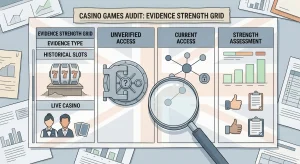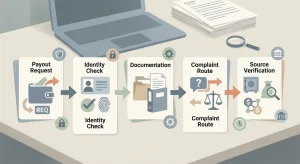
A practical account of the briefcase format, online bonus play, UK safeguards and the limits of available evidence.
The Briefcase Format Behind Deal or No Deal
The premise of Deal or No Deal is a comparison between two amounts that remain uncertain until late in the game: the prize associated with a contestant’s briefcase and the Banker’s cash offer. The contestant must decide whether to take the offer or continue towards revealing the value of the briefcase. That contrast supplies the central dramatic question behind the format and explains why the Banker’s offer matters even before the contestant knows what their own case contains.
The show begins with 16 briefcases. In the opening round, three are opened, revealing their contents to the audience and contestant. A Banker’s offer follows, and the contestant must choose between accepting it and continuing. The sequence establishes the format’s basic tension: each opened case removes a possible amount from consideration, while the contestant’s own case remains closed.
The offers are not simply another prize displayed alongside the briefcases. They create a point at which the contestant can end the uncertainty in exchange for a known amount. Continuing, by contrast, leaves the outcome dependent on the value in the contestant’s case. The decision therefore turns on comparing a definite offer with a prize that has not yet been revealed. Neither option changes what is inside the case; the choice concerns whether to settle for the Banker’s proposed amount or keep the possibility of the case prize.
For a deal-or-no-deal casino search in the UK, payout timing is one practical detail to check when considering your options. The entries below note the payout information available for each operator.
1. NightLuck
Payout speed: 1-3 business days NightLuck has a stated payout speed of 1–3 business days.
2. Jetsetspins
Payout speed: 1-3 business days Jetsetspins has a stated payout speed of 1–3 business days.
3. SpinFormula
Payout speed: 1-3 business days SpinFormula has a stated payout speed of 1–3 business days.
4. Revery Play
Payout speed: 1-3 business days Revery Play has a stated payout speed of 1–3 business days.
5. WinBeast
Payout speed: 1-3 business days WinBeast has a stated payout speed of 1–3 business days.
6. x3bet
Payout speed: 1-3 business days x3bet has a stated payout speed of 1–3 business days.
7. SlotoSport
Payout speed: 1-3 business days SlotoSport has a stated payout speed of 1–3 business days.
8. BeOnBet
Payout speed: 1-3 business days BeOnBet has a stated payout speed of 1–3 business days.
9. Zombillion
Payout speed: 1-3 business days Zombillion has a stated payout speed of 1–3 business days.
10. NightWin
Payout speed: 1-3 business days NightWin has a stated payout speed of 1–3 business days.
As the programme proceeds, further cases are opened and the Banker makes offers. Before the final stage, contestants receive three such offers, each followed by the host’s familiar question: “Deal or No Deal?” The wording captures the format’s recurring choice, rather than naming a separate game within the show. Each time, the contestant can accept the offer or decline it and continue. The repeated decision points give the format its structure: uncertainty is reduced as cases are opened, but the value of the contestant’s own case remains concealed.
The Banker’s figure and the briefcase prize are distinct outcomes. Accepting means taking the stated offer; declining means carrying on with the possibility of winning the amount in the contestant’s case. The offer does not reveal the hidden prize, and the hidden prize does not determine whether accepting is the better decision in every instance. The show presents a choice under incomplete information, not a contest in which the contestant is told which option will prove more valuable.
At the final stage, the contestant can accept the offer, reject it and take the prize linked to their own briefcase, or switch to the last unopened briefcase. Switching introduces a further decision: whether to keep the case selected earlier or exchange it for the remaining one. The format still rests on concealed values. The choice to switch does not itself disclose which case holds the larger prize; that is established only when the relevant case is opened.
A further feature of the show’s premise is that the contestant is asked to assess an offer without knowing the value of the case they hold. The audience can follow which cases have been opened, but the contestant’s final case remains unresolved. This difference in what is known creates the setting for the Banker’s proposals and the contestant’s decisions. The choice is not between two fully visible amounts. One is stated; the other remains attached to a closed case.
French Roulette Online Casinos in the UK: Rules and Play
This distinction is useful when interpreting casino entertainment that borrows the show’s name or briefcase imagery. The television format is built around a sequence of opened cases, Banker’s offers and choices about whether to continue. Its defining premise is not simply that briefcases contain prizes, but that a contestant must weigh a known offer against an unrevealed case value. The familiar title refers to that decision structure. The online game’s own sequence and rules are a separate matter and should not be inferred solely from the television format.
The show’s format therefore provides a clear source for the phrase “Deal or No Deal”: a contestant repeatedly faces an offer and decides whether to accept or risk finding out what the remaining case holds. The final choice can include switching cases, but the underlying comparison remains between a certain offer and an uncertain prize. That is the premise carried by the briefcases, and the context needed before considering how an online version handles its own play.
How the Online Game’s Bonus Round Works
The online game begins with a qualification stage, followed by an optional Top Up feature and then the Deal or No Deal game itself. This order matters: the briefcase-based play is not the first step in the sequence. Qualification determines whether the player proceeds, while Top Up is a separate choice that may be used to add to prizes before the main game begins.
Qualification depends on the rings shown in that stage. All three must land on a gold slice for the player to qualify. If that condition is met, play can move on to the next part of the sequence. The condition is specific: it is not enough for some of the rings to land on gold. The stated requirement applies to all three.
Monopoly Live Casino UK: Evidence and Game Guide
Top Up is optional, rather than a condition of qualification. Its stated purpose is to add to prizes, and it sits between qualifying and playing the Deal or No Deal game. That position distinguishes it from the Banker’s offers, which occur during the subsequent briefcase game. The two features therefore serve different roles in the sequence: Top Up may affect prizes before the main game, while the Banker’s offers arise as the game progresses.
The main game uses opened briefcases to move play forward. After batches of briefcases have been opened, the Banker makes an offer. At each offer point, the player has a choice between accepting the proposed amount and continuing to play. This creates a repeated decision structure: a batch is opened, an offer follows, and play either ends through acceptance or carries on.
The offer is not simply another prize added to the game while the player continues. Accepting it ends that game, and the player collects the amount offered. The choice therefore changes the outcome of the current round: acceptance settles it at the Banker’s proposed amount, whereas continuing leaves the game in progress. The game’s central tension comes from that contrast between a defined offer and the possibility of carrying on.
This is the feature that makes the online title more than a conventional sequence of spins. A search for a Deal or No Deal slot machine game may suggest a standard slot format, but the described play includes qualification, a possible Top Up, briefcase openings and Banker offers. The offers introduce decisions within the game rather than leaving the player with only a single, uninterrupted spin outcome. The specific sequence is essential to understanding what the online game involves.
The same structure applies whether the title is described as an online slot game or as a casino game. Those labels do not change the stated order of play: qualify first, optionally use Top Up, and then enter the Deal or No Deal game. Within that game, offers arrive after groups of briefcases have been opened. A player who accepts one ends the round and collects that offer; a player who declines to accept continues.
Online Game Sequence
Step 1: Qualification
All three rings must land on a gold slice for the player to qualify and proceed.
Step 2: Optional Top Up
Players may choose to use the Top Up feature to add to prizes before the main game begins.
Step 3: Briefcase Game
Players open batches of briefcases and face the Banker’s offers, deciding whether to accept the amount or continue playing.
Step 4: Final Decision
At the final stage, the player can accept the final offer, take their briefcase prize, or switch to the last unopened briefcase.
The offer points also provide natural pauses in the sequence. Each one follows a batch of openings, so the decision is made after some play has occurred rather than before the game begins. The amount offered is presented as a potential stopping point. The player can take it and end the game, or keep playing without having accepted it. No outcome is guaranteed by either choice: acceptance fixes the result at the offered amount, while continuing leaves the game unresolved.
For those looking to play the Deal or No Deal slot online, the mechanics can be understood as two connected stages. First comes qualification, where all three rings need to land on gold; Top Up may then be used to add to prizes. The second stage is the briefcase game, in which the Banker’s offers follow batches of openings. Treating these as separate parts helps clarify why the initial qualification condition and the later accept-or-continue choice should not be confused.
The game’s identity rests on this progression from qualification into an offer-based bonus game. It is not necessary to assume that every choice has the same value or that continuing is preferable to accepting. The rules described establish what happens after an offer is taken: the current game ends and the player collects that amount. They also establish that play can continue instead. The decision belongs to the structure of the game, not to a guaranteed method for improving its outcome.
Live Baccarat Online Casinos in the UK: How It Works
In practical terms, a Deal or No Deal casino game online combines a qualifying requirement with a later sequence of briefcase openings and Banker offers. The qualification condition is clear, Top Up is optional, and acceptance has a defined consequence. These mechanics explain the flow of the game without implying that any particular offer, prize or result is assured.
Playing Online in Great Britain: Regulation and Key Safeguards
A casino game’s rules and branding do not determine whether its online version is lawful to offer in Great Britain. That question concerns the operator and the regulatory framework governing the service. Whether a search concerns a Deal or No Deal-themed slot, another online casino game, or a slot machine described in different terms, the relevant distinction is between a product offered by a properly licensed operator and one outside the British regulatory system.
The UK Gambling Commission is the sole regulator of commercial gambling in Great Britain. Its remit covers remote gambling offered to consumers in Great Britain even when the operator’s key equipment is located elsewhere. A business cannot avoid the relevant licensing requirement simply by hosting its systems abroad: operators selling remote gambling into the British market must hold a Gambling Commission licence.
The Gambling Act 2005 provides the principal statutory framework for gambling in England, Wales and Scotland; it does not extend to Northern Ireland. In Great Britain, the Commission issues operating licences to businesses and personal licences to individuals working in specified roles. These licences serve different purposes: the operating licence concerns the business offering gambling, while a personal licence applies to an individual whose role falls within the licensing system.
Licensing Requirement
Operators selling remote gambling into the British market must hold a Gambling Commission licence; using a licence from another jurisdiction is not a replacement for a UKGC licence.
What licensing means for online casino play
Online gambling is lawful in Great Britain when it is offered by an operator holding the appropriate UKGC licence. A legal online casino serving British players must have a current operating licence. This requirement applies to remote operators irrespective of where they are based, and the Commission’s public register allows licence details to be checked. The websites and apps of remote licensees must also display information about their licence and link to the relevant register entry.
A game title alone is not evidence of the regulatory status of the site offering it. The presence of a Deal or No Deal-themed casino game, for instance, would not establish that the operator is licensed, nor would a familiar brand name substitute for checking the business. Licensing attaches to the operator and its authorised gambling activity, not merely to the name or appearance of an individual game.
The distinction matters because offshore casinos operate outside the UKGC system when they do not hold a British licence. A licence issued by another jurisdiction is not a replacement for the licence required to serve consumers in Great Britain. The regulatory protections described below apply in the context of UKGC-licensed gambling; they should not be assumed to apply to an unlicensed site.
Live Blackjack Online Casinos in the UK: How They Work
Safeguards required of licensed operators
Age verification is a prerequisite to depositing: operators must verify a customer’s age before allowing funds to be paid into a gambling account. Online gambling in Great Britain is for people aged 18 and over, provided the operator holds the required Commission licence. This is not simply a matter of accepting an age declaration at registration.
Licensed remote operators must also prompt new customers to set a financial limit before their first deposit and make account-level limit controls accessible. These tools do not remove the possibility of financial harm, but they form part of the safeguards that regulated operators are required to provide. UKGC-licensed casinos must also offer responsible gambling tools, including self-exclusion.
Payment rules impose further limits on how gambling can be funded. Remote operators cannot accept credit-card payments for gambling, including credit-card funds routed through a money service business. They also cannot accept wallet payments where the wallet permits credit-card funds to be used for gambling. These restrictions mean that a payment method’s availability for ordinary purchases does not establish that it may be used to fund casino play.
For online slots, game-cycle limits apply to the amount an individual may stake: the maximum is £2 for customers aged 18 to 24 and £5 for those aged 25 or older. The applicable £5 limit for all adults took effect on 9 April 2025. Online slot autoplay is prohibited in Britain, and at least 2.5 seconds must pass from the start of one game cycle before the next can begin. These are market-wide rules for online slots, rather than features specific to a particular branded title.
Do
- Verify the operator’s licence on the UKGC public register
- Set a financial limit before the first deposit
- Use approved Alternative Dispute Resolution services for complaints
Don’t
- Use credit cards to fund gambling accounts
- Use autoplay features on online slots
- Rely on a game’s brand name as proof of regulatory status
Complaints and checking a licence
UKGC licensees must provide an internal complaints process and access to an approved Alternative Dispute Resolution service. This gives customers a route to raise a dispute with the operator and, where appropriate, have it considered by an independent approved body. It is a regulatory safeguard, not a guarantee that every complaint will be resolved in the customer’s favour.
Before depositing, the operator’s licence should be checked against the UK Gambling Commission’s public register. The register helps confirm whether the business holds a current operating licence; the licence details shown on the site should correspond to that public information. If the site does not clearly identify its licence or the details cannot be confirmed, its claims about serving Great Britain should not be treated as proof of regulatory approval.
These requirements establish the conditions under which online casino gambling may be offered in Great Britain. They do not determine whether a particular branded game is available, nor do they establish its rules or outcomes. They identify the operator-level framework and protections that apply when a licensed service offers remote gambling to British consumers.
Live Casino UK: Games, Rules and Offers
Demo and Free Play: What the Available Evidence Establishes
A demo is generally understood as a way to try a casino game without staking real money. That description alone does not establish that a demo version of Deal or No Deal is offered in Great Britain. Nor does it establish whether a free-play mode exists, how it would be accessed, or whether it would reproduce the same features as a real-money game.
The distinction matters because a game’s title and its presence in a casino do not, by themselves, confirm a separate no-stake version. A player looking for a Deal or No Deal slot demo may encounter references to the game, but those references are not evidence that a playable demo is available. The same caution applies to claims about free play: the phrase can describe a mode, a promotional route or simply an informal way of referring to a game, and these meanings should not be treated as interchangeable.
There is also no basis for describing what a demo might contain. It cannot be stated that it includes the full game, gives access to every feature, or uses the same settings as paid play. Those details depend on the version and its terms, and should not be inferred from the general idea of a demo. Equally, the absence of a confirmed demo does not show that every version lacks one; it means that availability and functionality cannot be stated as settled facts.
Live Dream Catcher Casino in the UK: What to Know
The game’s bonus round and its Banker offers belong to the rules of the online game, rather than to an assurance about access without a stake. A description of those rules does not answer whether the game can be tried for free. Keeping those questions separate avoids turning known gameplay information into an unsupported claim about a demo.
The term “Megaways” raises a related but distinct issue. It is a name commonly associated with a particular slot format, but a search for a Deal or No Deal Megaways game does not verify that a version with that feature exists or is available in a casino serving Great Britain. No mechanics, layout, or relationship between a Megaways title and the established Deal or No Deal game can be inferred from the label alone. The same applies to references to Megaways casinos: that wording does not establish a specific title, product or playable mode.
For someone comparing a demo with a paid version, the practical distinction is between what is confirmed about the game’s rules and what is confirmed about access. The rules can be described without claiming that a no-stake edition exists. A demo could also differ from a real-money version, but no such difference should be asserted without details about the particular edition.
Accordingly, Deal or No Deal free play and demo access should be treated as unconfirmed, rather than assumed to be available or unavailable. The same restraint applies to a Megaways edition. A clear product listing from the relevant operator would be needed to establish whether any such option is offered and what it includes. Until then, neither the word “demo” nor a variant label is sufficient evidence of a playable free version.
Named Variants, Double Action and Bonus Offers
The name “Double Action” does not, by itself, establish a separate game or explain how it would differ from the core Deal or No Deal casino game. Nor does a label such as “Golden Box Megaways” establish a connection to a particular game, provider or set of mechanics. Titles can resemble one another while referring to different products, so a name alone is not a reliable basis for describing how a game works.
Live & Table Games: Roulette, Blackjack and More
The established core game has a defined sequence: players qualify, may use Top Up, and then play Deal or No Deal. Qualification requires all three rings to land on a gold slice. Those mechanics should not be attributed to a named variant unless the game’s own rules identify that connection. Equally, features suggested by a title cannot be treated as part of the core game without supporting rules.
A similar distinction applies to casino promotions. A no-deposit bonus is a promotional offer, not a feature of the Deal or No Deal game itself. The phrase alone does not establish whether an offer exists, who can claim it, which games it covers or what conditions apply. Those details need to be set out in the relevant promotion’s terms; a headline or game name cannot supply them.
This matters because promotional wording can combine several separate claims: that a particular game is available, that a bonus applies to it, and that the bonus can be used in a particular way. Each claim requires its own evidence. A promotion associated with a casino does not automatically apply to every game there, and a game title does not prove that a bonus is attached to it.
American Roulette at UK Online Casinos: Rules and Play
Consequently, “Double Action” and “Golden Box Megaways” should be treated as labels rather than descriptions of verified mechanics. The core game rules remain distinct from claims about variant titles and promotional terms. Where a casino presents a named game or offer, its rules and conditions—not the wording of the name—are what determine what is actually being offered.
Free Spins and Box Clever: Details Not Verified
A claim that Deal or No Deal offers free spins requires more than the presence of the game’s name beside a promotion. Free spins could refer to a casino offer, a feature within a game, or access that does not involve a cash stake; these are distinct arrangements.
The same care applies to the name Box Clever.
These distinctions matter because promotional language can suggest a connection that is not demonstrated by the game’s documented mechanics. A reference to free spins does not, by itself, show that spins can be claimed or used on a particular title. Likewise, a named feature cannot be treated as part of the game merely because the terms appear together in a listing or discussion.
Live Roulette UK with English-Speaking Dealers
For anyone trying to determine whether either option is available, the relevant evidence would be an operator’s current game listing or promotion terms that identify the title and set out the applicable conditions.
What’s in Your Box: The Return Figure and Its Limits
A specialist review reports that the game’s help file gives an expected return of 95.42%. This is the stated return figure associated with the game, not a prediction of what a particular player will receive or what any individual box contains.
RTP, or return to player, is a measure of expected returns across game play rather than a guaranteed result for each session. It does not identify the value inside a specific box, determine which box will be selected, or show what an individual round will pay. A player’s result may therefore differ from the stated figure; the percentage cannot be used to infer the contents of an unopened box.
The distinction matters because the game presents box prizes and Banker offers as separate amounts, while the return figure describes an aggregate measure. It does not say that a box is worth a fixed share of the percentage, nor does it establish that accepting an offer produces a particular return. The figure alone also provides no breakdown of how outcomes are distributed.
Online European Roulette in the UK: Rules and Odds
The reported percentage should be read with its source in view: it is a value attributed to the game help file in a specialist review. It is not, by itself, evidence that every version carrying the same title uses identical settings or that the figure remains current. Without further substantiation, it should not be treated as a market-wide standard.
For anyone assessing “What’s in Your Box”, the key limit is straightforward: the expected return does not reveal the box’s contents. It offers no basis for identifying a favourable box or anticipating the result of an individual game. The figure is relevant as a stated game-level statistic, but it cannot replace information about a specific outcome.
Reviewing Double Action and What’s in Your Box
A meaningful review of Double Action or What’s in Your Box would need to describe each game’s rules, features and the way its play differs from the core Deal or No Deal title. It would therefore be misleading to assign either game a style, feature set or comparative advantage on the basis of its title.
Expected return (RTP) is an aggregate measure of expected returns across gameplay and does not predict the outcome of an individual session or reveal the contents of a specific box.
The same limitation applies to a side-by-side assessment.
This distinction matters because a familiar brand name does not demonstrate that two products share the same rules. Nor does a variation in a title, by itself, show what has changed. A review should not infer a different game structure, additional options or a particular prize format from the words “Double Action” or “What’s in Your Box”.
General familiarity with the television format or the core game does not establish the mechanics of a separate title. Accordingly, no reliable game-by-game verdict can be given for Double Action or What’s in Your Box.
For anyone assessing a review of either name, the useful distinction is between a description supported by title-specific rules and an impression derived from branding.
Choices at the Banker’s Offers and Final Stage
The decision points in Deal or No Deal invite the idea that a fixed strategy might produce “perfect play”. The game’s established rules, however, describe choices rather than a method that guarantees a favourable result. The Banker makes offers as suitcases are opened, creating opportunities to stop or continue; the player’s decision changes how the round proceeds, but does not establish what remains concealed.
There are four Banker offers before the final stage. At each offer, the player can accept or reject it. Accepting ends that game, with the offered amount collected. Rejecting keeps the game in progress, so later decisions depend on the offers and the unopened suitcases still in play. The rules identify these options, but they do not establish that accepting at a particular point is reliably better than continuing.
After the fourth offer, two briefcases remain unopened and can be switched before they are revealed. Switching is therefore a choice about which of the two remaining cases to keep; it is not evidence that one contains a better prize. A strategy that always switches, or never switches, cannot be described as perfect on the basis of the stated mechanics alone.
Live Casino Lightning Roulette UK: How It Works
This distinction matters when evaluating claims about optimal decisions. A rule can specify when an offer appears and what choices follow without supplying enough information to determine a winning tactic. The existence of repeated offers does not itself show that the Banker’s proposal can be predicted, nor that a particular response improves the final result. Likewise, the final switch gives the player an alternative, not a guarantee.
Accordingly, “perfect play” is best understood as a question about decision-making under uncertainty, not as a confirmed route to a desired outcome. The available rules establish the sequence of offers and the final switching option. They do not establish a universally correct decision at each stage, or a strategy that removes uncertainty from the result.
Free Online Play: Availability Is Not Established
Free online play and real-money access are different questions. A title appearing in connection with online casinos does not, by itself, establish that it can be launched without depositing or wagering money.
That distinction also matters when interpreting descriptions of the game. Rules or features associated with a casino version do not prove that the same version can be accessed for free. Nor does a reference to free access establish what a player could do, whether play would be restricted, or whether the experience would match the real-money game. Those details should not be assumed.
The question is narrower than whether online casino play exists in Great Britain. Real-money gambling is legal for adults at online casinos holding the relevant UK Gambling Commission licence. That regulatory status does not confirm that any particular game is offered free of charge.
Accordingly, free online access should be regarded as unconfirmed unless an operator explicitly identifies a no-cost option and explains its terms. A general game description or casino listing is not enough to establish such availability.
Material created by the team NationalBet Casino UK