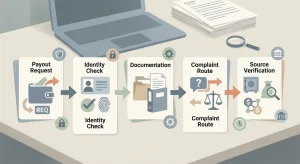
Ratings are only one signal; licensing, game availability, wagering terms and payouts need separate checks.
What a Casino Rating Can—and Cannot—Establish
A casino rating is an assessment, not a regulatory status. A high score may summarise an evaluator’s view of a site, but it does not, by itself, establish that the casino holds a UKGC licence, carries a particular software provider’s games or meets a defined standard. Those are separate claims, and each requires evidence suited to the claim.
This distinction matters when comparing top-rated online casino sites in the UK. A rating can help organise information or indicate that a reviewer has considered a site against stated criteria. Its meaning depends on how the score was produced: which features were assessed, how they were weighted and whether the information was checked recently. Without that context, a number or label such as “best rated” has limited interpretive value. It should not be treated as a certification issued by a regulator.
Nor does a favourable rating settle whether a casino offers Amatic titles. Ratings commonly concern the casino as a whole, while game availability is a separate and potentially changeable detail. A review may mention a provider, but a score alone cannot establish that the provider’s games are present in the casino’s current lobby. Conversely, a site’s listing of a provider does not demonstrate that the casino has received a particular rating or passed an independent quality test.
Choosing an online casino in the UK for 2026 means checking practical details as well as the overall offer. The payout information below gives one useful point to consider when reviewing each option.
1. NightLuck
Payout speed: 1-3 business days NightLuck lists a payout speed of 1–3 business days, a useful detail to consider when assessing how quickly withdrawals may be processed.
2. Jetsetspins
Payout speed: 1-3 business days Jetsetspins lists a payout speed of 1–3 business days, offering a clear timeframe to keep in mind when reviewing its payout information.
3. SpinFormula
Payout speed: 1-3 business days SpinFormula lists a payout speed of 1–3 business days. This gives readers a specific withdrawal-processing timeframe to consider.
4. Revery Play
Payout speed: 1-3 business days Revery Play lists a payout speed of 1–3 business days, providing a practical detail for readers checking payout expectations.
5. WinBeast
Payout speed: 1-3 business days WinBeast lists a payout speed of 1–3 business days. Readers can use this stated timeframe as one factor in their review.
6. x3bet
Payout speed: 1-3 business days x3bet lists a payout speed of 1–3 business days, giving readers a stated timeframe for withdrawals to consider.
7. SlotoSport
Payout speed: 1-3 business days SlotoSport lists a payout speed of 1–3 business days. This is a relevant practical detail when looking into its payout process.
8. BeOnBet
Payout speed: 1-3 business days BeOnBet lists a payout speed of 1–3 business days, a clear point to factor into a review of its payout information.
9. Zombillion
Payout speed: 1-3 business days Zombillion lists a payout speed of 1–3 business days. That stated timeframe can help readers consider withdrawal timing.
10. NightWin
Payout speed: 1-3 business days NightWin lists a payout speed of 1–3 business days, giving readers one concrete detail to consider when assessing its payouts.
The company behind the games and the company operating the casino have different roles. Amatic Industries GmbH is an Austrian business-to-business software supplier, founded in 1993. It does not run consumer-facing casinos. Its UK Gambling Software (Remote) licence, account number 47992, has been active since 27 April 2017. That licence concerns its software-supply activity; it is not an operating licence for a casino bearing a high rating.
A casino’s UKGC operating status therefore cannot be inferred from Amatic’s software licence. The reverse is also true: a casino’s licence does not establish that Amatic games are available there. The two facts concern different entities and different permissions. A rating that fails to distinguish between a casino operator and a game supplier can leave those claims blurred, even where its overall assessment is clearly presented.
The presence of Amatic in a casino lobby should also be interpreted narrowly. A lobby is the operator’s presentation of games, not a register entry recording licence status. Any UKGC-licensed operator may use the business-to-business model involving Amatic; seeing the provider’s name in a catalogue is not, on its own, proof of a separate regulatory endorsement of the casino. Equally, the absence of a provider name from a review does not prove that the operator cannot offer its games.
Playtech Online Casinos UK: What Is Verified
Consequently, lists of the highest-rated UK casinos and claims about software supply answer different questions. A ranking may compare casinos according to an editorial method. A claim about Amatic requires confirmation of the supplier relationship or of game availability at the operator. Neither substitutes for the other. Treating a casino’s rating as proof of a provider’s presence converts a broad evaluation into a specific factual assertion that the score may not support.
The same caution applies to labels such as “best” or “highest rated”. They describe a conclusion within some chosen comparison, not a universal measure. A rating can be informative when its scope and basis are clear, but it cannot certify every feature that a reader might associate with a well-regarded casino. In particular, it cannot turn a supplier licence into an operator licence, or establish the contents of a live game lobby.
A careful reading keeps these categories separate: the rating is an editorial judgement; the operator’s status is a licensing question; and the presence of Amatic games is a matter of supply and availability. A single label cannot answer all three.
Real-Money Play and the Operator’s Responsibilities
When an Amatic game is offered for real-money play, the casino operator is the business that accepts the bet. Amatic Industries supplies software; it does not run a consumer-facing casino or take bets directly from British players. The distinction identifies who provides the game and who conducts the gambling transaction.
Amatic Industries GmbH supplies the software but does not run consumer-facing casinos or take bets directly from players.
A player-facing casino may receive Amatic titles through a direct integration or an aggregator feed, but the route by which a game reaches the site does not change the operator’s role. A game appearing in a lobby is made available through the casino’s service. It does not create a separate account or payment relationship between the player and Amatic. Deposits and bets are handled through the operator, which holds the relevant licence for those activities.
This separation matters when assessing real-money casinos. A description of Amatic as a software provider cannot establish how a particular casino manages accounts, handles payments or responds to customers. Those responsibilities sit with the operator. The same applies whether a game is accessed through a website or a casino app: the interface may differ, but the party taking the bet remains the casino operator.
The operator’s responsibilities extend across the main parts of the customer relationship. It handles deposits into gambling accounts and is responsible for payouts. It also sets and administers the bonus terms attached to its offers, and provides customer support. Amatic’s role as a supplier does not make it responsible for a casino’s payment decisions, promotional conditions or replies to account queries.
As a result, a claim about a game and a claim about a casino concern different things. A title may be supplied by Amatic, while the conditions under which it can be played are determined by the operator making it available. The supplier’s identity alone does not show what a casino’s bonus requires, how it processes a payment, or what help it provides if an account issue arises. Those matters belong to the operator’s service rather than to the software relationship.
Amatic Slots in UK Casinos: Formats and Rules
The distinction is relevant to promotional offers as well. A bonus displayed beside a game is an offer made by the casino, not by the studio that created the software. Its terms are therefore part of the operator’s relationship with its customer. A player considering a real-money offer needs to distinguish the game provider from the business responsible for the promotion; an Amatic title does not, by itself, indicate that any particular bonus is available or specify its conditions.
Customer support follows the same allocation of responsibility. Questions about deposits, withdrawals, account access or bonus conditions concern the casino account and its operator. Amatic supplies games to operators rather than maintaining those consumer accounts. The casino is therefore the relevant point of contact for issues arising from its service. The presence of a software supplier in a game’s information does not transfer the operator’s customer-service duties to that supplier.
This structure also explains why the phrase “Amatic casino” can be imprecise. It may refer informally to a casino that lists Amatic games, but it should not suggest that Amatic itself operates the site. The operator remains the business with which a customer places bets and maintains an account. The supplier provides the software used within that service.
For anyone comparing real-money casino options, it is useful to separate software availability from the terms and administration of play. A casino’s game catalogue concerns which titles it makes available; its operator is responsible for the financial and customer-facing arrangements attached to them. Neither the presence of Amatic games nor their distribution through a third party changes that division. A provider’s name can identify the source of a game, but it cannot stand in for information about the operator’s deposits, payouts, bonuses or support.
Do
- Distinguish between the game provider and the casino operator.
- Contact the casino operator for issues with deposits, payouts, or bonuses.
Don’t
- Assume the software supplier is responsible for account management.
- Treat a game provider’s name as a guarantee of specific bonus terms.
UK Oversight of Remote Casino Gambling
Remote casino gambling in Great Britain sits within a national regulatory framework administered by the UK Gambling Commission. The Commission regulates commercial gambling, including casino activity conducted online, and is the sole regulator for commercial gambling in Great Britain. Its remit covers remote gambling offered to consumers in Great Britain even when the equipment used to provide the service is located elsewhere. A business therefore cannot avoid the relevant regulatory requirements simply by operating its servers outside the country.
The framework is grounded in the Gambling Act 2005, which governs gambling in England, Wales and Scotland. Northern Ireland is outside the Act’s scope, so the position should not be described as a single, identical arrangement across every part of the United Kingdom. In Great Britain, the Commission’s responsibilities include regulating operators that provide remote gambling to consumers and issuing licences to the businesses and individuals involved in commercial gambling.
Licensing operates at more than one level. An operating licence authorises a business to conduct the relevant gambling activity, while a personal licence applies to individuals performing specified roles in gambling operations. These are different permissions: an individual’s personal licence does not replace the operating licence required by a business. The licensing system establishes who is authorised to provide gambling services and who may carry out regulated functions within those businesses.
This distinction matters when assessing claims about online casinos. A casino’s branding, game selection or appearance in a comparison does not itself establish that the business is authorised to offer remote gambling in Great Britain. Nor does the presence of a game supplier’s title determine the operator’s status. The relevant question for the regulatory framework is whether the business providing the gambling service holds the appropriate UKGC licence. A list described as showing the “top-rated online casinos” may express an editorial judgement, but that description is not a regulatory category.
Wazdan Online Casinos in the UK: Verified Facts
The Commission’s remit is tied to the market being served, not merely to where a company is incorporated or where its technical infrastructure is based. Remote operators offering gambling to consumers in Great Britain must hold the relevant Commission licence. This provides a common regulatory point of reference across businesses with different corporate structures and technical arrangements. The regulator also issues personal licences to individuals operating in the sector, reflecting that oversight applies to both organisations and certain people working within them.
Amatic’s presence in the wider UK gambling market should be understood against that framework. The Commission regulates gambling activity and licences businesses and individuals; a supplier’s role in providing software is not equivalent to operating a casino for consumers. The regulatory status of a game provider and the authorisation of a casino operator answer different questions. For a player considering a site that offers Amatic titles, the Commission’s system concerns the legal authority of the operator serving the market, not a general endorsement of a casino’s quality or ranking.
The practical result is that regulatory status and reputation must not be treated as interchangeable. A casino may receive favourable editorial descriptions, but those descriptions do not confer permission to offer remote gambling. Conversely, the Commission’s licensing role is not a ranking of casinos by service, value or suitability. It defines the regulatory structure within which commercial remote gambling in Great Britain is permitted to take place.
How Amatic Games Reach Casino Sites
Amatic titles reach British players through business-to-business arrangements, rather than through a casino service operated by Amatic itself. The supplier distributes its games to UKGC-licensed operators either through a direct integration or through an aggregator’s feed. In both cases, the casino site is the consumer-facing point of access; Amatic’s role is to supply software.
Barcrest Slots and UK Online Casinos
The route matters because a game’s appearance in a casino lobby does not establish that the operator has a separate regulatory status for that title. A lobby is a catalogue assembled by the operator, not a register maintained by the Gambling Commission. The relevant regulatory permission belongs to the licensed operator, while Amatic’s software is supplied under the business-to-business model. Any UKGC-licensed operator may use that model with Amatic; the presence of a title in a lobby is not itself a licence entry.
Direct integration and aggregator distribution describe different ways of connecting a supplier’s games to an operator’s platform. A direct arrangement connects the operator with Amatic for the relevant software supply. An aggregator feed provides another distribution route, through which titles can be made available to an operator. The route alone does not establish that a particular title is currently available at every casino using that arrangement, or that a provider’s full catalogue is present.
Availability is therefore an operator-specific matter. A list of providers published by a casino is more relevant to current availability than a general statement that Amatic distributes games in the UK market. A specialist review has advised checking an operator’s current provider list before depositing, while noting that availability had not been individually verified. Such a review is a prompt to confirm the catalogue status, not evidence that a named casino currently carries a particular Amatic game.
This distinction also limits what can be inferred from descriptions of the best-rated casino sites or slot sites. A rating may concern an operator’s broader service, but it does not establish a distribution agreement with Amatic. Conversely, a mention of Amatic in a game directory or lobby confirms only that the title is presented there; it does not function as a regulatory endorsement or a substitute for the operator’s licence status.
For an operator, the practical question is whether its current catalogue includes the relevant Amatic titles and whether those games are accessible through its own platform. That information can change as distribution arrangements and casino catalogues change. A general provider list, an old review, or the existence of an aggregator relationship should not be treated as confirmation of present availability.
iSoftBet Online Casinos in the UK: What Is Verified
Amatic games are not sold as a standalone product for consumers to access independently. Their availability depends on a licensed casino offering them through its platform, using one of the distribution routes described above. This explains why the same supplier can be discussed across multiple casino sites without those sites becoming part of a single Amatic-operated service. It also explains why a lobby listing should be read as an editorial catalogue entry: it indicates how the operator presents its games, not what the regulator records.
Amatic Slot Formats, Free Spins and Return Variants
Amatic slots are commonly described as video games built around a five-reel, three-row layout. Many use nine or ten fixed paylines, with scatter symbols and a free-spin feature in a “Book of” format. This gives the games a recognisable structure, although individual titles can differ in presentation and bonus details.
Fixed paylines remain active from spin to spin rather than being selected as a changing number of lines. Scatter symbols serve a separate function from ordinary line wins: in the described format, they can help trigger a feature such as free spins. A “Book of” round is a recurring bonus design in which a book-themed symbol or event opens that feature. The name describes a format, not a promise that every game uses identical trigger conditions or awards the same number of spins.
Free spins are part of the game’s own feature set. They should be distinguished from promotional spins granted by a casino, since a game round and an offer attached to an account are different things. The format alone does not establish the value of a spin, the conditions for triggering the feature or the potential return from a particular session. Those details depend on the individual title and its configuration.
Pariplay Online Casinos UK: What Can Be Verified
Return to player, or RTP, is a theoretical measure expressed as a percentage. It describes an expected return across a very large number of plays, rather than predicting the result of an individual session. A higher stated RTP is not a guarantee of a win, nor does it indicate how quickly a game pays out. Comparing figures therefore requires the exact game version to be identified, rather than relying on a title name alone.
A specialist review reports that the same Amatic game may be supplied in different RTP versions depending on the casino operator. It gives Book of Aztec as an example, listing versions at 90.57% and 97.63%. These figures are claims reported by that type of review, not a basis for treating either value as universal or current at every casino. Availability of a particular version can change, so a title’s name by itself does not establish its return setting.
This variation matters when online slots are compared by advertised RTP. A figure attached to one listing may not describe the configuration offered elsewhere, even when the game title matches. The relevant distinction is between the game’s general format and the specific version made available by an operator. The former can describe reels, paylines and bonus style; it cannot, by itself, confirm a particular RTP.
For Amatic titles, then, the broad design pattern is useful for understanding how a game may be structured, while feature rules and return figures require title- and version-specific information. Free spins indicate a bonus mechanic within the game; they do not, on their own, establish the likely outcome or overall value of play.
Real-Money Slot Limits and Bonus Wagering
The stake permitted on a UK online slot is subject to an age-based cap. For players aged 25 and over, the maximum is £5 per game cycle, a limit that took effect on 9 April 2025. For players aged 18 to 24, the maximum is £2 per game cycle; that lower cap came into force on 21 May 2025. These are limits on the stake for an individual cycle, not recommended amounts or descriptions of what a particular casino chooses to offer.
Players 25+
Maximum stake is £5 per game cycle (effective 9 April 2025).
Players 18-24
Maximum stake is £2 per game cycle (effective 21 May 2025).
The distinction between the two age groups matters when comparing real-money slot terms. A game may be available to both groups, but the permitted stake is not the same for all adults. A casino’s general description of its slots therefore cannot be treated as a single stake limit applicable to every customer. The relevant cap depends on the player’s age, and a higher permitted amount for one group does not apply to the younger group.
These caps concern online slots rather than every form of casino play. They set an upper boundary for the stake in a slot game cycle; they do not establish a minimum stake, the amount required to start a game, or the likely cost of playing over time. Nor do they indicate a slot’s return or outcome. Those are separate features and cannot be inferred from the stake limit alone.
Bonus wagering is governed by a separate restriction. The UK Gambling Commission’s cap on wagering requirements for bonus funds took effect on 19 December 2025 and limits the requirement to 10× the bonus amount. A wagering requirement is the amount of play a promotion requires before bonus funds or associated winnings can be withdrawn, subject to the offer’s terms. The cap sets a ceiling on that requirement; it does not mean every promotion has the same terms or that a bonus has no conditions.
Amatic Slots at UK Casinos: Formats, Offers and Rules
The stake caps and the bonus wagering cap should not be conflated. One controls how much may be staked in a slot game cycle, with different limits for the two age groups. The other restricts the playthrough condition attached to bonus funds. A promotion can therefore have a wagering term within the permitted ceiling while the player’s slot stakes remain subject to the applicable age-based cap.
For a meaningful comparison of real-money slot offers, the relevant details are consequently the player’s age, the stake limit applying to that age group, and the specific bonus conditions. A headline offer alone does not show how wagering is calculated or whether other terms apply. The UK limits provide boundaries for play and promotions, rather than a measure of which casino or slot is best rated.
Reading Casino Reviews Against Verifiable Evidence
A casino review can combine observable details with judgements that depend on the reviewer’s criteria. A rating may summarise an assessment, but it does not establish every claim attached to it. Statements about a casino’s software, regulatory status and overall quality therefore need to be considered separately.
Amatic Industries GmbH is an Austrian business-to-business software supplier, founded in 1993, rather than a company operating casinos for consumers. It holds a UK Gambling Software (Remote) licence under account number 47992, active since 27 April 2017. That information supports a specific conclusion: Amatic is licensed to supply remote gambling software within the relevant framework. It does not, by itself, establish that a particular casino is licensed, that Amatic games are currently available there, or that the casino merits a favourable rating.
A software supplier’s licence or the presence of their games in a lobby does not establish that a casino is licensed or meets a specific quality rating.
The distinction matters when reviews describe an operator as “Amatic-powered” or use a provider’s licence as a mark of the casino’s quality. A software supplier’s status and a consumer-facing operator’s status concern different businesses and different responsibilities. Evidence about one cannot simply be transferred to the other. Similarly, the appearance of Amatic in a casino lobby is an editorial listing, not an entry in a regulatory register. Any UKGC-licensed operator may use a business-to-business arrangement involving Amatic; that fact does not turn a lobby listing into regulatory confirmation.
Reviews can still be useful when their claims are traceable. A statement naming a software supplier is more informative when it identifies what supports the claim, such as an operator’s game catalogue or a clearly described listing. A rating is less probative when its basis is unclear, or when a specific feature is treated as proof of broad reliability. The presence of a recognised supplier says something about the supplier relationship, not about every aspect of the casino.
The phrase “top-rated online casino reviews” can cover very different kinds of assessment. One review may focus on game availability, while another may weigh interface design or customer-service impressions. Without a stated method and evidence for each claim, scores from separate reviews cannot be assumed to measure the same qualities. A high score is therefore not a substitute for checking the underlying assertions.
The same caution applies to newer casinos. A recent launch or a favourable review does not itself establish a lasting record of quality. Nor does the mention of Amatic settle whether a casino’s current offering matches a review, since a review is a snapshot rather than a regulatory record.
A sound reading keeps the claims at their proper scale: Amatic’s licence establishes its software-supplier status, while its B2B role and a casino lobby listing do not establish an operator’s overall quality. A casino rating requires evidence about the casino itself; a supplier credential cannot supply that evidence by association.
Player Protections for UK Casino Customers
Safeguards at UK-licensed online casinos include a prompt to set a financial limit before the first deposit and access to GamStop. These measures apply across the regulated market; they are not features that distinguish one casino rating from another.
Endorphina Casinos in the UK: What’s Verified
The financial-limit prompt must appear before a customer makes a first deposit. Its purpose is to give customers the opportunity to set a limit on their gambling finances at the point of account funding. If a customer lowers a limit, the operator must put that reduction into effect immediately. This timing matters: a reduction is not meant to remain pending while further deposits can be made under the previous limit.
The requirement does not, by itself, establish what limit a particular customer should choose or how an operator presents its account controls. Nor does the existence of a prompt show that a casino will suit every customer. It is a common regulatory safeguard, rather than a rating of the operator’s overall service.
GamStop provides a route for self-exclusion from online gambling with participating operators. Since 31 March 2020, participation has been mandatory for all online operators licensed in Great Britain. A UK-licensed casino therefore must provide access to the scheme; participation is not an optional distinction between highly rated and lower-rated sites.
These protections have different functions. A financial limit is an account-level control, while GamStop is a self-exclusion measure. Neither should be treated as evidence about a casino’s games, customer-service quality or payout performance. Their relevance is that licensed operators must make these safeguards available as part of the framework for remote gambling.
A comparison of casinos can describe ratings or other service features, but such comparisons do not replace the safeguards required across the licensed market. In particular, a favourable player rating cannot establish whether an operator has correctly applied a limit reduction or whether its GamStop access is functioning in a given case. The protections are requirements applying to operators, not endorsements of any individual casino.
Payouts Depend on the Casino Operator
A game provider’s role does not determine how quickly a casino pays winnings. Amatic Industries supplies software and does not take bets from British players directly. The casino operator is responsible for handling deposits and payouts, as well as setting bonus terms and providing customer support. A casino’s payment performance is therefore an operator-level matter, not a feature that can be inferred from the presence of Amatic games.
This distinction matters when comparing claims about fast withdrawals or instant cashouts. A software supplier’s licence or catalogue describes its role in providing games; it does not establish how a particular casino processes a withdrawal. Nor does a casino’s inclusion of Amatic titles, by itself, demonstrate that payouts are rapid. Claims about payment speed need to relate to the operator and its procedures rather than to the software running a slot.
For the same reason, a ranking of online casinos that pay out quickly requires evidence specific to each operator. A general label such as “fast payout” cannot substitute for information about the casino’s own payment handling. Without operator-specific evidence, comparisons between casinos on withdrawal speed would be unsupported. The distinction applies whether the claim concerns ordinary payouts, fast cashouts or an instant-payout service.
The relevant responsibility rests with the business holding the customer account and processing the payment. Amatic’s games may be part of the casino’s offer, but the supplier is not the party that sends winnings to players. Any assessment of payout speed must therefore be based on the casino operator’s practices, not on the identity of its game provider.
Playing Amatic Slots on Mobile
Amatic games are generally played through a mobile browser as HTML5 titles, so a separate game download is not required. This is a browser-based format: the game is opened as part of the casino’s mobile web experience rather than installed as an individual Amatic application.
That distinction matters when “mobile casino” is used to describe different kinds of access. A casino may have a website designed for mobile browsing, while an app is a separate piece of software. The established format for Amatic games is browser play; the games do not depend on a download to be accessed in that way. Calling a site or service a casino app does not, by itself, establish how its Amatic titles are delivered.
HTML5 is the technology associated with these browser-play versions. In practical terms, the game is presented within a web page rather than requiring a separately installed game file. The browser is therefore the access route, while the casino remains the setting in which the title is made available. This describes the format of play, not a guarantee that every Amatic title appears on every mobile casino site.
Mobile access should consequently be understood as a method of reaching the games, not as a separate category of Amatic product. A native app is not necessary for the browser-based format described here, and no download is required for the games generally played this way. The distinction keeps claims about mobile access specific: Amatic titles are generally HTML5 browser games, rather than games that must be installed before they can be played.
Are Amatic slots covered by GamStop self-exclusion?
Yes. GamStop self-exclusion applies at the operator level, so it covers Amatic games offered by a GB-licensed casino.
Do Amatic casinos on GamStop have self-exclusion options?
Yes. GamStop has been mandatory for all GB-licensed online operators since 31 March 2020, and self-exclusion applies to the operator’s gambling services, including its Amatic games.
What is Amatic Industries and when was it founded?
Amatic Industries GmbH is an Austrian business-to-business software supplier founded in 1993. It supplies games but does not operate consumer-facing casinos.
Material created by the team NationalBet Casino UK