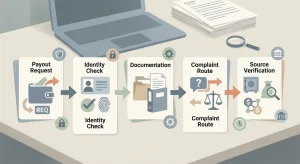
A casino’s deposit threshold applies to account funding, while each game sets its own permitted stakes.
Online and Mobile Casinos: What a £20 Minimum Means
A £20 minimum deposit is an account-funding threshold set by a casino. It means that a deposit below that amount will not meet the stated minimum for the relevant account or cashier transaction. It does not mean that £20 must be placed on a single game, or that every session has to begin with a fresh £20 payment. The deposit is credited to the account for play; the amount staked is determined separately when a game is used.
The distinction matters because a cashier minimum and a game’s permitted stake answer different questions. The cashier sets the amount that can be added to the balance in a transaction. A game sets the amounts that can be wagered within it. Many online slots accept bets from £0.10 to £0.20 per spin, so a £20 account minimum can be substantially higher than the amount needed for an individual spin. Those figures describe a range of available stakes, not a promise about how long a balance will last or what a player will win.
If you’re looking for a UK casino with a £20 minimum deposit in 2026, check the available payment and withdrawal details before choosing. This reference card notes the payout speed provided for each operator.
1. NightLuck
Payout speed: 1-3 business days NightLuck lists a payout speed of 1–3 business days.
2. Jetsetspins
Payout speed: 1-3 business days Jetsetspins lists a payout speed of 1–3 business days.
3. SpinFormula
Payout speed: 1-3 business days SpinFormula lists a payout speed of 1–3 business days.
4. Revery Play
Payout speed: 1-3 business days Revery Play lists a payout speed of 1–3 business days.
5. WinBeast
Payout speed: 1-3 business days WinBeast lists a payout speed of 1–3 business days.
6. x3bet
Payout speed: 1-3 business days x3bet lists a payout speed of 1–3 business days.
7. SlotoSport
Payout speed: 1-3 business days SlotoSport lists a payout speed of 1–3 business days.
8. BeOnBet
Payout speed: 1-3 business days BeOnBet lists a payout speed of 1–3 business days.
9. Zombillion
Payout speed: 1-3 business days Zombillion lists a payout speed of 1–3 business days.
10. NightWin
Payout speed: 1-3 business days NightWin lists a payout speed of 1–3 business days.
A stated minimum also should not be read as a required balance. If £20 is the lowest amount accepted when making a deposit, it does not follow that the account must continuously hold £20, or that the full amount must be wagered at once. The casino’s account rules determine how deposits are credited and used, while each game’s own stake options determine the cost of a particular play. The two thresholds are related only in the practical sense that the deposit supplies the balance from which stakes may be taken.
The same distinction applies when a casino is accessed on a phone. A mobile casino may be reached through a website designed for a smaller screen or through an app, but the device is not itself a separate kind of account balance. A £20 minimum shown in an operator’s cashier concerns depositing to the account, not the size of a screen or the format in which a game is opened. Whether a particular operator displays the same cashier options across its website and app depends on its own arrangements; a mobile label alone does not establish a different minimum.
This is why the wording on a casino’s cashier page is more useful than the general description “mobile casino”. A site may be usable on mobile while still applying its own account-funding rules. The minimum should be understood as the amount required for the relevant deposit option at that operator, rather than as a universal rule for all online casinos in Britain. Some UK casinos accept deposits as low as £1, which demonstrates that £20 is not a market-wide minimum. It is a threshold attached to particular operators or account arrangements.
There is also a difference between an advertised minimum and the amount that can be selected in a transaction. If the cashier identifies £20 as the minimum, selecting a lower amount would not satisfy that requirement. Conversely, the presence of a £20 minimum does not establish that larger deposits are necessary for ordinary access to the account. The threshold says where acceptance begins; it does not describe the full range of account balances or dictate how the balance is spent.
£2 Minimum Deposit Casinos in the UK: What to Know
For an online account, deposits are part of real-money gambling and are subject to UK rules. Legal online casinos serving British customers must hold the relevant UK Gambling Commission operating licence, and customers must be at least 18. Operators must verify age before allowing deposits. They must also prompt new customers to set a financial limit before their first deposit and provide accessible account-level limit controls. These requirements concern access and account safeguards, not the meaning of the £20 figure itself.
Accordingly, “£20 minimum deposit” should be read narrowly: it describes a minimum amount for funding an account through the stated cashier arrangement. It does not mean that every game costs £20 to play, nor does it turn a £20 deposit into a compulsory stake. On mobile as on desktop, the deposit threshold and the game-level stake remain separate parts of the account experience. A minimum-deposit description is therefore most precise when treated as a rule about adding funds, rather than as a measure of the cost of each play.
How £20 Fits into the UK Deposit Tiers
A £20 cashier minimum sits at the higher end of the deposit thresholds described for UK casinos accepting direct banking. A specialist review gives £10 as the typical minimum in that group, while noting that some operators set the threshold at £5 and others at £20. That range places a £20 minimum within the reported market picture, but not at its central point. It is a particular operator’s entry condition, rather than a universal UK requirement.
The distinction matters because “minimum deposit” describes the amount needed to fund an account, not a standard applied across every casino. A site with a £20 minimum may be unsuitable for someone intending to start with less, even if another UK-licensed casino permits a smaller initial deposit. Conversely, the existence of lower thresholds does not make a £20 minimum unusual or invalid. Deposit tiers reflect operator rules, and the amount should be read as a property of the specific cashier rather than as a general market boundary.
£3 Minimum Deposit Casinos in the UK: What to Check
Direct-banking thresholds offer a useful comparison because the reported £10 figure provides a reference point for the £20 tier. The review’s account of operators setting minimums at £5 or £20 also shows that the thresholds are not evenly distributed around that reference point. A casino requiring £20 is therefore at the upper end of the specific range reported for direct banking, whereas a £5 minimum is at the lower end. These comparisons describe reported operator settings; they do not establish that every site using a particular payment route has the same limit.
For an account funded under a £20 rule, the practical consequence is straightforward: an amount below the cashier minimum cannot meet the stated entry condition. The threshold can therefore matter more than a casino’s general description of its games or account features when the intended starting balance is lower. It also separates two questions that are sometimes conflated: how much is required to open a funded balance, and how much might later be available to withdraw. The deposit threshold answers only the first.
Withdrawal thresholds are a separate tier. A specialist review reports minimum withdrawal requirements ranging from £10 to £20 at many UK casinos. This is a reported range, not a fixed rule applying to all operators, and it should not be treated as a guarantee about any particular account. Comparing it with a £20 deposit minimum shows why the two figures should not be assumed to match: one governs the amount needed to deposit, while the other concerns the minimum balance or payout request accepted for withdrawal. They may coincide at an operator, but one figure does not establish the other.
That distinction is relevant when assessing what a £20 minimum means in practice. Depositing the required amount satisfies the cashier’s entry condition, but it does not establish that a balance can be withdrawn in any amount or at any time. The site’s separate account rules determine the withdrawal threshold. A £20 deposit requirement should therefore not be read as evidence that £20 is also the minimum payout, nor that a deposit of that size will necessarily produce a withdrawable balance.
Do
- Check the cashier’s specific deposit minimum
- Verify the separate withdrawal threshold
- Treat each threshold as an independent rule
Don’t
- Assume the deposit minimum is a market rule
- Confuse the entry condition with payout rules
- Use the deposit figure as a guide for withdrawals
The tier also should not be confused with a legal minimum imposed across the UK. The reported figures describe operator-level conditions. UK online casinos serving customers in Great Britain must hold the relevant Gambling Commission licence, but the licensing requirement does not make their cashier minimums identical. Consequently, a £20 minimum deposit casino is best understood as one with a higher account-funding threshold than operators reporting lower direct-banking minimums, not as a separate regulatory category.
When comparing stated tiers, the useful questions are limited but precise: what amount does the cashier require, does that amount apply to the intended account, and what separate minimum applies to withdrawals? The first figure establishes whether an account can be funded at the planned level. The withdrawal figure concerns a different transaction and must be checked independently. Keeping those thresholds distinct gives a more accurate picture of where a £20 minimum sits than treating the deposit amount as a guide to every later account condition.
Assessing Claims About the Best and New £20-Deposit Casinos
A claim that a casino is among the best places to deposit £20 combines two separate judgements: whether its cashier accepts that amount and whether it compares favourably with alternatives. The first can be checked against an operator’s current terms. The second needs defined criteria and evidence that the same criteria have been applied across a relevant group of casinos. Without that comparison, “best” is a promotional description rather than a substantiated ranking.
£4 Minimum Deposit Casinos in the UK: How It Works
The amount named in a headline does not, by itself, show that £20 is the minimum deposit. It may describe a deposit level used in an offer, a recommended starting balance or a threshold attached to a particular payment route. The cashier terms are the more direct way to establish the operator’s minimum, and those terms may change. A claim should therefore be read in relation to its date and to the precise condition being described.
A specialist casino review reported six UK Gambling Commission-licensed casinos with genuine £1 cashier minimums at the time of its assessment. That is a specific finding about low minimum deposits; it does not establish a ranking of casinos requiring £20, nor does the lower threshold make any of those operators “best” for a £20 deposit. The comparison would need to address casinos with the relevant £20 condition and use consistent measures of quality.
“New” also requires a clear basis. A recently published review or a recently advertised offer does not necessarily mean that the casino itself has newly launched. To substantiate a new-casino claim, the relevant distinction is the operator’s actual launch status, rather than the age of a page or promotion. A site may also be new to a particular list without being a newly launched operator. These meanings should not be treated as interchangeable.
A useful assessment separates the claims before considering them together:
- Minimum deposit: Does the operator’s cashier state that £20 is the minimum, and does that apply to the payment method being discussed?
- Newness: Is the claim about a newly launched casino, a new offer or simply a newly published review?
- “Best” status: Are the comparison criteria explicit, and are the casinos being assessed on the same basis?
A ranking that answers only the first point cannot establish the other two. Nor does a deposit threshold alone reveal whether a casino is suitable for a particular player. A defensible “best” label would need to explain what is being compared and why the chosen criteria matter, rather than relying on the deposit figure as a proxy for quality.
The wording around bonuses also needs care. “No deposit bonus” refers to a different offer condition from a £20 minimum deposit. The two phrases may appear together in advertising, but one does not prove the other. A casino’s deposit threshold cannot establish whether a promotion is available or what conditions attach to it; those are separate terms and should not be inferred from a headline.
For UK-facing real-money casinos, regulatory status is another distinct issue. Operators serving the British market must hold the relevant Gambling Commission licence. That requirement establishes a regulatory condition, not a quality ranking: a licence does not, on its own, show that one casino is better than another for a £20 deposit.
Assessing Casino Claims
Step 1: Verify Deposit Minimum
Check the operator’s cashier to confirm if £20 is the actual minimum for the chosen payment method.
Step 2: Evaluate Newness
Determine if the operator has actually launched recently or if only a promotion or review is new.
Step 3: Compare Quality
Apply explicit, consistent criteria to see if the casino performs better than other £20-deposit alternatives.
Accordingly, claims about the best new UK casino for a £20 deposit are strongest when they specify what “new” means, identify the cashier condition and set out a consistent comparison method. Where those elements are absent, the label remains difficult to verify. A £20 figure is a useful starting point for checking terms, but it cannot carry the wider claims of newness and superiority on its own.
£20-Deposit Casinos and GamStop Status
A £20 cashier minimum describes the amount an operator requires for a deposit; it does not indicate whether the casino participates in GamStop. The two details concern different things. The deposit threshold is a payment condition, while GamStop status relates to the operator’s connection with a self-exclusion service. A site accepting a £20 deposit cannot be classified as inside or outside the scheme on that basis alone.
The same distinction applies to mobile casinos and deposits made by text message. A payment route, where offered, does not establish an operator’s GamStop status, and a £20 minimum does not show which deposit methods are available. Those details need to be assessed separately rather than inferred from the amount shown in the cashier.
GamStop status also does not establish whether a casino is authorised to serve customers in Britain. Remote gambling operators offering services to the British market must hold the relevant licence from the UK Gambling Commission, regardless of where the operator is based. A casino’s claims about being outside a self-exclusion scheme should therefore not be treated as a substitute for its regulatory status.
For someone who has chosen self-exclusion, seeking a site that is not covered by that decision could undermine the purpose of the restriction. A deposit threshold does not alter that concern, nor does it provide a reliable indication of what protections or controls are in place. The relevant issue is not whether the minimum is £20, but whether the operator’s status and the individual’s circumstances make gambling appropriate.
It is also important not to treat “not on GamStop” as a single, sufficient description of a casino. It does not, by itself, confirm the operator’s licensing position, the terms governing an account, or the availability of particular payment options. Equally, a low or high minimum deposit says nothing about whether the site is connected to the scheme. These are separate attributes and should not be collapsed into one claim.
GamStop Caution
Seeking a site outside of GamStop to bypass a self-exclusion decision undermines the purpose of the restriction and the individual’s gambling protections.
Accordingly, a £20 minimum deposit casino in the UK cannot be identified as outside GamStop merely from its deposit requirement. The amount is a cashier condition, not evidence of scheme membership or regulatory approval. Any claim about GamStop should be considered independently from the minimum deposit, and any claim about serving British customers should be considered in light of UK licensing requirements.
Using a £20 Deposit for Online Slots
A £20 cashier minimum is an account-funding condition, not the price of a slot spin. Once funds are in the account, the stake is selected within the limits set by the game and operator. Many online slots accept bets of £0.10 to £0.20 per spin, so a £20 balance can cover a different number of spins depending on the stake chosen and the results of play.
At those stakes, £20 would equal 100 spins at £0.20 each or 200 at £0.10 if every spin returned nothing. That is only a spending illustration, not a prediction of session length: wins can change the balance, and losses reduce it. A deposit amount therefore cannot establish how long play will last. The balance may also be used across different games, subject to the casino’s rules.
The distinction matters when comparing slots sites with a £20 minimum deposit. A site may require that amount to fund an account even though its games permit much smaller individual bets. Conversely, a lower stake does not mean that the account can be opened or funded with an equally small deposit. The cashier threshold and the game’s stake options are separate conditions.
No minimum deposit casino UK: what £1 really means
In Britain, online slots cannot offer autoplay. Each spin must be initiated individually and last at least 2.5 seconds. This means a player cannot set a sequence of spins to run unattended, and the minimum duration places a floor on the time taken by each spin. It does not, however, determine the overall length of a session or how much of the balance remains.
A £20 starting balance should therefore be understood as a limit on funds initially placed in the account, not as a required stake or a guaranteed amount of play. The chosen stake affects how quickly that balance may change, while game outcomes remain uncertain. Before making a first deposit, UK-licensed operators must prompt new customers to set a financial limit and make account-level limit controls available. That safeguard is separate from the cashier minimum and from the stake selected for a slot.
Online gambling in Great Britain is legal when provided by an operator holding the relevant UK Gambling Commission licence. For online slots, the maximum stake per game cycle is £5 for customers aged 25 and over, and £2 for those aged 18 to 24. These are upper limits, not recommended stakes; the smaller bets available on many slots allow play below them.
Bonus Eligibility and Wagering on a £20 Deposit
A cashier minimum and a bonus qualifying deposit are separate conditions. A casino may accept a £20 payment without that payment meeting the terms of a welcome offer. Eligibility depends on the promotion’s stated minimum qualifying deposit, not solely on the amount required to open or fund an account.
Bonus Eligibility
A £20 deposit may fund an account but not necessarily meet the higher minimum qualifying deposit required for a welcome bonus.
A specialist review has reported that some UK casinos exclude their lowest deposit bracket from welcome promotions. This makes it important to distinguish a £20 minimum deposit casino bonus from a £20 cashier minimum: the same figure may apply to both, but one does not establish the other. The promotion’s terms should specify the deposit needed to qualify and identify any restrictions. Where the terms do not make that clear, eligibility cannot be inferred from the cashier threshold.
The same distinction applies to a no-deposit bonus. By definition, it is not activated by making a qualifying deposit, so a £20 cashier minimum alone does not show whether such a promotion is available or what conditions apply. Any offer still needs to be assessed on its own stated eligibility and wagering terms; the label “no deposit” does not establish that winnings can be withdrawn without conditions.
For gambling incentives, the wagering ceiling changed on 19 January 2026. Since that date, the UK Gambling Commission has limited wagering requirements to 10x the bonus funds. This cap concerns the amount of incentive funds that must be wagered, rather than the amount deposited. A £20 payment therefore does not itself determine the wagering target. The offer’s terms should state how the requirement is calculated and which funds or games count towards it.
Other conditions remain relevant to the value of an offer. Bonus funds must expire within 7 to 30 days, and bets made while wagering those funds must not exceed £5 per spin. These restrictions can affect whether the bonus can be used as described, even when the deposit satisfies the qualifying threshold. A promotion should be judged from its complete terms rather than from the headline bonus or minimum deposit alone.
Online Casinos With No Sister Sites in the UK
The practical conclusion is narrow: a £20 minimum deposit does not guarantee access to a welcome bonus, and it does not establish that a no-deposit offer exists. Eligibility depends on the promotion’s own terms, while wagering requirements for gambling incentives are subject to the 10x cap in force from 19 January 2026.
Payment Methods at Casinos with a £20 Minimum
A casino’s stated £20 minimum deposit is not necessarily a separate rule for every payment option. At a given UK operator, the cashier minimum is generally consistent across the available methods. There can be an exception for direct banking: some casinos set a higher threshold for bank transfers than for debit cards or e-wallets. The exact amount therefore depends on the operator and the selected route, rather than on the £20 figure alone.
This distinction matters when a deposit is declined or the cashier displays a different minimum. A site may accept a particular amount through one method but require more through another. The cashier’s payment-specific terms are the relevant place to confirm the threshold before proceeding; a general statement that the casino has a £20 minimum may not describe every route precisely. Payment availability and limits should be treated as operator-specific, not assumed to be identical across casinos.
UK gambling payment rules also determine which funding sources are permitted. The UK Gambling Commission’s 2020 credit-card gambling ban means deposits cannot be made using credit cards. Permitted routes include debit cards, bank accounts and e-wallets funded with debit-card money. A wallet cannot be used for gambling if it allows credit-card funds to be used for the transaction. This restriction applies to the funding source, even where the payment is presented through an intermediary service.
Credit Card Ban
Under UK Gambling Commission rules, deposits cannot be made using credit cards, including e-wallets funded with credit-card money.
A £20 cashier minimum does not make a credit-card deposit acceptable, nor does it alter the rules attached to a payment method. For a compliant deposit, the funds must come through an allowed route. Debit-card payments and direct banking are distinct from credit-card borrowing, while e-wallet use depends on how the wallet is funded and whether it permits credit-card money to reach gambling transactions.
Before a first deposit, the operator must prompt a new customer to set a financial limit and provide accessible account-level controls for managing limits. Age checks must also take place before deposits are allowed, and UK players must be at least 18. These requirements are separate from the cashier minimum: meeting a payment threshold does not replace the operator’s obligations.
The practical comparison is therefore between the minimum shown for each permitted method, not simply between casinos advertised as accepting £20. Where one method has a higher threshold, that is a payment-specific condition rather than evidence that the operator’s general minimum has changed. Payment rules and cashier settings should be read together, while avoiding any method that relies on credit-card funds.
Checking the Reliability of £20-Deposit Casino Sites
A £20 cashier minimum says how much an account must receive in a deposit; it does not, by itself, establish whether the casino is reliable. A site’s appearance or the size of its minimum deposit is not evidence of regulatory oversight. For customers in Great Britain, the relevant starting point is whether the operator holds a current licence from the UK Gambling Commission for the gambling services it provides. Operators serving this market must be licensed even when based elsewhere.
Age controls are another basic safeguard. Gambling is restricted to people aged 18 or over, and an operator must verify a customer’s age before allowing a deposit. A registration screen that asks for a date of birth is not a substitute for completing the required checks. The timing matters: funds should not be accepted before the operator has established that the customer is eligible to gamble.
The initial account process also has a specific protection. Remote operators must prompt new customers to set a financial limit before their first deposit, and account-level controls must remain accessible. This does not demonstrate that a particular site is trustworthy in every respect, but it is a practical test of whether a required safeguard is built into the customer journey.
The complaints process offers another point to examine. UK-licensed operators must provide an internal route for complaints and access to an approved Alternative Dispute Resolution service. Their terms should explain how a complaint can be raised and how an unresolved dispute may proceed. A site that gives no clear information about these routes warrants closer scrutiny; a published procedure, however, is not proof that every complaint will be decided in a customer’s favour.
These checks are more informative than treating “safe £20 minimum deposit casino” as a category with a single defining feature. The deposit threshold cannot verify an operator’s licence, age controls, account-limit tools or dispute arrangements. Nor does a generic claim that a casino is trusted establish that these safeguards are in place.
A reliable assessment therefore depends on operator-specific evidence, not a ranking based on the £20 figure alone. The relevant questions concern the legal permission to serve the market and whether the required protections are present before and after depositing. This distinction is important across UK casino sites with a £20 minimum: the amount accepted at the cashier is a payment condition, not a safety credential.
Reliability Check
- Confirm the operator holds a UK Gambling Commission licence
- Verify that age checks are completed before depositing
- Ensure a financial limit prompt appears before the first deposit
- Check for a clear internal complaints and ADR process
Real-Money Play and Cashing Out
A £20 minimum deposit describes the amount required to fund an account; it does not establish the minimum balance that can be withdrawn. These are separate cashier conditions. A real-money online casino may accept a deposit of £20 while applying a different threshold to a cash-out request, so the deposit figure alone cannot show whether a particular balance is eligible for withdrawal.
A specialist review reports withdrawal minimums of £10 to £20 at many UK casinos. That range is an attributed finding, not a rule applying to every operator. The relevant figure is the one in the casino’s current withdrawal terms. A threshold can affect a balance that is smaller than the permitted cash-out amount, even when the account was opened with a deposit that met the cashier minimum.
The distinction also matters when the account balance has changed through play. The amount deposited and the amount available to withdraw are not necessarily the same: the balance at the time of a request is what must be considered alongside the operator’s withdrawal conditions. A £20 deposit does not guarantee that £20 will remain in the account, nor does it prove that a resulting balance meets the withdrawal minimum.
For anyone comparing real-money £20-minimum deposit casinos in the UK, withdrawal terms should therefore be checked independently of deposit terms. The cashier information should state the minimum amount for a withdrawal and any applicable conditions. If those terms are unclear, the deposit threshold is not a reliable substitute for them.
This separation avoids treating a £20 entry point as a promise of access to a particular cash-out amount. The minimum deposit governs money going into the account; the withdrawal minimum governs the amount that can be requested from it. Neither figure, on its own, describes the other. A site’s terms are needed to determine how its own cashier handles a real-money balance.
PayPal and Other E-Wallet Deposits
A £20 cashier minimum is set by the casino, not by the wording of a payment option. The available information does not establish a PayPal-specific minimum deposit for UK casinos, so the presence of PayPal as a cashier choice cannot by itself show whether a £20 deposit is required. The operator’s stated threshold remains the relevant figure.
Payment method does not, in itself, give direct banking deposits different welcome-bonus treatment from card or e-wallet deposits at UK-licensed casinos. The same bonus terms apply across those methods. Eligibility therefore depends on the offer’s conditions, rather than on whether the qualifying payment is made through direct banking, a card or an e-wallet. A cashier minimum and a bonus’s qualifying deposit requirement are separate conditions; meeting one does not automatically establish that the other has been met.
This distinction matters when a site lists a welcome offer beside several deposit methods. The payment route does not alter the wagering requirements, game restrictions or maximum withdrawal caps attached to the bonus. Those conditions apply to the bonus amount, regardless of the method used to deposit. The cashier display and the promotion’s terms should therefore be read as separate parts of the transaction.
For gambling deposits, UK rules exclude credit cards. E-wallet payments must also comply with restrictions on credit-card funding: operators cannot accept wallet payments where credit-card funds can be used for gambling. A compliant e-wallet route is distinct from an unrestricted promise that every wallet or account configuration will work.
Remote operators must prompt new customers to set a financial limit before the first deposit and provide accessible account-level controls. This requirement applies before depositing through an e-wallet just as it does with other permitted routes. The payment brand alone does not determine the casino’s minimum, the offer’s eligibility conditions or whether the transaction is permitted; those questions depend on the operator’s cashier and the applicable terms.
Which payment method is best for low-deposit casino players?
Debit cards and some e-wallets support £1 deposits. Check the casino’s cashier for payment-specific minimums, as some methods may have a higher minimum.
What is the smallest deposit I can make at these casinos?
The lowest deposit tier is £1, although it is rare and may be available only through particular payment methods. NetBet is the only UKGC-listed casino identified with a £1 cashier minimum.
Can I take out winnings from a £1 deposit?
You may be able to, but a £1 deposit does not guarantee that you can withdraw £1: minimum withdrawal limits can be higher. Some casinos set them at £1–£5, while many set them at £10–£20.
Can I use a £1 deposit to claim all welcome bonuses?
No. Welcome offers commonly require a £5–£10 deposit, and some casinos exclude their lowest deposit bracket; some bonuses require at least £10.
What is the maximum wagering requirement in Great Britain?
Since 19 January 2026, gambling incentives in Great Britain cannot require more than 10× wagering of bonus funds.
Material created by the team NationalBet Casino UK