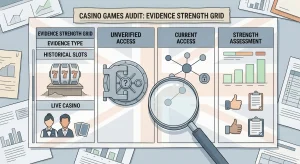
The cashier minimum is only an account threshold; payment routes, withdrawal limits and bonus conditions can change how a small balance works.
What a £3 Minimum Deposit Means in Practice
A £3 minimum deposit is a low entry point, but it does not define what a player can afford to lose or how long a balance will last. It describes the smallest amount accepted at the cashier under the relevant conditions. Those conditions may differ between casinos, so the amount should be understood as an account threshold, not as a recommended budget.
UK casino minimums do not sit at a single level. Some casinos accept deposits of £1, making that a rarer tier below £3; a £3 threshold therefore occupies the lower end of the range without being the absolute minimum. The distinction matters because a site that accepts a small deposit is not necessarily offering the same terms as one with a different cashier minimum. Nor does a low threshold establish that every payment route or account will allow that amount.
The available evidence illustrates how limited the £1 tier is. A specialist review reported verifying six UK Gambling Commission-licensed casinos with a genuine £1 cashier minimum. That is a finding from a particular review, rather than a permanent count of the UK market. Minimums can change, and the figure should not be treated as a complete or timeless inventory. It does, however, show why a £3 minimum can be described as low without being the lowest possible entry point.
If you’re looking for a UK casino with a £3 minimum deposit, check the deposit terms before signing up, as they are not specified in the details available here. The payout information below can help you assess one part of the picture.
1. NightLuck
Payout speed: 1-3 business days The listed payout speed is 1–3 business days. No deposit-minimum details are provided here.
2. Jetsetspins
Payout speed: 1-3 business days The listed payout speed is 1–3 business days. No deposit-minimum details are provided here.
3. SpinFormula
Payout speed: 1-3 business days The listed payout speed is 1–3 business days. No deposit-minimum details are provided here.
4. Revery Play
Payout speed: 1-3 business days The listed payout speed is 1–3 business days. No deposit-minimum details are provided here.
5. WinBeast
Payout speed: 1-3 business days The listed payout speed is 1–3 business days. No deposit-minimum details are provided here.
6. x3bet
Payout speed: 1-3 business days The listed payout speed is 1–3 business days. No deposit-minimum details are provided here.
7. SlotoSport
Payout speed: 1-3 business days The listed payout speed is 1–3 business days. No deposit-minimum details are provided here.
8. BeOnBet
Payout speed: 1-3 business days The listed payout speed is 1–3 business days. No deposit-minimum details are provided here.
9. Zombillion
Payout speed: 1-3 business days The listed payout speed is 1–3 business days. No deposit-minimum details are provided here.
10. NightWin
Payout speed: 1-3 business days The listed payout speed is 1–3 business days. No deposit-minimum details are provided here.
A low minimum is most useful as a way to control the amount initially transferred, provided that the amount is genuinely affordable. It cannot make gambling financially safe by itself. A small deposit can be lost quickly, and a person may deposit again after the initial balance is spent. The relevant financial limit therefore needs to be set before the first deposit, rather than inferred from the cashier’s minimum.
UK-licensed remote operators must prompt new customers to set a financial limit before their first deposit and make account-level limit controls accessible. This is distinct from the minimum deposit: the cashier threshold controls the smallest permitted payment, while a personal limit sets a boundary on spending. These figures serve different purposes. A low entry amount should not be used as a substitute for deciding how much can be spent without affecting essential costs or other financial commitments.
The difference between a minimum and an affordable amount is especially clear where promotional eligibility is involved. A specialist review described welcome offers as commonly requiring a deposit in the £5 to £10 range. On that account, a £1 payment can fund an account without meeting the qualifying amount for a promotion. That range is a time-sensitive description of offers, not a rule applying to every casino. The cashier minimum and the amount required for a promotion are separate conditions, and the latter must be considered on its own terms.
£4 Minimum Deposit Casinos in the UK: How It Works
This distinction also prevents a common misreading of the phrase “minimum deposit.” It refers to the lowest payment the operator will accept in the circumstances described, not necessarily the amount needed to access every feature or offer. A £3 threshold does not imply that a promotion starts at £3, nor that the amount will produce a particular duration of play. Those outcomes depend on separate terms and on what happens after the funds enter the account.
Age is another threshold that precedes any question of deposit size. UK players must be at least 18 years old to gamble online legally at a UK-licensed casino. A low cashier minimum does not alter that requirement. Licensed operators must verify a customer’s age before allowing a deposit, so the small size of a payment does not make the activity exempt from the account’s controls.
In practice, the meaning of a £3 minimum deposit is narrow: it identifies a low permitted starting payment, situated above the rarer £1 tier. It does not establish affordability, promotional access or the likely value of play. Treating those questions separately gives the figure its proper significance without assigning it more than it can show.
How to Assess a £3 Casino Claim
A stated £3 minimum is only meaningful if it describes the amount accepted for a real-money deposit, rather than a promotional threshold or a headline detached from the cashier’s conditions. The claim should therefore be checked against the operator’s own terms and the deposit process for a UK account. A figure on an advertisement or comparison page is a starting point, not proof that every customer can fund an account with that amount.
Do
- Check the operator’s own current terms
- Verify the cashier screen for the specific payment route
- Confirm the operator holds a UKGC licence
Don’t
- Rely solely on a third-party summary
- Assume a general minimum applies to all payment methods
- Treat a promotional figure as proof of cashier conditions
The first distinction is between the operator’s general cashier minimum and the minimum attached to a particular payment option. The cashier may display a general threshold while individual methods have separate conditions. A claim that a casino accepts £3 should specify whether the amount applies to the payment route being considered, and whether it is available to customers in the UK. If the terms and the cashier disagree, the claim remains unclear until the operator’s current conditions resolve the difference.
It also matters whether the stated amount is accepted as a deposit in its own right. A promotional page may use a small figure to describe an offer, while the account’s actual funding conditions set another threshold. Conversely, a site may accept a small deposit but impose separate rules on what that deposit can be used for. These are different claims and should not be treated as interchangeable: acceptance into the account does not, by itself, establish eligibility for an offer or access to every feature.
A useful check is to read the operator’s deposit terms alongside the cashier screen, rather than relying on a short description of the site. The terms should identify any method-specific minimums, account restrictions and conditions that affect the amount accepted. The cashier should then show whether the relevant amount can be entered and processed for the account in question. If the listed minimum appears only in an old promotion, or is absent from the operator’s current information, it is not sufficient evidence of a current £3 option.
£2 Minimum Deposit Casinos in the UK: What to Know
There can also be a gap between a platform’s technical minimum and the amount needed to qualify for a promotion. A specialist review has reported cases in which an operator accepts deposits of £5 but requires £10 for a qualifying bonus. That does not establish a general rule across casinos; it illustrates why the cashier minimum and the promotional minimum need separate checks. A casino may accept a £3 deposit without making that deposit eligible for a welcome offer. The offer’s own terms, not the general deposit claim, determine eligibility.
A related issue appears at the lowest deposit levels. A specialist review has described casinos that do not count £1 deposits towards welcome offers, restrict some payment methods at that level, or set withdrawal thresholds above the deposit minimum. Those observations concern particular cases and should not be applied to every operator. They do show why a minimum-deposit claim should be read narrowly: it may confirm that a small amount can enter an account without establishing that the same amount qualifies for other conditions.
The operator’s identity and regulatory status are separate checks from the amount itself. In Great Britain, a remote gambling operator serving consumers must hold the relevant UK Gambling Commission licence. A low cashier minimum does not establish that an operator is licensed, and a licence does not prove that a particular deposit threshold is available. Both points need independent confirmation. Online gambling is legal in the UK for adults aged 18 and over when the operator holds a UKGC licence; operators must verify age before allowing deposits.
The account setup process is another practical part of the assessment. Remote operators must prompt new customers to set a financial limit before their first deposit and provide accessible controls for account limits. A claim about a small entry amount should not be read as encouragement to deposit without first deciding on a financial boundary. The advertised minimum describes a transaction condition, not what is affordable or suitable for an individual.
Assessing a £3 Casino
- Verify the casino is licensed by the UK Gambling Commission
- Check if the £3 minimum applies to the chosen payment method
- Set a personal financial limit before the first deposit
- Confirm if the deposit amount meets promotional eligibility
- Review the minimum withdrawal threshold
Where information is inconsistent, the discrepancy should be treated as unresolved rather than resolved in favour of the lowest figure. An operator’s current terms and cashier are more directly relevant than a third-party summary, but they still need to agree on the deposit route and any eligibility conditions. If the operator’s public information does not explain the difference, its customer-support response may clarify the terms; a clear answer should identify the applicable minimum and any relevant restriction, rather than merely repeating a promotional phrase.
Accordingly, a “legit £3 minimum deposit” claim has several distinct parts: a current UK-facing cashier must accept the amount, the relevant payment option must permit it, and the operator must be appropriately licensed. Promotional eligibility is a separate matter, and the claim should not imply it unless the offer terms explicitly support it. Without those distinctions, “£3 minimum” may be technically accurate but incomplete.
Online Casino Deposit and Withdrawal Thresholds
A casino’s minimum deposit and minimum withdrawal are separate account rules. The first sets the smallest amount the cashier will accept when adding funds; the second sets the balance that must be available, or the amount that can be requested, before a withdrawal can be submitted. A low entry threshold therefore does not establish that the same small amount can later be taken out.
A specialist review reports minimum withdrawal thresholds of £10 to £20 at many UK casinos. That is a reported range, not a fixed rule for the market: each operator sets its own conditions, and those conditions may change. Where a cashier accepts a deposit of £3 but the withdrawal threshold is higher, the two amounts do not conflict. They govern different transactions. The deposit rule concerns funding the account, while the withdrawal rule concerns access to funds already held there.
No minimum deposit casino UK: what £1 really means
The distinction matters when assessing a casino advertised as accepting a £3 minimum deposit. The claim may accurately describe the smallest permitted deposit without describing the full movement of money through the account. A withdrawal threshold could mean that a balance below the stated minimum cannot be requested as a payout at that time. It does not, by itself, show that funds are forfeited; the operator’s account terms determine how the threshold works and what happens to a balance that falls below it.
The amount displayed in a cashier can also be conditional. The relevant figure is the minimum that applies to the account and transaction being made, rather than a headline amount considered in isolation. A cashier may set a general minimum, while its terms distinguish between deposit and withdrawal rules. Those rules should be read separately, since a single label such as “minimum” can otherwise obscure which transaction it describes.
Deposit thresholds can differ between operators even within the same regulated market. A specialist review puts the minimum deposit at UK casinos accepting direct banking at £10 as a typical figure, while recording operators with thresholds of £5 or £20. Those figures describe reported operator settings; they should not be treated as a guarantee about a particular account. The cashier is the relevant place to confirm the amount currently accepted, with the operator’s terms providing context where the display is unclear.
A casino’s minimum deposit and minimum withdrawal are separate rules; a low entry threshold does not guarantee that the same small amount can be requested as a payout.
Within one operator, the cashier minimum is generally consistent across payment methods, although some casinos impose a higher minimum for direct banking than for cards or e-wallets. This means the account may have a common deposit threshold while a particular route has an additional condition. A £3 claim should therefore be understood as applying only where that amount is accepted for the selected transaction, not necessarily as a universal threshold across every route offered by the casino.
It is useful to distinguish three questions when reading a threshold: what amount the casino accepts as a deposit, what amount must be present before a withdrawal can be requested, and whether the rules differ by transaction route. These are not interchangeable measures. In particular, a listed minimum deposit cannot be used to infer a minimum withdrawal, nor can a withdrawal figure be assumed to apply to deposits.
A higher withdrawal minimum can affect how a small balance is managed, because the balance may remain below the amount eligible for a payout. The practical consequence depends on the exact wording of the operator’s rules. The threshold may be expressed as a minimum request, or as a minimum balance required to process one; the two formulations should not be assumed to mean precisely the same thing. The terms should also clarify whether any other account conditions affect a withdrawal. No general conclusion about those conditions follows from the deposit figure alone.
For a search for an online casino with a £3 minimum deposit in the UK, the useful comparison is therefore not limited to whether £3 appears as an accepted deposit amount. The withdrawal threshold should be checked independently, alongside any differences between transaction routes. A casino can meet the deposit description while requiring a larger amount before a payout request is possible. Conversely, a withdrawal rule does not establish the minimum needed to fund the account.
Online Casinos With No Sister Sites in the UK
This separation also prevents misleading comparisons between operators. One site may advertise a lower cashier minimum but set a higher withdrawal threshold; another may have a higher entry amount and different payout terms. The deposit figure alone cannot show which arrangement better fits a particular account balance. Since thresholds are operator-specific and can change, current cashier information and the applicable account terms are more informative than treating a reported market range as universal.
Using a Small Deposit for Real-Money Mobile Play
A £3 deposit can provide a small real-money balance for mobile play, but the amount deposited does not determine how long that balance will last. Its practical reach depends mainly on the stake chosen for each spin and on the results of play. Many slots accept bets starting between £0.10 and £0.20 per spin, so a modest balance can cover multiple low-stake spins if no winnings or losses are counted in advance. That is a description of the stake scale, not a prediction of how many spins a deposit will fund.
On a phone, the same balance is used as it would be on a desktop account. The smaller screen does not increase the value of the deposit, and a mobile version of a casino does not make a low balance more durable. The key distinction is between access and affordability: being able to open a game on a mobile device does not establish that the money deposited is affordable or that the session will remain within a planned limit.
Financial Limits
Set a financial boundary before depositing; a low cashier minimum is not a substitute for deciding how much you can afford to spend.
A real-money mobile casino account should be treated as a gambling account, not as a way to test a game without financial consequences. UK-licensed operators must verify a customer’s age before permitting a deposit, and gambling is restricted to people aged 18 and over. They must also prompt new customers to set a financial limit before the first deposit and provide account-level controls for managing limits. A planned amount should therefore be set before depositing, rather than inferred from the fact that the cashier accepts a small sum.
The stake selected in a mobile game can quickly change the scale of play. A balance that supports repeated low-value spins can be used up more rapidly if the stake is raised. The displayed balance may also change after each spin, so the amount remaining should be monitored rather than assuming the original deposit will remain available throughout a session. A £3 cashier minimum is only an entry amount; it does not describe the pace or outcome of play.
Online slot rules also apply when slots are played on mobile devices. In Britain, a spin must last at least 2.5 seconds, and autoplay is prohibited. These rules do not guarantee a particular session length or a particular result. They set conditions for how online slots operate, while the balance continues to depend on stakes and outcomes.
There are practical limits to interpreting the word “minimum” in this context. The amount accepted at deposit is separate from the stake range of an individual game, and neither figure alone indicates what a mobile session will cost. A casino may accept a low deposit while the available games have different minimum stakes. The cashier and the game interface therefore answer different questions: one concerns the amount placed in the account, and the other concerns the amount risked on each play.
No-ID Verification at UK Casino Withdrawals
Payment access can also differ from mobile access. Debit cards and some e-wallets support transactions as low as £1, but a specialist review reported minimum withdrawal figures ranging from £1 to £5. Those figures are not a guarantee for a particular account or payment route. Depositing a small amount on a phone should not be taken to mean that the same amount can necessarily be withdrawn under identical conditions.
A £3 minimum deposit mobile casino is best understood as a claim about the entry point, not a measure of session value. The balance remains real money, and the relevant safeguards are a set financial limit, age verification and attention to the stake shown before each spin.
Bonuses, Free Spins and the Conditions on Winnings
A casino’s cashier minimum and its welcome-offer threshold are separate terms. A site may accept a small deposit while requiring a larger qualifying payment before a promotion is activated. Specialist reviews have reported that some UK casinos exclude their lowest deposit bracket from welcome offers; this is an operator-specific condition, not a rule that applies across the market. A £3 deposit therefore cannot be assumed to trigger a bonus simply because it is accepted.
The distinction also matters when an offer is described as a “no-deposit bonus”. The phrase refers to whether a qualifying deposit is needed to receive the promotion; it does not, by itself, establish that winnings can be withdrawn without conditions. The terms need to be checked for eligibility, the treatment of winnings, any game restrictions and the period in which the offer must be used. A promotion’s headline description is not a substitute for those rules.
Attention A £3 deposit may be accepted by the cashier but might not meet the higher qualifying threshold required to trigger a welcome bonus.
How wagering terms affect bonus value
Wagering requirements specify how much qualifying play must take place before bonus funds, or winnings linked to them, become withdrawable. Specialist reviews have recorded requirements of 30x to 65x the bonus value. Those figures should not be read as a current permitted range for UK offers: since 19 January 2026, the UK Gambling Commission has capped wagering requirements on bonus funds at 10x. Any offer available to customers after that change must be assessed against the cap, rather than treated as valid because similar terms appeared in older descriptions.
The amount used as the basis for wagering also matters. A multiple applied to bonus funds is not necessarily calculated on the same basis as one applied to winnings from free spins. The promotion’s wording should say which balance is subject to the requirement and how progress is counted. If it is unclear whether the requirement applies to the bonus, the spin winnings, or both, the stated headline value alone is insufficient to establish the funds’ cash value.
Free spins and resulting winnings
Some specialist reviews have described free-spin packages linked to a £1 deposit as containing 10 to 100 spins. That is a reported range from review material, not a dependable description of every offer or a promise that a £3 deposit will qualify. The number of spins says little about the value that can be withdrawn: the terms may attach wagering conditions to the winnings generated by those spins.
Specialist review material has reported wagering requirements of 30x to 65x on free-spin winnings. As with bonus-fund requirements, those figures do not override the UKGC’s 10x cap that took effect on 19 January 2026. The relevant terms should identify the amount to which wagering applies and whether the stated requirement concerns the winnings rather than the original deposit. If an offer combines deposited funds and free spins, each component may have its own eligibility and withdrawal conditions.
For a £3 minimum-deposit promotion, the practical check is therefore not merely whether the cashier accepts that amount. The offer must explicitly include deposits at that level, and its wagering terms must be compatible with the current UK rules. An advertised bonus that excludes the qualifying deposit, or relies on terms inconsistent with the cap, should not be treated as an available benefit. These conditions apply to UK-licensed promotions; an offer associated with a site outside the UK regulatory system is not an equivalent UK-licensed offer.
Slot Play on a Small Balance
A £3 balance can translate into several slot spins only when the selected game allows a sufficiently small stake. Many slots accept bets of £0.10 to £0.20 per spin, but the amount available does not determine how long play will last: each spin uses part of the balance, and a run of losing spins can reduce it quickly. The number of spins a small deposit might cover is therefore not a dependable measure of its value.
The minimum stake is set by the game, not by the casino’s cashier minimum. A site may accept a £3 deposit while offering slots whose lowest permitted bet is higher than the balance can support. Even where a game offers a low stake, its other settings can affect the amount committed on a spin. The displayed total bet, rather than a single coin or line value, is the relevant figure. Checking that amount before starting helps establish whether the game fits the available balance.
Maximum stake rules for bonus funds
When wagering bonus funds, bets must not exceed £5 per spin. If a specific promotion has a maximum-bet rule lower than this ceiling, those tighter restrictions apply.
Small stakes do not remove the uncertainty of slot outcomes. A low bet may make each individual spin cost less, but it does not ensure a return or preserve the starting funds. Nor does a £3 deposit imply that a particular number of spins is possible: the stake level, game settings and results all matter. Any comparison of minimum-deposit slot sites is more meaningful when it distinguishes the cashier minimum from the lowest playable stake.
Bonus funds add another set of limits. A promotional balance may be subject to wagering requirements or game restrictions, so the displayed amount should not be treated as unrestricted cash. Since 19 January 2026, incentives cannot require more than 10x wagering of bonus funds. That cap concerns the wagering requirement; it does not mean the bonus can be withdrawn immediately, nor does it remove other conditions attached to a promotion.
The maximum stake while wagering bonus funds is also constrained: bets must not exceed £5 per spin. This is a ceiling, not a recommended stake, and a lower game minimum remains relevant when the balance is small. If a bonus has a maximum-bet rule below that ceiling, its own terms may impose the tighter restriction. A stake that breaches the applicable bonus condition can affect eligibility for winnings, so the terms governing the specific promotion matter.
For real-money slot play, a fixed spending limit set before depositing provides a clearer boundary than relying on the small size of the initial balance. The limit should account for the possibility that the full deposit may be lost; a low entry amount is not evidence that continued play is affordable. Age verification is required before a customer can deposit at a UK-licensed casino, and slot play is available only to adults.
A £3 deposit can therefore be compatible with slot play, but it does not establish that every slot is accessible, that a bonus will apply, or that the balance will last for any set period. The practical test is whether the chosen game’s total stake fits the available funds and, where promotional funds are involved, whether the bet complies with the relevant conditions.
PayPal and Other E-Wallet Deposits
PayPal may be available as a casino payment option, but its presence does not by itself determine the cashier minimum. At a given UK operator, the stated minimum is generally shared across payment methods, although some casinos set a higher threshold for direct banking than for cards or e-wallets. The figure shown for an account therefore matters more than assumptions about PayPal as a payment type.
A £3 deposit made with PayPal depends on the casino’s own cashier rules and on whether PayPal is offered for that account. E-wallet support for a small transaction should not be treated as proof that every casino accepts the same amount through that wallet.
A specialist review reports that debit cards and some e-wallets can process transactions as low as £1. It also gives a £1 to £5 range for minimum withdrawals, but these are reported figures rather than a fixed rule for every operator. Deposit and withdrawal conditions can differ, so a low cashier minimum does not, on its own, establish that a small balance can be withdrawn at the same threshold.
Funding source is also relevant. The UK Gambling Commission’s credit-card gambling ban took effect in 2020. Casino deposits must therefore use permitted sources such as debit cards, e-wallets funded by debit, or bank accounts. An e-wallet is not a compliant workaround if the gambling payment uses credit-card funds. Remote operators also cannot accept credit-card gambling payments routed through a money service business, and wallets that allow credit-card funds to be used for gambling cannot be accepted.
Credit Card Ban
UK-licensed casinos cannot accept credit-card gambling payments, including those routed through e-wallets or money service businesses.
These rules distinguish an e-wallet’s role as a payment channel from the source of the money behind it. PayPal or another wallet can be considered for a small deposit only where the casino offers it and the funds comply with the restrictions. The cashier’s displayed threshold and the wallet’s funding route are separate details, both relevant to whether the transaction can proceed.
What Changed for Casino Bonuses in 2026
From 19 January 2026, the UK Gambling Commission’s cap limits wagering requirements attached to bonus funds to 10x. The change concerns how much qualifying play an incentive can require before the associated funds or winnings become available under its terms. It applies to gambling incentives, rather than changing the amount a casino accepts as a minimum deposit.
That distinction matters when comparing newly advertised casinos with a £3 cashier minimum. A low entry threshold and a bonus’s wagering condition are separate features: the deposit amount describes what is needed to fund an account, while the cap concerns the requirement attached to bonus funds. The 2026 change does not, by itself, establish that a particular casino accepts £3 or that a deposit at that level qualifies for an offer.
The date is also relevant when reading older promotional material. Terms published before the change may describe wagering requirements that no longer reflect the limit applying from 19 January 2026. Current terms should therefore be read in context, rather than assuming that an older offer description accurately states the rules now in force. A casino’s own current bonus conditions are the relevant place to establish what applies to a specific promotion.
The cap should not be read as a guarantee that every deposit earns a bonus, nor as a statement that all incentives have identical conditions. It sets a ceiling on the wagering requirement for bonus funds; it does not remove other eligibility or promotional terms. For a £3 minimum deposit casino, the regulatory change is consequently relevant to the promotion attached to the deposit, not proof of the cashier minimum itself. The threshold and the incentive must be assessed as separate claims.
SMS and Mobile-Billing Deposits
Paying through mobile billing is a distinct route from using a debit card, an e-wallet or direct banking. Boku and Payforit are examples associated with this option, but their mention does not mean that every casino supports them or that they are available for every account.
A specialist casino review describes £1 as the lowest deposit tier and links it to limited methods such as Boku or Payforit. That is a narrow indication of how low mobile-billing deposits may go, not a basis for treating them as a standard cashier option. Nor does a £1 minimum on a particular method establish that the same casino accepts a £3 deposit by SMS. The cashier terms for the specific operator and method determine what can be deposited.
The payment route should also be considered within the UK regulatory framework. A real-money casino serving customers in Great Britain must hold a UK Gambling Commission licence, and operators must verify a customer’s age before allowing a deposit. The minimum-deposit figure alone does not establish whether a payment option is available under an operator’s current terms.
Mobile billing should not be treated as interchangeable with cards or e-wallets: a low threshold associated with one route says nothing conclusive about the minimum for another. UK-licensed casinos cannot accept credit cards for gambling, including credit-card funding routed through a money service business; wallet payments cannot be accepted where the wallet permits credit-card funds to be used for gambling. A mobile-billing option does not remove the need for the operator’s payment arrangements to comply with these rules.
Accordingly, a £3 SMS deposit is a question about the named casino’s current cashier settings, not something that follows from the existence of low-value mobile billing elsewhere. The relevant distinction is between a general claim about a payment category and an operator-specific minimum.
What is the maximum wagering requirement in Great Britain?
Since 19 January 2026, gambling incentives in Great Britain cannot require more than 10x wagering of bonus funds.
What is the minimum deposit at UK casinos accepting direct banking?
The typical minimum is £10, although some operators set it at £5 or £20. Bank transfers may also have a higher minimum than cards or e-wallets at some casinos.
Do direct banking deposits qualify for welcome bonuses at UK-licensed casinos?
Yes, direct banking deposits can qualify on the same basis as card or e-wallet deposits; the bonus terms do not change with the payment method.
Material created by the team NationalBet Casino UK