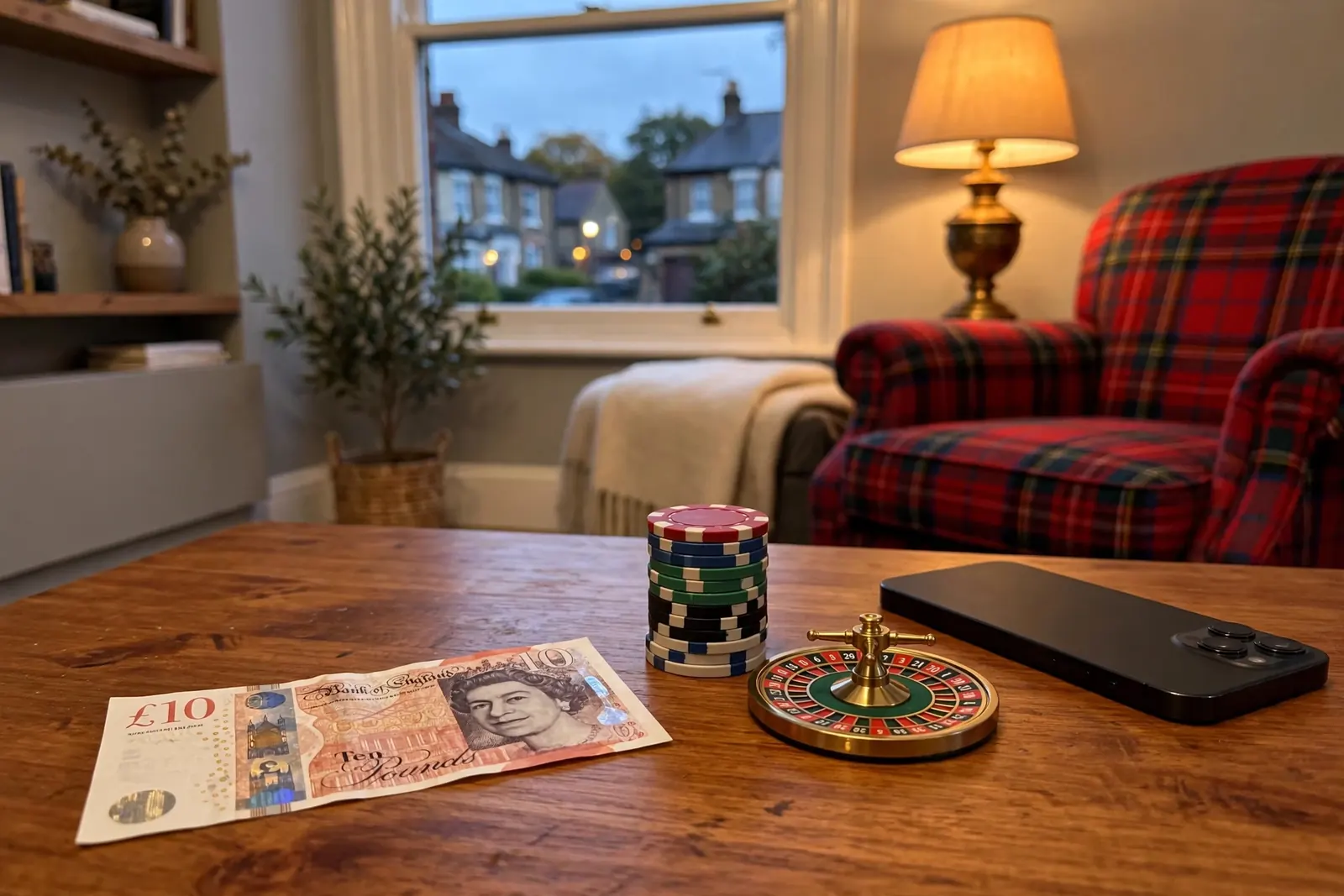
A £10 minimum is a cashier threshold, and the amount accepted can vary between casino operators.
What a £10 Minimum Deposit Means in Practice
A £10 minimum deposit is a cashier threshold: it is the smallest amount an operator will accept in a single deposit under the relevant terms. It does not mean that £10 is needed to create an account, nor does it establish the minimum amount accepted by every casino serving the UK. Account registration and adding funds are separate steps. An account can be opened before money is deposited, while the cashier determines whether a proposed payment meets the operator’s funding threshold.
For a UK casino accepting direct banking, a specialist review describes £10 as a typical minimum deposit, while recording that some operators set the threshold at £5 or £20. Those figures describe different cashier policies, not different ways of expressing the same limit. At a £5 threshold, a smaller deposit may be accepted; at £20, an amount of £10 would not meet the stated minimum. The operator’s own cashier terms therefore determine what can be deposited.
The lower end of the range is also relevant. Some UK casinos accept deposits from £1, although this is not the same as saying that every casino offers a £1 option. A specialist review reported that six UK Gambling Commission-licensed casinos it checked accepted a genuine £1 minimum deposit. That figure is a snapshot of the operators included in that review, rather than a count that should be treated as a permanent market total. Cashier terms can change, and a low threshold at one operator does not establish the threshold at another.
For a £10 minimum-deposit casino, check the practical details that matter before choosing where to play. This list highlights the payout-speed information available for each operator.
1. NightLuck
Payout speed: 1-3 business days NightLuck lists a payout speed of 1–3 business days.
2. Jetsetspins
Payout speed: 1-3 business days Jetsetspins lists a payout speed of 1–3 business days.
3. SpinFormula
Payout speed: 1-3 business days SpinFormula lists a payout speed of 1–3 business days.
4. Revery Play
Payout speed: 1-3 business days Revery Play lists a payout speed of 1–3 business days.
5. WinBeast
Payout speed: 1-3 business days WinBeast lists a payout speed of 1–3 business days.
6. x3bet
Payout speed: 1-3 business days x3bet lists a payout speed of 1–3 business days.
7. SlotoSport
Payout speed: 1-3 business days SlotoSport lists a payout speed of 1–3 business days.
8. BeOnBet
Payout speed: 1-3 business days BeOnBet lists a payout speed of 1–3 business days.
9. Zombillion
Payout speed: 1-3 business days Zombillion lists a payout speed of 1–3 business days.
10. NightWin
Payout speed: 1-3 business days NightWin lists a payout speed of 1–3 business days.
The distinction between a £10 minimum and a £1 minimum is practical. Where the cashier minimum is £10, depositing less will not fund the account through that route, even if the account itself has already been created. Where a lower minimum is offered, the player may be able to add a smaller amount. The difference concerns the amount accepted by the cashier; it does not, by itself, establish anything about the games available, the likelihood of winning or the overall suitability of the casino.
A stated minimum should also be read as a threshold, not as a required starting balance for every account holder. It sets the lower boundary for an accepted deposit. It does not mean that every customer must deposit immediately after registering, or that the same amount applies across all operators. Nor should a casino described as having a £10 minimum be assumed to accept a £10 payment through every possible route: the cashier’s terms identify the applicable conditions. The figures above describe the broad deposit tier, rather than the details of individual transaction methods.
This distinction helps explain why a headline amount can be easy to misread. A casino may accept a registration without requiring an initial payment, yet impose a minimum when funds are added. Conversely, a low cashier minimum does not imply that all account functions or promotions are available at that level. The deposit threshold answers a narrow question: what is the least the cashier accepts for funding? It does not answer what is needed to register, what conditions apply to a promotion, or what amount may later be withdrawn.
For a search for a £10 minimum deposit casino in the UK, the useful comparison is therefore between the advertised threshold and the amount the cashier actually permits. £10 sits between the lower £1 and £5 tiers reported for some operators and the £20 threshold set by others. It is neither the lowest amount available across the market nor a universal requirement. A £10 threshold may be the relevant one at a particular casino, but the label should not be generalised to every UK-licensed site.
£2 Minimum Deposit Casinos in the UK: What to Know
The term “minimum deposit” can also refer to different levels of detail. A general description may state an operator’s headline cashier minimum, while the live payment screen gives the amount accepted for a selected method. Those figures need not be interchangeable. The threshold is meaningful only in relation to the operator and the deposit option being used. This is why account-opening language and deposit language should be kept separate: registration establishes an account, while a qualifying deposit places money into it.
In practical terms, £10 is a mid-range threshold among the amounts described for UK casinos accepting direct banking. Some operators set a lower bar, and a specialist review identified a limited set accepting £1; others set the minimum at £20. These differences make it inaccurate to treat “£10 minimum deposit” as a market-wide rule. The amount required to open an account is a separate matter from the minimum accepted when funds are added, and only the applicable cashier terms establish the latter.
Online and Mobile Deposits: Payment Limits and Rules
A £10 cashier minimum is a condition on the amount accepted for a transaction, not a feature of a phone or computer. The same casino account may be accessed on a mobile device or a desktop, while the deposit is still made through a particular payment route. The relevant threshold is therefore the one attached to the chosen method in that operator’s cashier, rather than the device used to reach it.
At a given UK casino, the minimum deposit is generally shared across payment methods. That means a £10 threshold may apply whether the transaction is made by debit card, e-wallet or direct banking. There are exceptions: an operator may require a higher amount for a bank transfer than for a card or e-wallet deposit. A single advertised minimum should not, therefore, be assumed to apply identically to every route.
£3 Minimum Deposit Casinos in the UK: What to Check
Debit cards and direct banking
Visa and Mastercard debit cards are accepted at almost all UK casinos and can support low minimum deposits. A £10 minimum deposit online casino may consequently allow a card payment at that threshold, but the method’s availability and its precise cashier minimum are separate questions. Acceptance of a card brand does not establish that every operator sets the same transaction floor.
Direct banking is another route for funding an account. Although casinos may set the same minimum across their available methods, some apply a higher threshold to bank transfers than to card payments or e-wallets. A difference of this kind is an operator-level rule, not a general requirement that applies to every casino. The cashier’s stated minimum for the selected route is the relevant condition.
The distinction matters when a casino is described as having a £10 minimum deposit. That wording may refer to the lowest amount accepted by the account overall, rather than the minimum for every method. If a route has a higher threshold, a deposit below it may not be accepted through that route even where another payment option has a lower minimum. The published figure and the payment method therefore need to be considered together.
E-wallets and mobile access
An e-wallet is a payment route in its own right; using a mobile phone to open the casino does not turn a card or wallet transaction into a different kind of deposit. A mobile casino may present the same payment methods as its desktop service, but the cashier minimum remains tied to the method and the operator’s rules. The device alone does not establish whether a deposit of £10 will be accepted.
Credit-Card Ban
UK gambling deposits cannot be made using credit cards, including funds routed through e-wallets or money service businesses.
For UK gambling deposits, an e-wallet must be funded from a permitted source. The credit-card gambling ban means that an e-wallet funded by debit may be used, but credit-card funds cannot be used to make a gambling deposit. This applies even where the payment appears to pass through a wallet rather than directly from a card to the casino. The route does not remove the restriction on the source of the money.
A mobile payment option should not be confused with permission to use any funding source. The relevant distinction is whether the funds come from a debit card, an e-wallet funded by debit, or a bank account. These are the permitted deposit sources identified under the UK restriction. Credit cards are not an alternative for funding a casino account.
The credit-card restriction
The UK Gambling Commission’s ban on credit-card gambling took effect in 2020. As a result, UK casino deposits cannot be made using a credit card. The restriction covers direct credit-card payments and credit-card funding routed through a money service business. A wallet that permits credit-card funds to be used for gambling is also not an acceptable workaround.
This rule is separate from the cashier minimum. A casino could state a £10 threshold, but that amount does not make a prohibited funding source permissible. Conversely, the ban does not itself set a minimum deposit for debit cards, e-wallets or bank accounts. The amount accepted depends on the operator’s cashier rules for the selected route.
£4 Minimum Deposit Casinos in the UK: How It Works
For a £10 minimum deposit mobile casino, the useful distinction is therefore between access, payment method and funding source. Mobile access describes how the account is reached; the cashier identifies the available transaction routes and their minimums; and the credit-card restriction determines which sources may be used. These conditions should not be collapsed into one claim about a casino’s minimum deposit. A £10 figure may describe the account’s general entry point, while a particular payment route can have a different threshold, especially where the operator sets a higher minimum for bank transfers.
What the Evidence Can Establish About “Best” and New Casinos
Calling a casino the best choice for a £10 starting deposit requires more than confirmation of a cashier threshold. A ranking would need comparable evidence about the criteria being assessed and the same basis for evaluating each operator.
The same limitation applies to claims about new casinos. A £10 minimum does not, by itself, show when a casino launched or whether its UK-facing service is new. “New” and “best” are different claims, and neither follows simply from a stated cashier minimum.
There is a narrower, specific point about three named brands. A specialist review reports that UK accounts at Zodiac, Luxury Casino and UK Casino Club are subject to a £10 minimum, and that none of the three offers a sign-up bonus. This is a report about those accounts and those promotional terms, not an endorsement or a comparative assessment. It also does not establish that the same terms apply to every account or remain unchanged over time.
Zodiac
Reported £10 minimum deposit and no sign-up bonus.
Luxury Casino
Reported £10 minimum deposit and no sign-up bonus.
UK Casino Club
Reported £10 minimum deposit and no sign-up bonus.
That caveat matters when the phrase “best £10 minimum deposit casino” is interpreted as implying a welcome offer. The reported absence of a sign-up bonus at these three brands means their stated minimum should not be taken as evidence of a bonus-led proposition. Nor does the report establish that other casinos with the same minimum provide a sign-up bonus. A cashier threshold and a promotion are separate features; evidence for one cannot stand in for evidence about the other.
A meaningful comparison would also need clearly defined criteria. A minimum deposit could be relevant to an assessment, but it cannot determine the result on its own. No ranking can be derived from the named examples alone, and listing them as recommendations would misrepresent the limited point the report supports.
Accordingly, the evidence supports only a restrained statement: a specialist review identifies three UK-account brands with a reported £10 minimum and no sign-up bonus. It does not establish that they are the best options, that they are newly launched, or that their current terms are uniform across customers.
Not on GamStop: What Can and Cannot Be Verified
A £10 cashier minimum and GamStop status are separate characteristics. The first concerns the amount an operator accepts for a deposit; the second concerns whether the operator participates in the UK’s national self-exclusion scheme. A stated minimum deposit does not, by itself, establish anything about that participation.
No minimum deposit casino UK: what £1 really means
The phrase “not on GamStop” is often used for casinos outside the scheme, but it should not be treated as evidence that a site is suitable or authorised to serve customers in Britain. Remote gambling operators serving the British market must hold a UK Gambling Commission licence, regardless of where the company is based. A casino operating offshore without that licence is outside the UKGC regulatory system. Online gambling in the UK is legal only through licensed and regulated sites.
This distinction matters when a £10 minimum is presented alongside a claim that a casino is not on GamStop. Neither detail verifies the other. The cashier threshold does not confirm an operator’s licensing position, and a claim about self-exclusion does not show that a £10 deposit is accepted on a UK account. Those points require separate confirmation, rather than being inferred from a combined description.
Requests for mobile casino deposits by SMS raise a similar issue. The payment route and its minimum are operator-specific details; a reference to paying by text does not establish that the method is available, that it accepts a particular amount, or that it is suitable for gambling in Britain. UK rules restrict gambling deposits to compliant payment routes. Credit cards cannot be used for gambling deposits, including through arrangements that route credit-card funds indirectly.
GamStop is a self-exclusion service, not a measure of an individual casino’s deposit threshold or a substitute for UK licensing. A claim that a casino is outside the scheme should therefore not be read as proof of lower risk, greater flexibility or lawful UK operation. Where an operator offers real-money gambling to people in Great Britain, the relevant question is whether it holds the required UK Gambling Commission licence. A £10 minimum alone cannot answer that question.
Attention: A claim that a casino is not on GamStop does not verify its licensing status or that it is authorized to serve customers in Britain.
How a £10 Deposit Relates to Slot Stakes
A £10 starting balance describes the amount placed in the casino account, not the stake required for each slot spin. Once play begins, the balance is affected by the amount wagered and by each game’s outcome. The deposit figure therefore does not establish how long a session will last, nor does it imply that every slot has the same minimum stake.
For many slots, the lowest available bet is between 10p and 20p per spin. At those stakes, a £10 balance may fund a sequence of spins, but the number it supports cannot be treated as fixed: wins can add to the balance, while losing spins reduce it. The actual pace also depends on the selected stake. A player choosing a higher amount per spin will use the available balance more quickly, all else being equal.
The distinction matters when comparing slots that can be played from an account funded with £10. A casino’s cashier minimum concerns how much must be deposited to put funds into the account; a game’s minimum stake concerns the smallest amount accepted for an individual spin. Meeting the deposit threshold does not mean that every game will be playable at the same stake, or that every slot will offer the same range of betting options.
A low minimum stake can make a starting balance usable across more individual spins than a higher stake would, but it does not guarantee a particular session length or outcome. Each spin carries uncertainty, and a run of losses can reduce the balance even when the stake is modest. Conversely, winnings may change the amount available for subsequent spins. Any estimate that assumes a fixed number of plays would therefore depend on assumptions about both the stake selected and the results.
The practical comparison is between the balance and the game’s displayed stake options. For a £10 minimum deposit slots account, the relevant detail is not simply whether the casino offers slots, but whether a particular game’s minimum bet fits the amount available. Many games fall within the 10p–20p minimum-stake range, yet that range should not be read as a rule covering every title. Individual game information is needed to establish its own betting options.
Online Casinos With No Sister Sites in the UK
A deposit of £10 can thus provide a starting balance for slots with modest minimum stakes, while leaving the pace of play dependent on game choice, stake selection and results. It is a funding amount, not a measure of guaranteed play or a promise that the balance will last for a set period.
Bonus Eligibility and the 2026 Wagering Limit
A £10 cashier minimum and a £10 bonus qualifying deposit are separate conditions. A casino may accept a smaller payment for real-money play while making a particular promotion available only when the deposit reaches £10. A specialist review has reported this kind of qualifying-deposit rule, including at platforms that accept £5 deposits. It is therefore possible for a deposit to reach the account without meeting the stated threshold for a welcome offer.
The promotion’s terms determine whether a deposit qualifies. They may specify a minimum amount, eligible payment routes and any requirement to opt in. The cashier minimum alone does not establish that a bonus will be credited. Nor does depositing £10 guarantee eligibility: the offer may have other conditions, or may not be available to the account. The applicable terms should be read as a separate set of rules from those governing the deposit itself.
The phrase “no-deposit bonus” describes an offer that does not require a qualifying deposit to claim it. It does not mean that a casino has no cashier minimum, or that every account can claim such an offer. Whether an incentive of this kind is available, and what conditions govern it, depends on the operator’s current terms. A £10 deposit should not be treated as evidence that a no-deposit offer exists or has been activated.
Wagering requirements address a different stage: how much must be wagered before bonus funds or related winnings can be withdrawn, subject to the promotion’s terms. Before 19 January 2026, bonus offers could be described with higher wagering multiples. From that date, the UK Gambling Commission’s cap means that a gambling incentive cannot require wagering of more than 10 times the bonus funds. This is a limit on the wagering condition, not a rule that makes a bonus available whenever a deposit reaches £10.
The distinction matters when comparing an offer’s headline value with its practical conditions. A qualifying deposit answers whether the promotion can be triggered; the wagering rule describes what must happen to the bonus funds afterwards. The 10x cap applies to the latter. It does not remove other eligibility conditions or convert a regular deposit into a qualifying one.
£5 Minimum Deposit Casinos in the UK: A Guide
Accordingly, the relevant checks are the promotion’s minimum qualifying deposit and its wagering terms, considered separately. A £10 minimum deposit casino may provide access to a bonus only where the offer terms say that the deposit qualifies. For UK-licensed gambling incentives from 19 January 2026, the wagering condition must remain within the Commission’s 10x ceiling.
Why £10 Is a Common Minimum Across Payment Methods
A £10 cashier minimum is a familiar threshold at UK casinos that accept direct banking, but it is not universal. A specialist review reports £10 as the typical entry point for these operators, while also identifying casinos with lower or higher thresholds: £5 or £20. The figures describe variation between operators, rather than a single rule that applies across the market.
At an individual casino, the cashier minimum may be set as an operator-wide condition. In that case, the amount required to make a deposit is the same whether the selected route is direct banking, a card or an e-wallet. This can make the headline minimum straightforward to interpret: it applies across the available payment options rather than only to one of them.
That uniform approach is not guaranteed. Some casinos set a higher threshold for bank transfers than for card or e-wallet payments. A stated £10 minimum may therefore need to be read alongside the cashier’s method-specific terms; the general figure alone does not establish the minimum for every route. Where the cashier presents separate thresholds, the applicable amount is the one attached to the chosen method.
Jackpot Mobile Casinos in the UK: How They Work
The distinction matters when comparing casinos described as having a £10 minimum deposit. That description can refer to the lowest amount accepted by the operator, without proving that every payment method accepts the same amount. Conversely, an operator may apply one threshold across its payment options, so the cashier minimum need not vary simply because the funding route changes.
The most precise description is therefore conditional: £10 is reported as a typical direct-banking minimum, while operator-level thresholds can be lower or higher, and payment-method rules can differ within a casino.
A comparison of minimum-deposit casinos should consequently distinguish the operator’s general cashier minimum from any method-specific condition. The amount shown for one route should not automatically be attributed to another. That distinction keeps the £10 label useful without suggesting that it guarantees identical deposit terms across every option or every UK casino.
Deposit Limits, Age Checks and Account Controls
A cashier minimum is only one part of an account’s safeguards. In the UK, players must be at least 18, and a casino must verify a customer’s age before allowing a deposit. The ability to create an account or view its cashier does not mean that funds can be added before those checks are complete.
Remote gambling operators serving Great Britain must hold the relevant UK Gambling Commission licence. That licensing framework includes requirements for how operators handle new accounts and deposits. A site’s presentation or a stated minimum deposit does not, by itself, establish that these protections are in place; the operator’s legal status and account procedures are separate matters.
UK Online Casino Payouts: How RTP Works
Before a new customer makes a first deposit, the operator must prompt them to set a financial limit. The prompt is part of the deposit process, not an optional reminder that can be postponed until after gambling begins. Operators must also provide accessible controls for setting account-level limits. These measures are intended to make spending controls available at the point when an account is being funded and during its use.
A limit is not the same as the cashier minimum. The cashier minimum describes the smallest transaction the operator will accept; a financial limit concerns the amount a customer chooses to allow within the relevant account controls. Setting a limit does not alter the operator’s stated deposit threshold, and meeting that threshold does not remove the requirement to offer the limit-setting prompt.
For a £10 minimum deposit casino in the UK, the amount alone therefore cannot establish whether the account is safe or properly controlled. The relevant checks are whether age verification occurs before depositing, whether the first-deposit prompt is provided, and whether account-level financial limits can be accessed. These safeguards apply independently of whether the cashier accepts a smaller or larger sum.
The distinction also matters when comparing sites described as trusted. A low threshold is a payment condition, not evidence of effective safeguards. UK online gambling is lawful only through licensed and regulated sites; deposit controls should be considered within that framework rather than inferred from a casino’s minimum-deposit claim.
Real-Money Deposits, Withdrawals and Remaining Balance
A £10 cashier minimum describes the amount accepted when money is added to an account. It does not establish the minimum amount that can later be withdrawn. These are separate transaction rules, and a real-money balance below an operator’s cash-out threshold may not be eligible for withdrawal yet.
Do
- Check the operator’s withdrawal minimum separately
- Verify if the withdrawal limit depends on the payment route
Don’t
- Assume a £10 deposit guarantees immediate withdrawal
- Treat the cashier minimum as the withdrawal threshold
The reported figures vary by source. One specialist casino review reported withdrawal minimums of £10 to £20 at many UK casinos. A separate specialist review described minimum withdrawals of £1 to £5, while also noting that debit cards and some e-wallets can support deposits as small as £1. Neither account should be treated as a fixed rule for every operator: the figures describe what those reviews reported, not a universal standard.
The practical implication is that a £10 starting deposit does not guarantee that any amount left in the account can be paid out immediately. The relevant threshold is the operator’s withdrawal minimum, which may differ from its cashier minimum and may also depend on the payment route. A balance that falls below the applicable threshold could therefore remain in the account until it reaches the required amount. The withdrawal terms, rather than the initial deposit amount alone, determine whether a cash-out request meets the stated minimum.
This distinction matters even when no promotion is involved. Depositing £10 in a real-money online casino creates a balance available for play, but it does not make the full amount withdrawable after any outcome. If some of the balance remains, its treatment depends on the casino’s withdrawal conditions and the amount still held.
A comparison of minimum-deposit casinos is therefore incomplete if it considers only the amount needed to fund an account. The deposit threshold answers what is required to put money in; the withdrawal threshold answers what is required to take money out. Those figures should be checked separately in the operator’s terms before a transaction, since evidence from reviews does not establish the current rule at every UK casino.
PayPal and the £10 Minimum: What Is Confirmed
A £10 cashier minimum and a PayPal payment option are separate details. A casino may set a minimum for deposits across its cashier, or apply different thresholds to particular payment routes. The general pattern at UK operators is for the minimum to remain the same across methods, although bank transfers can be subject to a higher threshold. That pattern does not establish a PayPal-specific minimum.
Where PayPal appears as a deposit option, the amount permitted for a particular transaction depends on the operator’s cashier rules as well as the payment route. A £10 minimum shown for a casino should therefore not automatically be read as confirmation that PayPal is available there or that the same amount applies through PayPal. The relevant terms need to identify both the accepted method and its applicable minimum.
UK gambling rules also constrain how e-wallet deposits may be funded. Credit cards cannot be used for gambling deposits, including where the payment is routed through a money service business. Operators must not accept wallet payments that allow credit-card funds to be used for gambling. Debit-funded e-wallets are among the permitted payment routes. These rules describe the funding conditions; they do not establish the cashier threshold for PayPal at an individual casino.
The distinction matters because a payment provider’s transaction rules and a casino’s cashier minimum are not interchangeable. A provider may support a transaction amount that an operator does not accept, while an operator’s stated minimum does not prove that every listed method can be used at that amount. A reliable comparison must treat method availability and the minimum attached to it as separate terms.
Online gambling in the UK is legal only through operators holding the relevant UK Gambling Commission licence. Within that framework, a PayPal deposit can be assessed only where the operator expressly offers the method and states its conditions. The general £10 minimum found at some casinos cannot, on its own, substantiate a claim that PayPal deposits at UK casinos share a £10 threshold. Nor does a general rule about e-wallet funding resolve whether PayPal is available at a particular operator.
Material created by the team NationalBet Casino UK